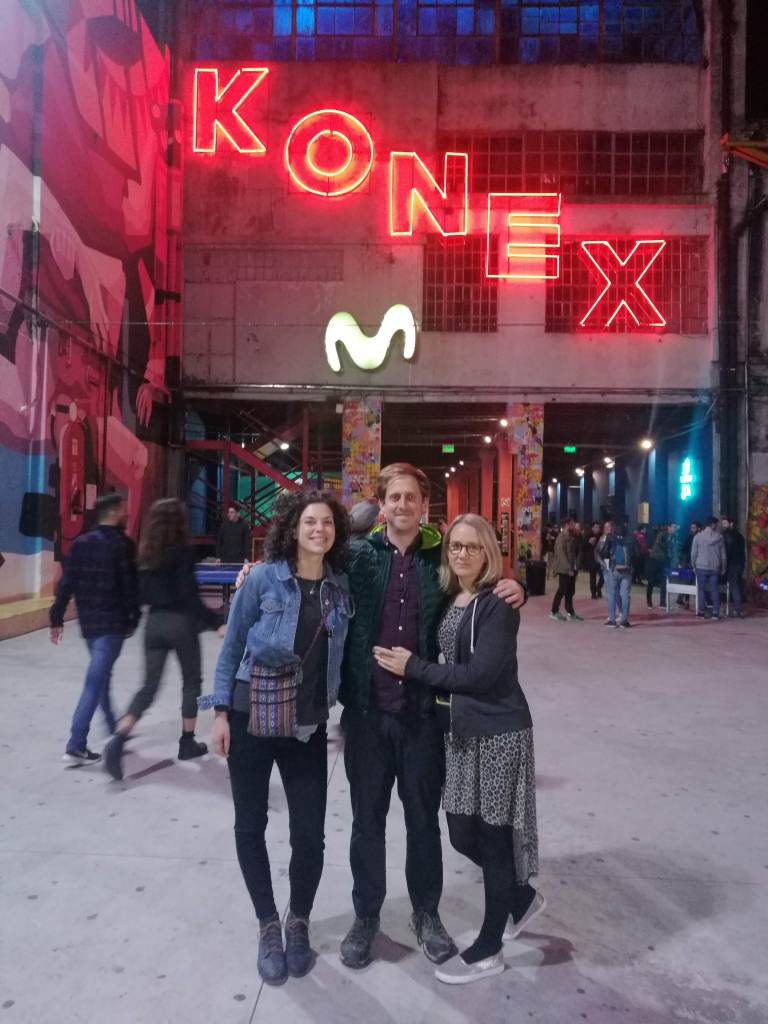
We like to hike

Trekking! Our two hikes – down and up a massive Peruvian valley and across central Ecuador’s volcanic landscape – have provided some of our best memories on this trip. By the way, it seems most posts on here big up our best memories of the trip which we think is how it should be. Nobody wants to read about food poisoning, whole days spent on badly driven buses or our quest to arrange more travel insurance (which is hard once you have started the trip, it turns out) do they?!

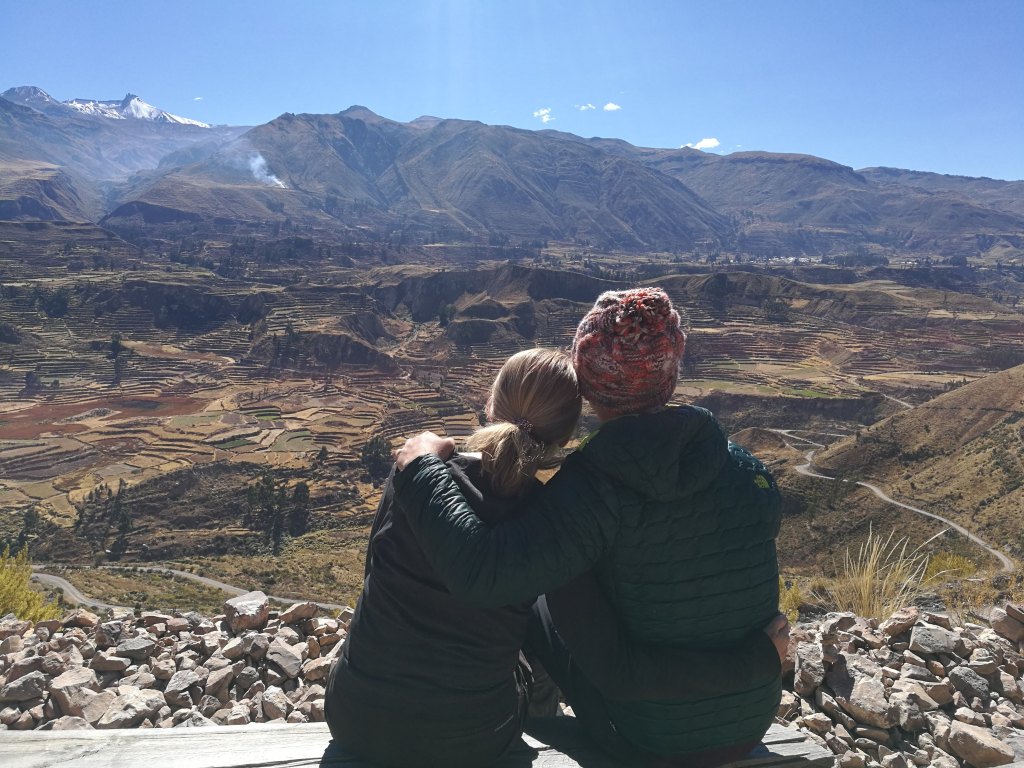
The Colca canyon in southern Peru is, at 3270m, one of the world’s deepest. The Colca River runs through it, giant condors swoop above it and foolhardy tourists like us tramp up and down it. We’d had our eyes on tackling Peru’s big daddy – the Inca Trail – but as compulsory hiking passes at non eye-watering prices had all sold out by the time we got to plan our trip, the canyon looked like a decent and properly challenging alternative. We decided on a 3-day rather than a 2-day trip to get more time in the valley itself and, not being on a hugely rushed schedule, we didn’t feel the need to complete 7+ hours of hard trekking on day 1 if we didn’t have to.
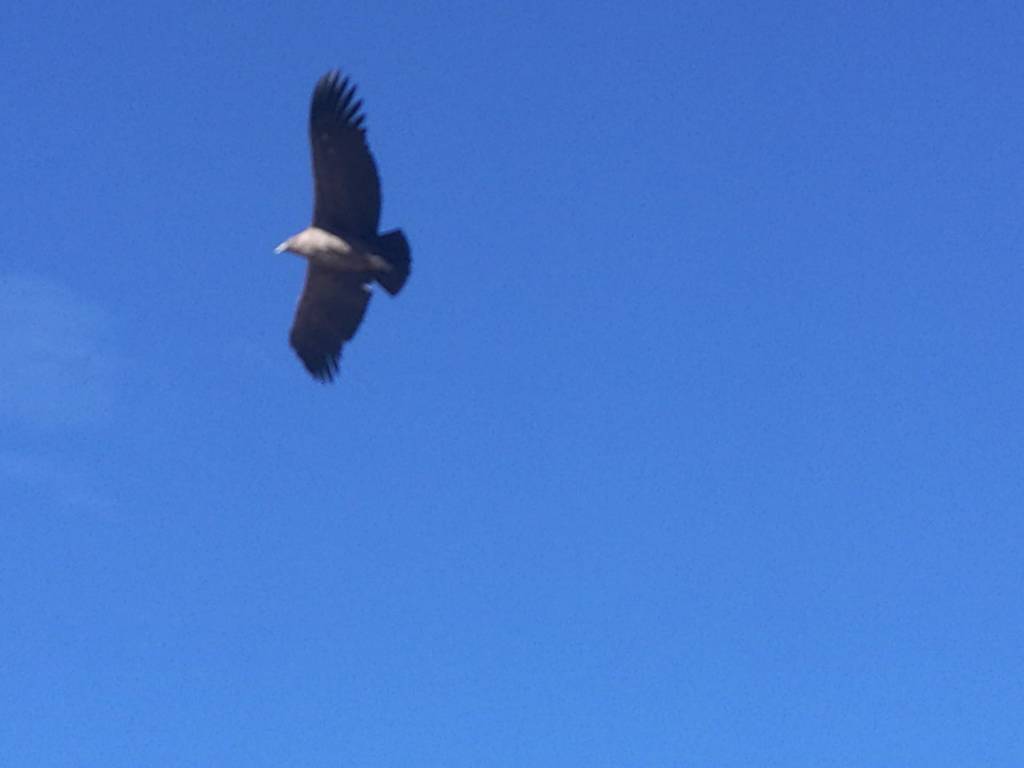
Condor – wingspan somewhere between 2 and 3 metres

A little sceptical about a 3-day, 2 night all-inclusive trip costing a grand total of US$50 each but confident that the many glowing online reviews couldn’t all be lies, we booked with Peru Andes and hoped for the best. Irksomely, most trips to the canyon depart Arequipa at 3am(!) to enable a 9am-ish trek start time. After the most cursory of mumbled hellos to our minibus buddies, we dozed the whole journey. This included the part where the altitude reached 5000m above sea level and the bus apparently frosted up. We woke up in Cabanaconde in time for breakfast which mercifully featured decent and unlimited coffee 😊 Food and caffeine needs sated, we met the rest of our group: an Australian/Peruvian couple, a British civil servant about to start a posting at the embassy in Lima, two German women and our guide Fabian.
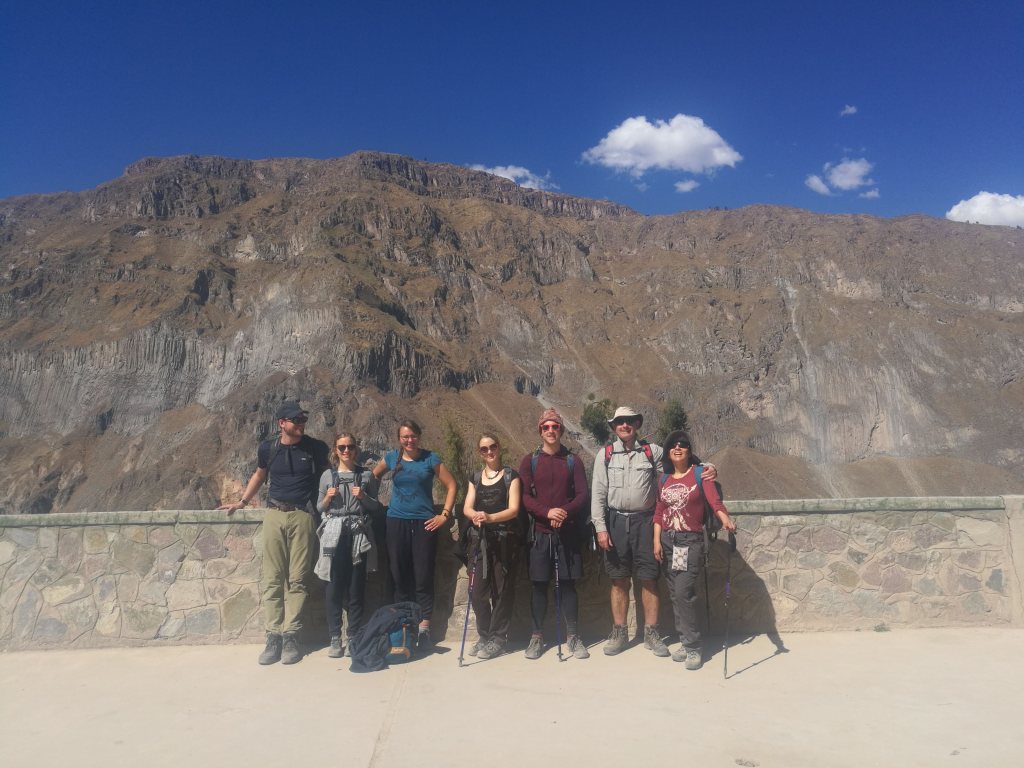
We set off, slightly surprised at how hot it already was. We left behind the noisy highway and the tourist hoopla and headed into an entirely quieter environment. This is what we had been looking forward to. Three and a half hours of descent followed, as did a near total collapse of our calf muscles as we neared the valley floor. Still, the vertiginous valleyscape was worth the effort. The avocados, potatoes and quinoa we saw growing up the side of the cliffs formed most of our very yummy plant-based meals throughout the trek, thriving in what looked like inhospitable conditions.
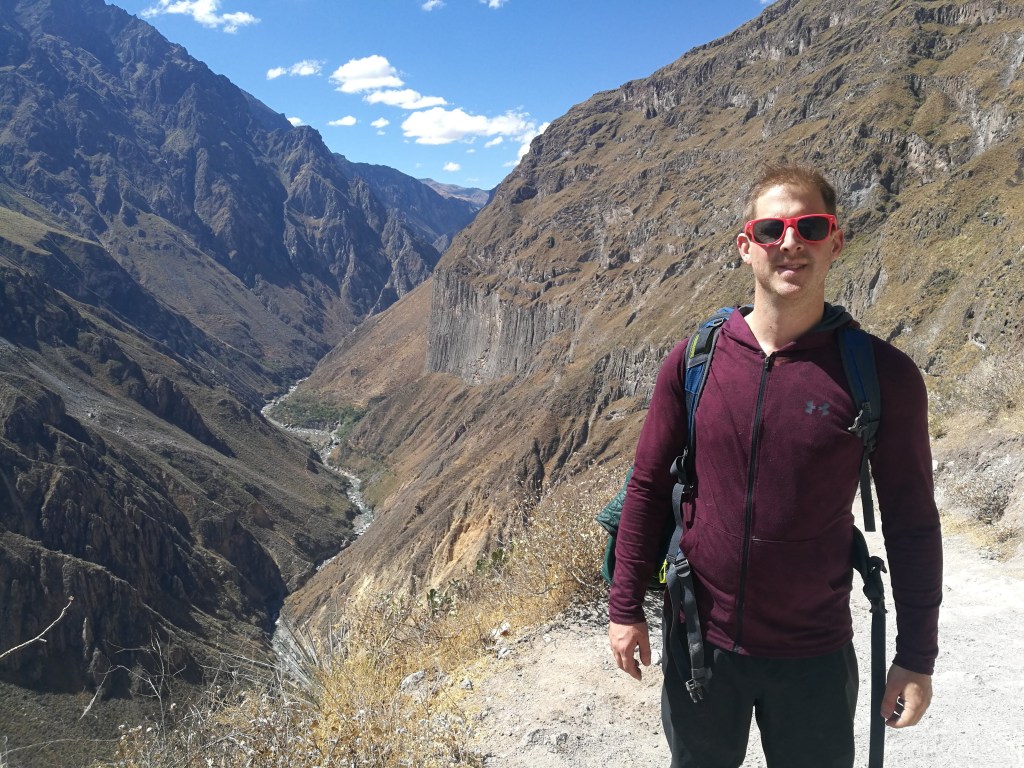
A punishing uphill section tested the promise of our new Chinese-made walking poles to act as ‘shock absorber with superior characteristics!’ Our group as a whole dealt with the trickier bits relatively well but we were all shattered by the time we reached our base for the night – simple huts without electric in San Juan de Chuccho, a town at the very bottom of the valley. There was precisely nothing to do apart from have a shower, read, play with the resident dogs and have beers with fellow trekkers. And that was perfect.
We emerged into a valley half in sun, half in shadow early the next day. Fabian had billed this as an ‘easy’ day – mainly flat with a lunchtime finish. He pointed out some white tick-like things clinging to the cacti beside the trail. These were actually cochineal beetles that, when crushed, create a vibrant red dye that ends up in food colouring (or err all over your hands and clothes).
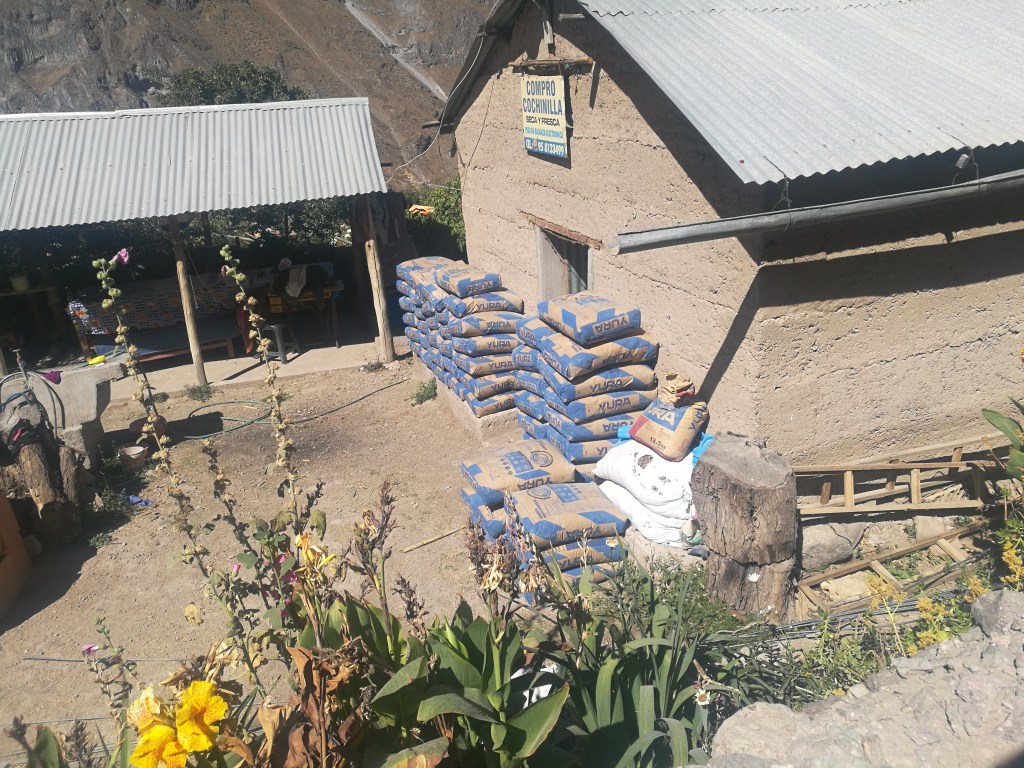
Bags of cochineal beetles, probably bound for a Percy Pigs factory in St Albans.

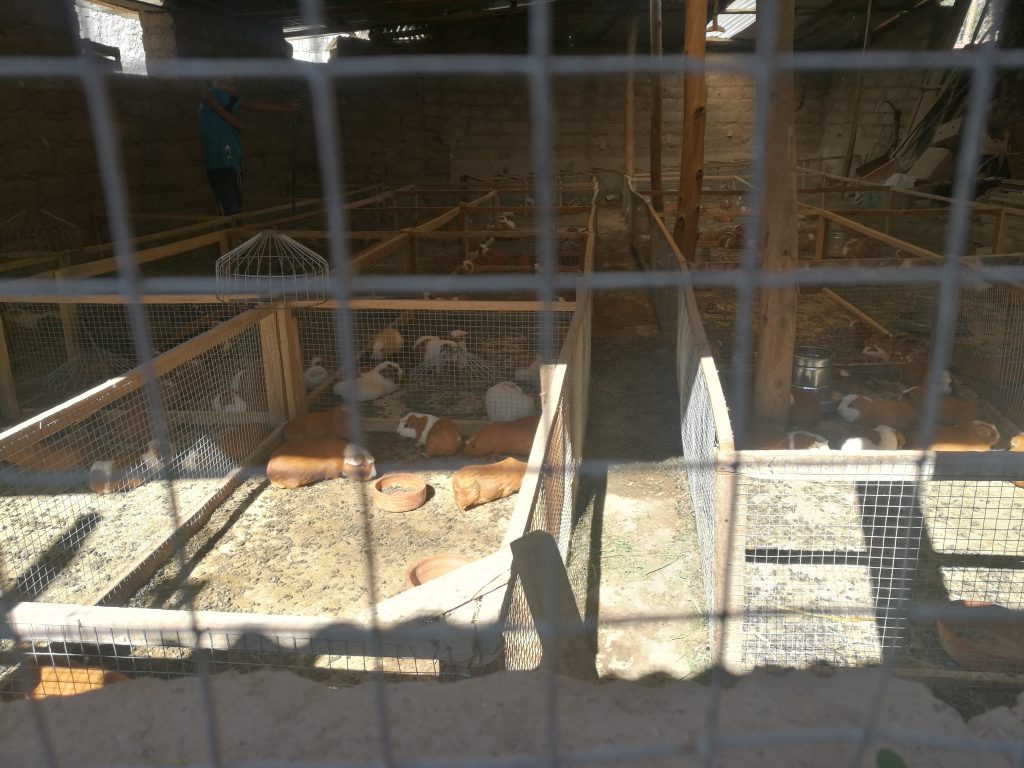
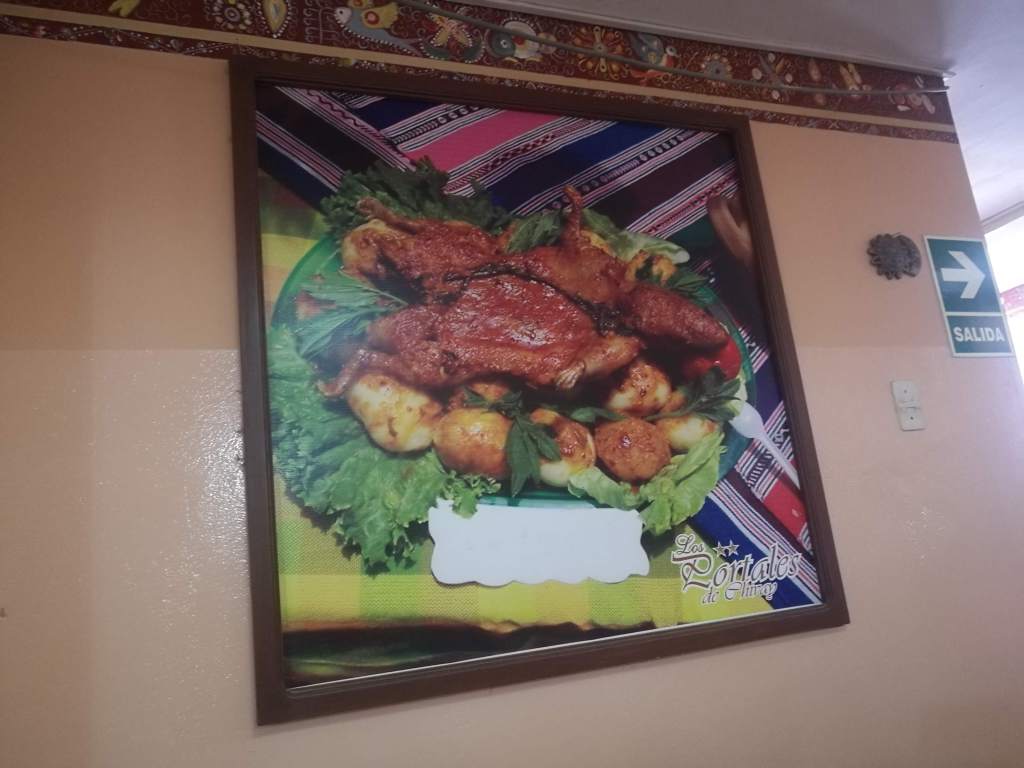
Having spent several weeks in south America by this point, we’d grown accustomed to seeing cuy (guinea pig) on the menu and roasting on spits by the roadside. But when Fabian led us to a cafe/shop for a well-deserved break, we were sad to see hundreds of cute g pigs penned in together, squeaking away quite unaware that they might be in someone’s belly by dinner time. No, we haven’t (knowingly) eaten any cuy on this trip!
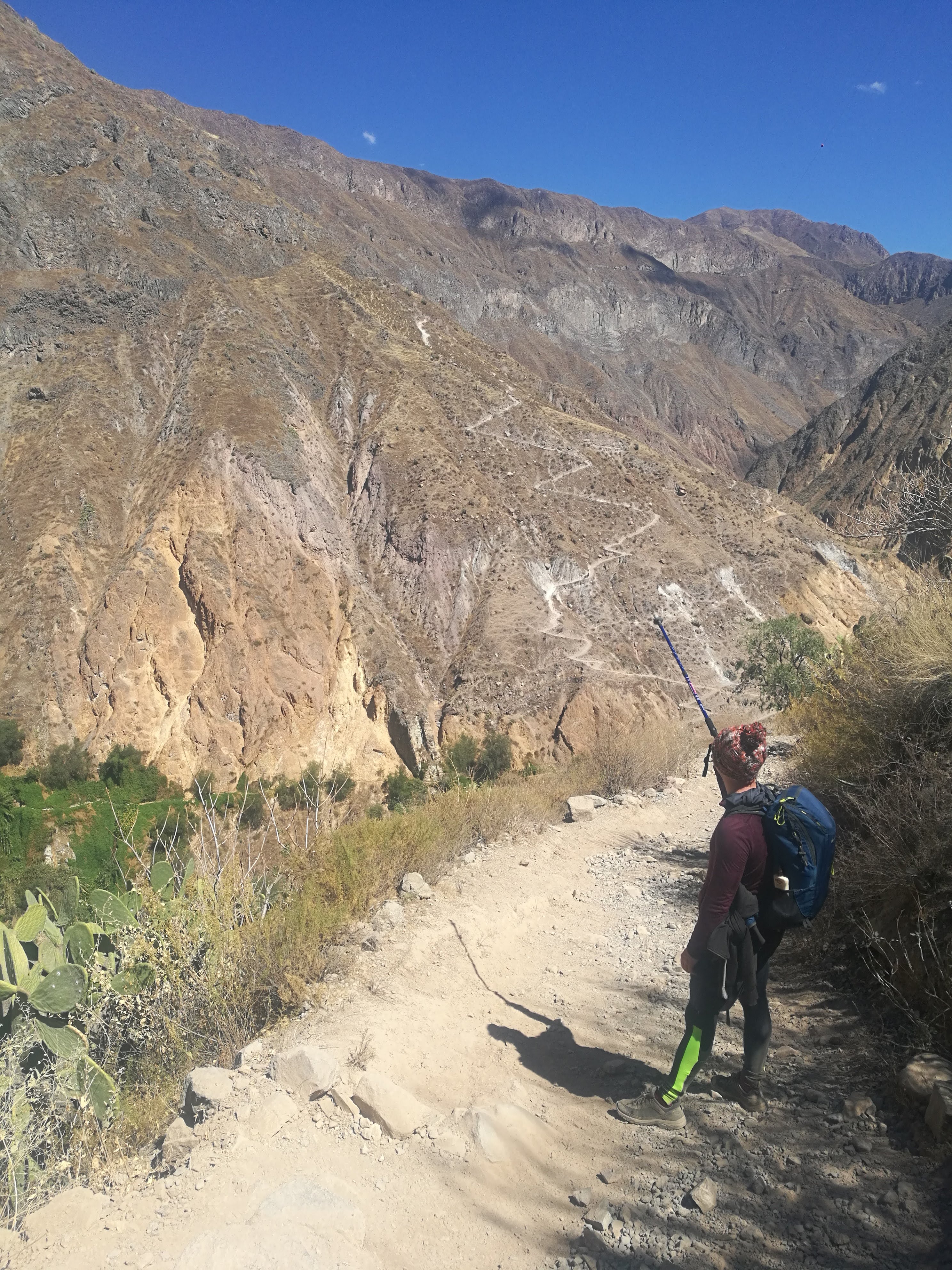
Shortly after this break, our guide pointed out the path we’d ascend tomorrow morning to exit the canyon. A steep series of switchbacks snaking up the opposite side of the valley. Wry smiles and nervous glances all round as we weighed our capabilities against the intimidating camino in front of us and tramped onwards to our base for the night.
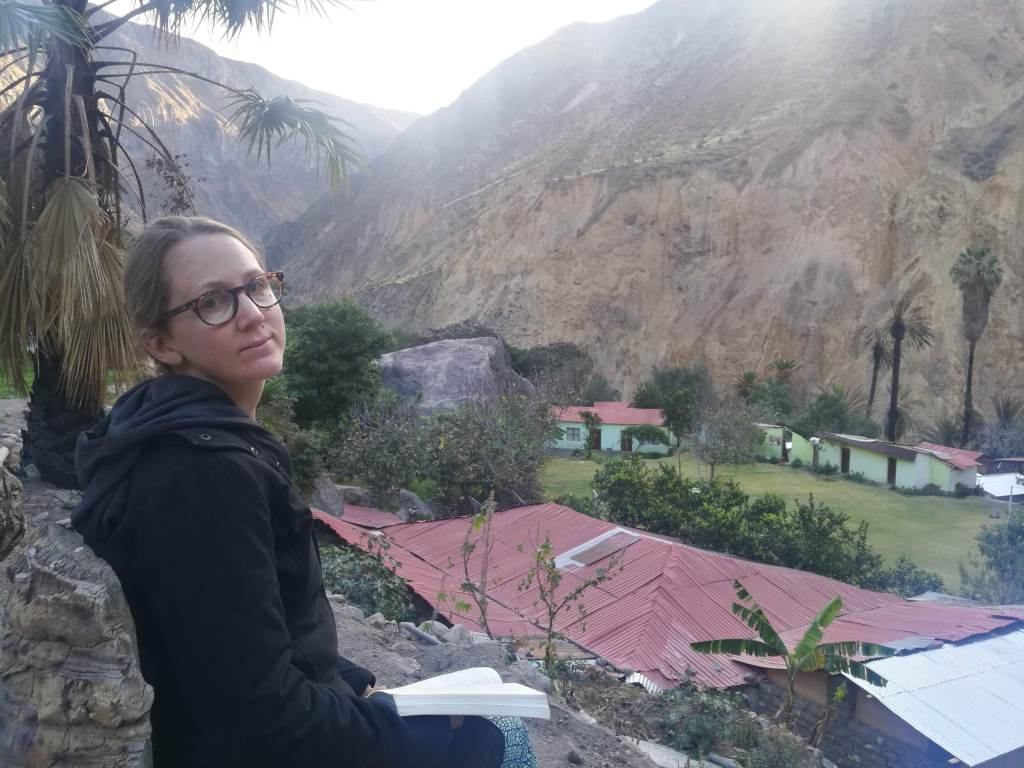
But who cares about tomorrow’s 4.30am start time (yes, we’d be hiking that thing in the dark) when there’s a pool to hurl yourself into and pisco sours to be enjoyed. Sangalle village was the deepest place we stayed in the valley. Eerily quiet and suddenly cold once the sun was gone. Just the odd butterfly flitting around or coconut falling with a plonk to the earth. We enjoyed a peaceful afternoon here, mucking around in the pool, reading and getting our stuff ready for the next morning before daylight subsided.
So, how was it? HORRIBLE!! Without doubt the hardest piece of trekking/exercise one of us (the one who has never run a marathon!) had ever done. It was quite novel to be part of a hundreds-strong chain of humans slowly snaking up the valley side in the dark. But even in the relative cool of the early morning, we soon regretted how many layers we’d donned. Frequent wardrobe readjustments were needed. And rest/snack breaks. Lots of those.

To say that this climb was fun at the time would be a total lie. As soon as we thought we’d conquered a particularly tough section, an equally beastly stretch of uphill angst confronted us. We were wading through unstable gravel a lot of the time so getting a decent foothold was hard. Uncouth mules thundered past intermittently, ferrying gringos either unable or unwilling to slog it out to the top. We’d been warned they sometimes kick out randomly so gave them as wide a berth as is possible when you are on a metre-wide path with a sheer drop to the valley floor below.

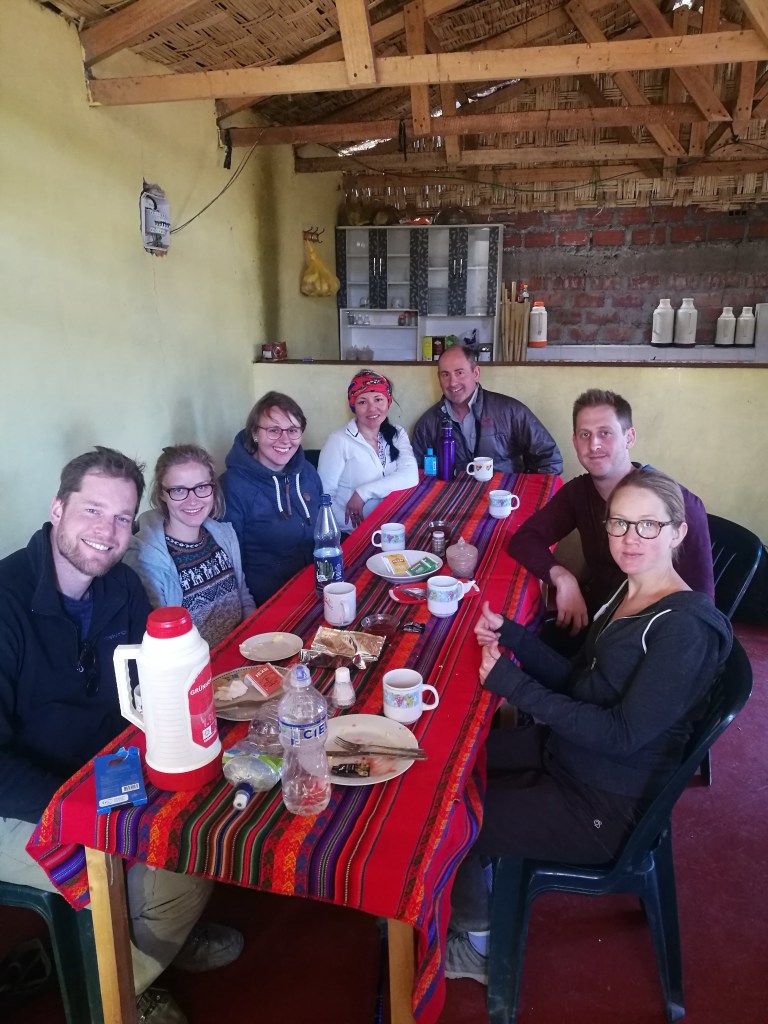
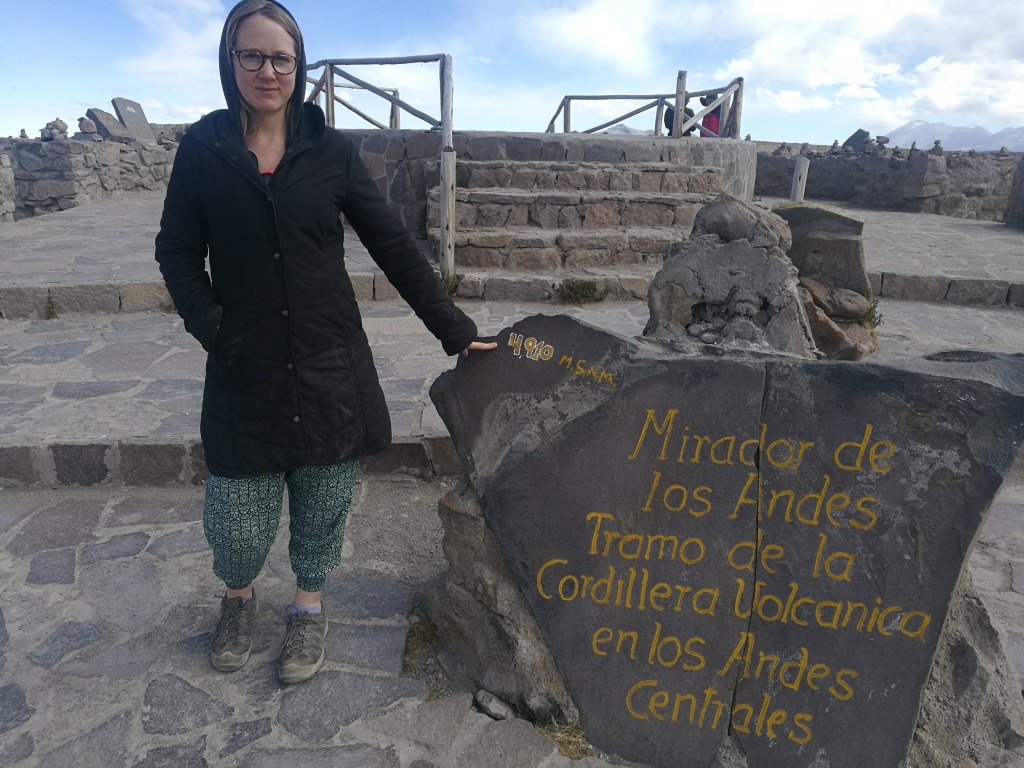
We never thought we wouldn’t finish the climb. It just became rather unenjoyable as we entered the third hour and our lungs and legs started to protest. However, we reached the top and reunited with our group after 3.5 hours. We plodded another 15 minutes into Cabanaconde – our original start point – for a celebratory team breakfast alongside several other trekking gangs. The photo below hopefully conveys the exhaustion, relief and maybe even elation we felt at having put such a gruelling ascent behind us.
We spent the rest of the day feeling happy we didn’t have to climb or trek any more, soothing our aching muscles in a nearby hot springs, gawping at the amazing pastoral scenes on the route back to Arequipa and actually managing to stay awake as we got up to about 5000m above sea level again.
THE END!
Trout of our minds

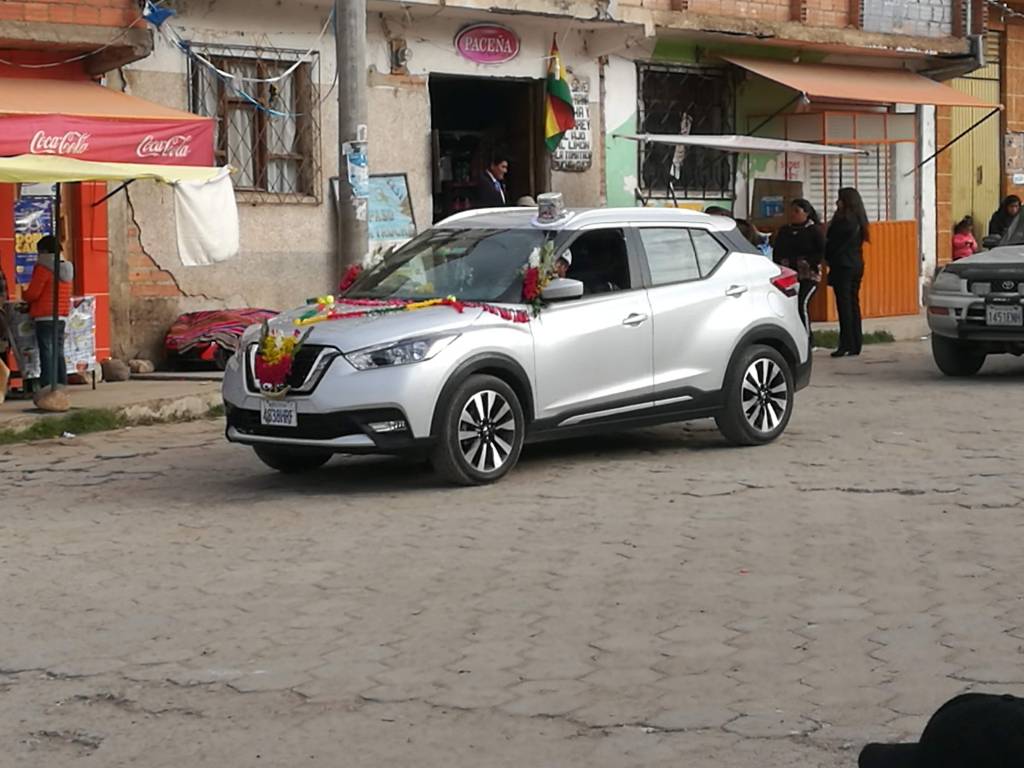
Our last stop in Bolivia was Copacabana on Lake Titicaca. We had no love for the town itself. Maybe this was because we stayed on what was essentially a construction site (it didn’t look like that on Airbnb!) featuring ice cold showers and an Alsatian with anger management issues. Or maybe it was because the charmless town was backpacking at its most dire – crap food, crap service, crap coffee, crap music blasting out everywhere…The one interesting thing that happens in the town is the vehicle blessing ceremony. Here’s a snap of a recently anointed 4×4 that we took whilst our bus driver stopped to down a beer with his mates by the roadside just before driving the scary clifftop bit. Look it’s got a little hat on and everything!
Bless you, my child.

Anyway, we did LOVE Isla del Sol so our trip to Copacabana was far from a waste. First you take a snail’s pace ferry from Crapacabana across Lake Titicaca during which your phone will freak out and think it’s in Peru, then Bolivia, then Peru again…it makes keeping track of the time in order to catch the last ferry back from the island a real hoot as the time zones change repeatedly!
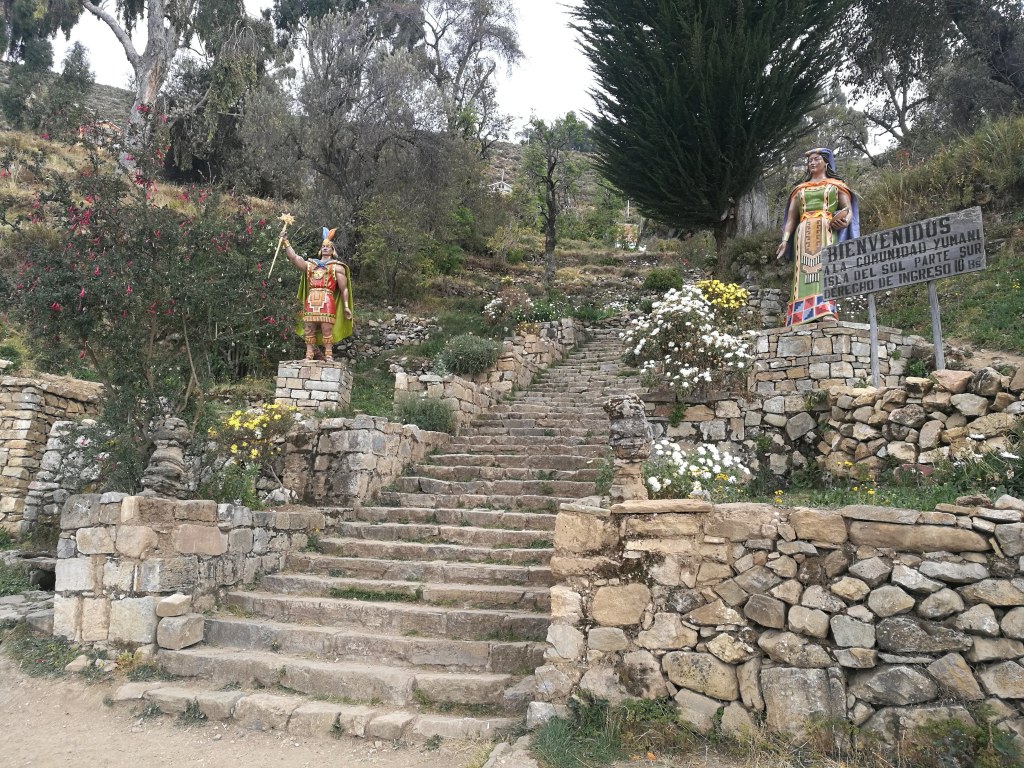
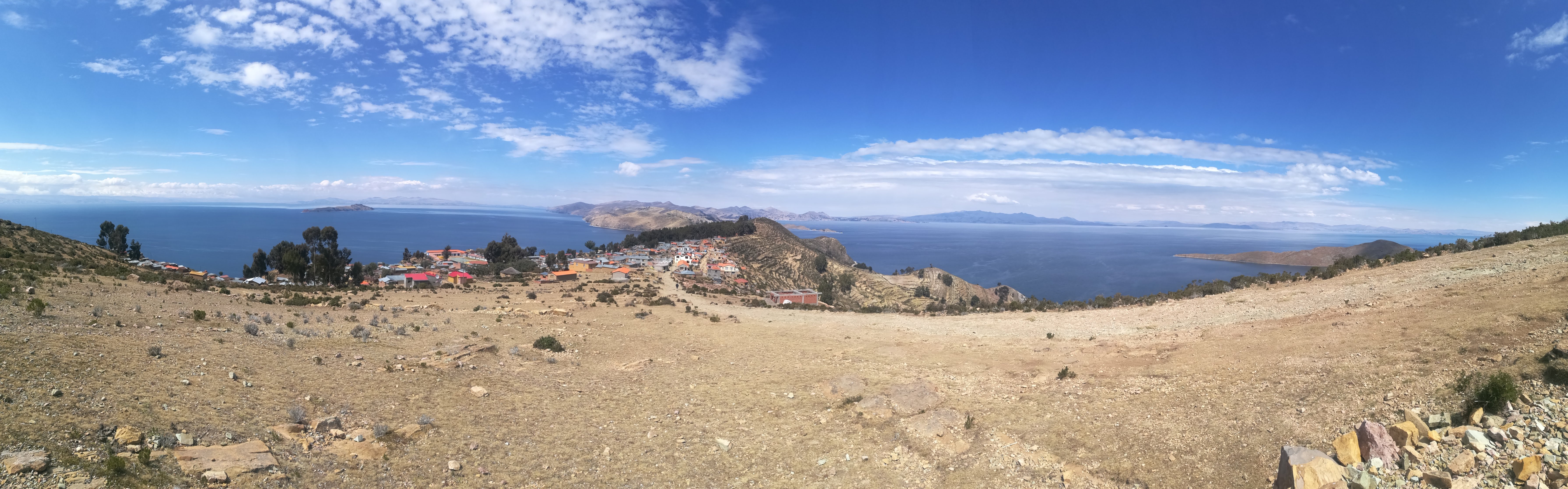
Isla del Sol is an ethereal nugget of loveliness sitting pretty in the middle of shimmering Lake Titicaca. This rocky wonder is a little over ten miles long, dotted with Incan ruins and traversed by a network of well-worn trails (but no roads which means…no cars!) Whilst a simmering local dispute about tourist revenues means the northernmost paths are off limits, there’s still plenty of quaintness to explore in the five or so hours most people spend here before heading back to the mainland.

A couple of caveats. You’d better have spent some time at altitude already and you’d better not get too annoyed at your own body for objecting to the conditions a bit. For Isla del Sol’s lowest point is 3800m and in order to really see anything except the harbour you’ll need to immediately climb a couple of hundred metres more. If you want to hike to the highest point, that’s at 4100m. We’d had several weeks at high altitude beforehand but still had headaches (that ibuprofen dealt with) and were stopping comically frequently and panting a bit like the Airbnb hound anticipating fresh unsuspecting backpackers when doing the very uphill bits.

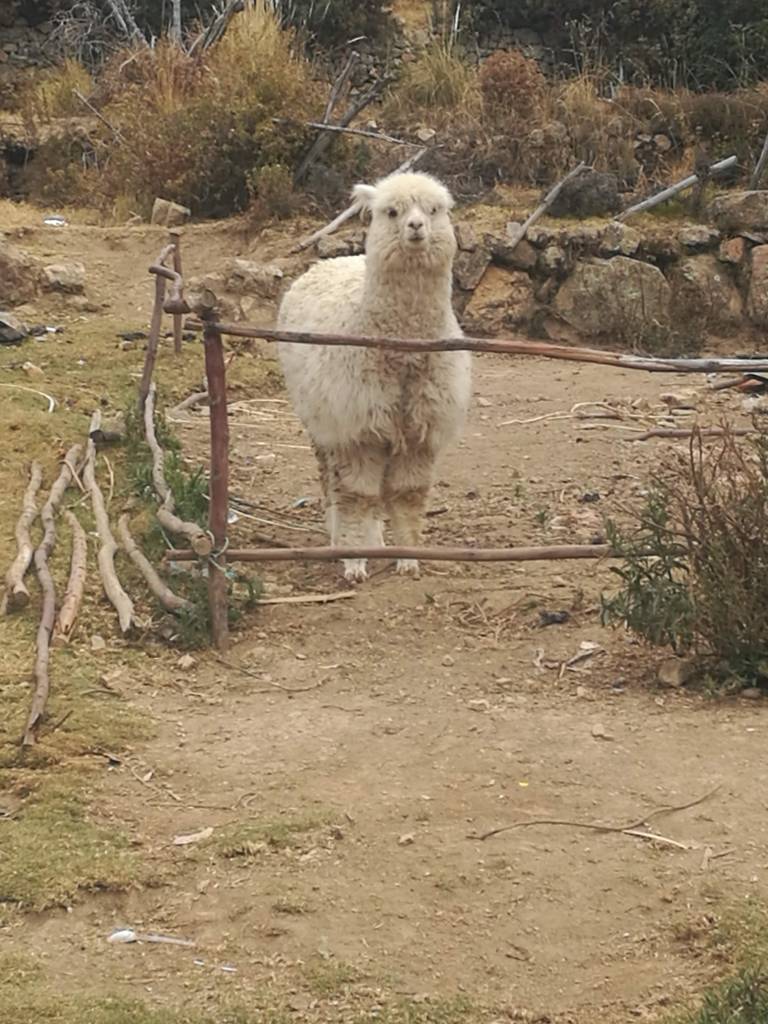
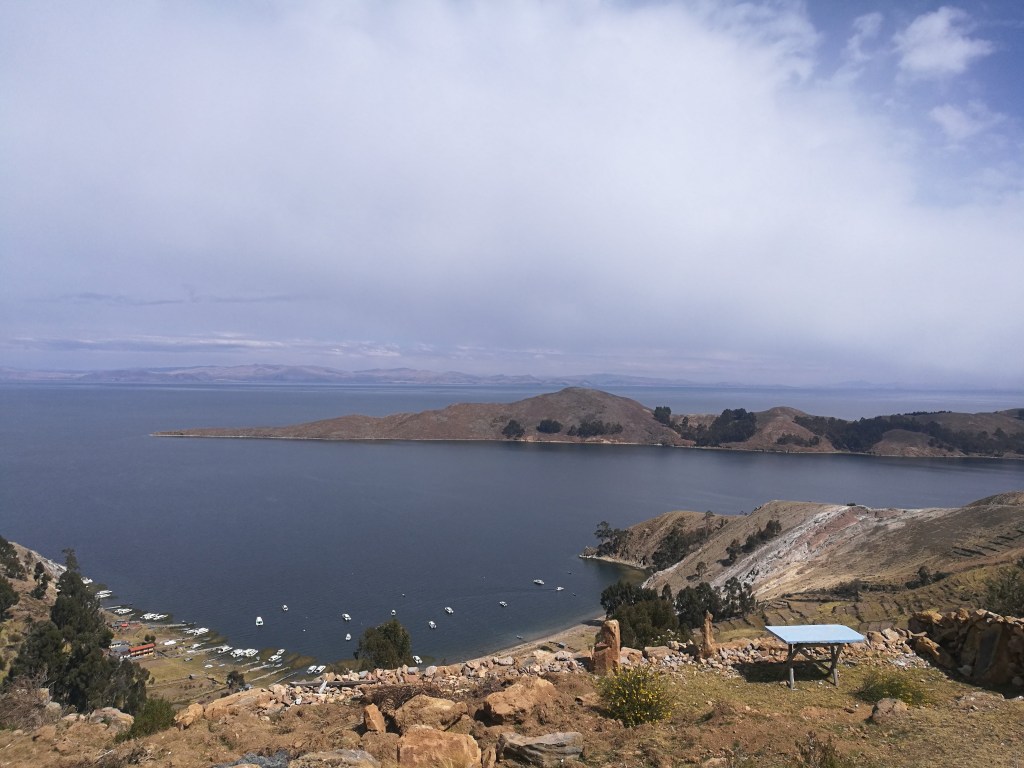
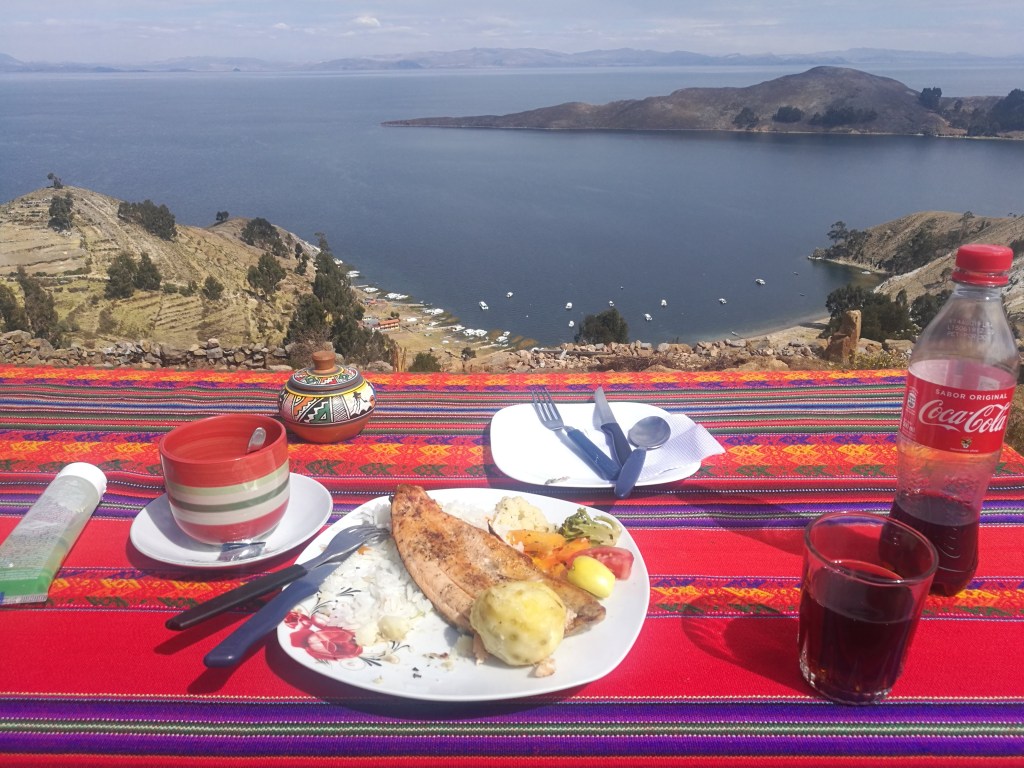
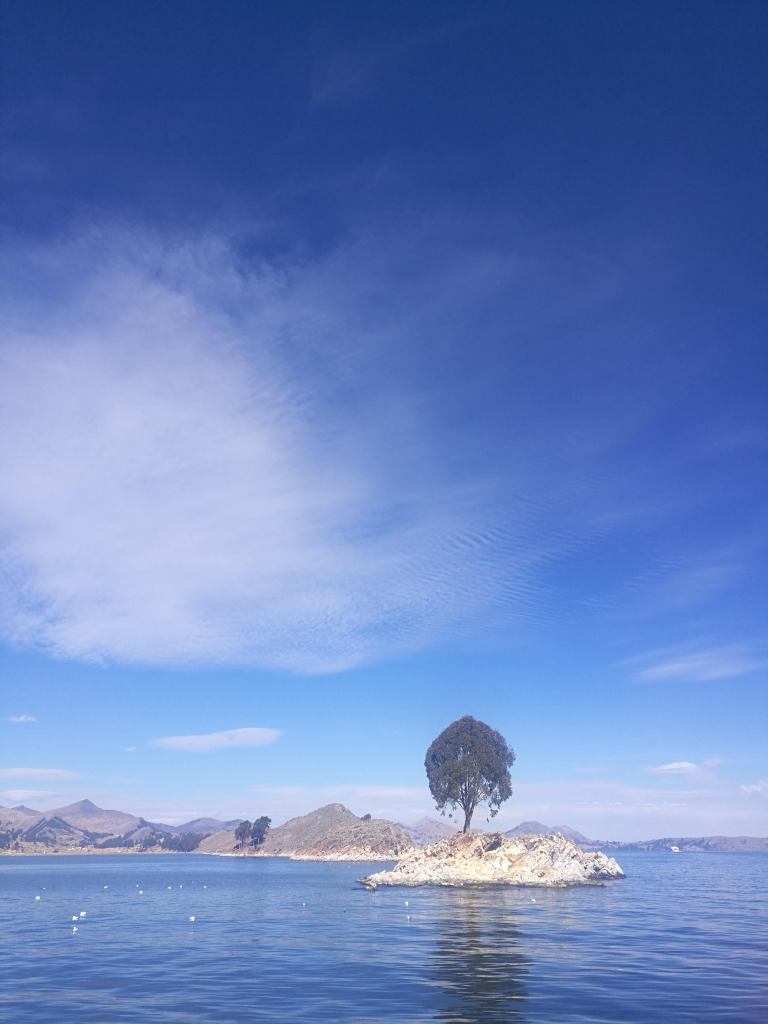
So apart from laugh at your own body’s feebleness in the face of thin, thin air, what is there to do on the island? Well the setting is stunning. The island isn’t very wide so at most points wherever you are standing you can see the calm azure waters of the lake and watch the weird way the wind sculpts the surface, man. You can wander around checking out what people are growing in their gardens – mostly veggies and pretty flowers – and most of the islanders are pretty friendly so you can try out your Spanish. Neither of us really eat trout in the UK (who does??) but as it’s a speciality around Lake Titicaca we thought we really should try it…AND IT WAS AMAZING! A pretty strong flavour, perfectly juicy and served simply with some veg grown on the island. Devoured at a plastic table overlooking the lake, this was the highlight of the day and probably cost a couple of quid.

Trucha de la plancha con coca cola zero.

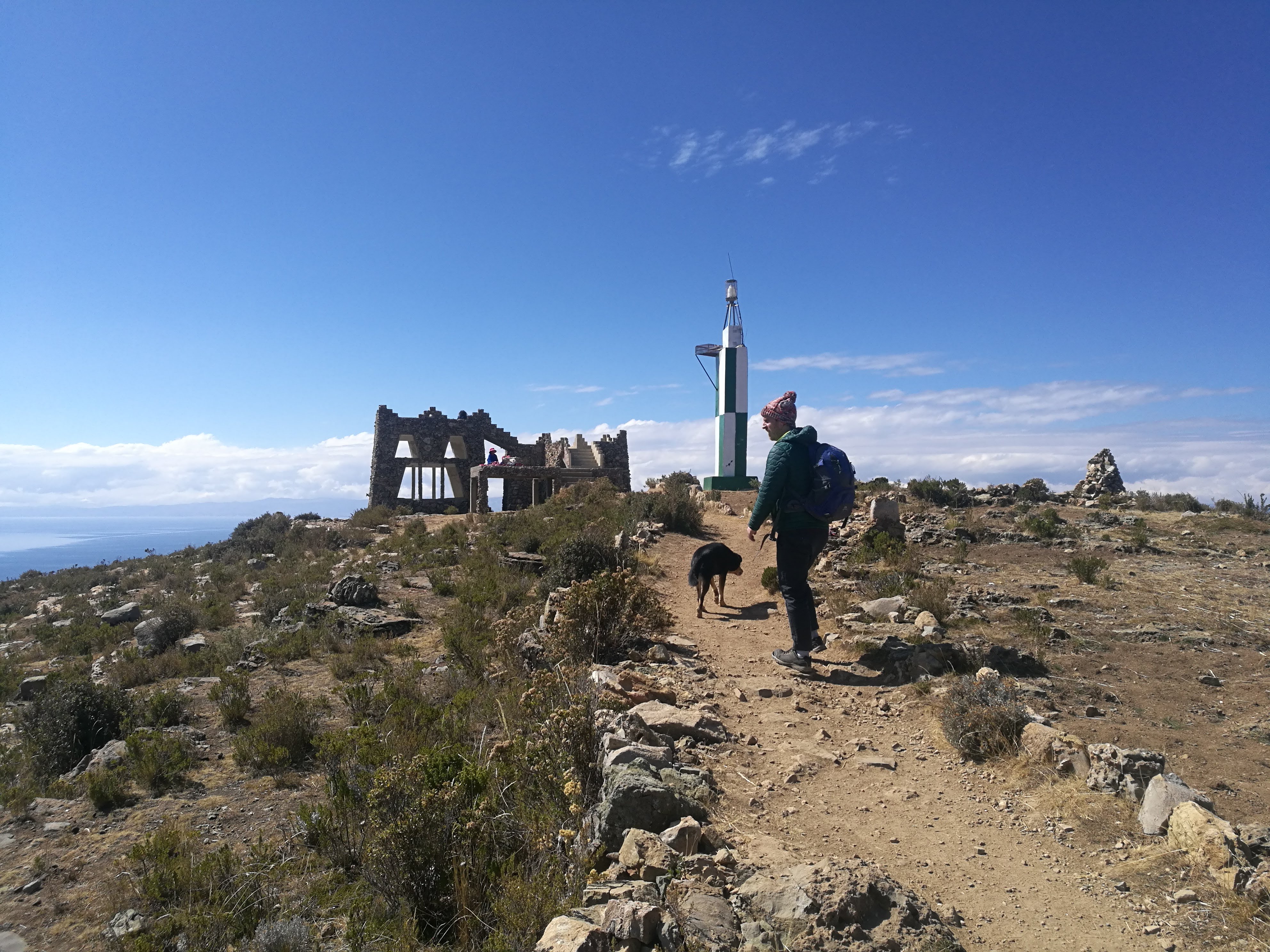
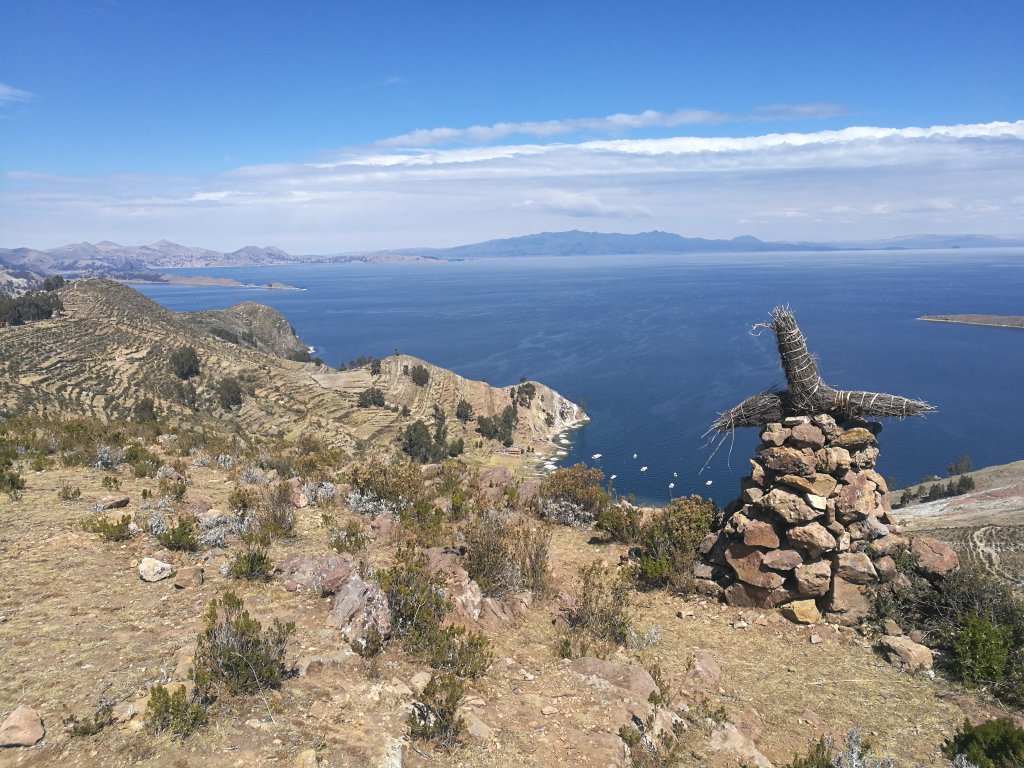
Possibly trout of our minds at this point (lol) we decided to hike to the highest point which was a bit of a slog but worth it for the best views we had all day. There was something undeniably peaceful about being surrounded by a vast expanse of calm blue water and none of the usual irksome urban noises.

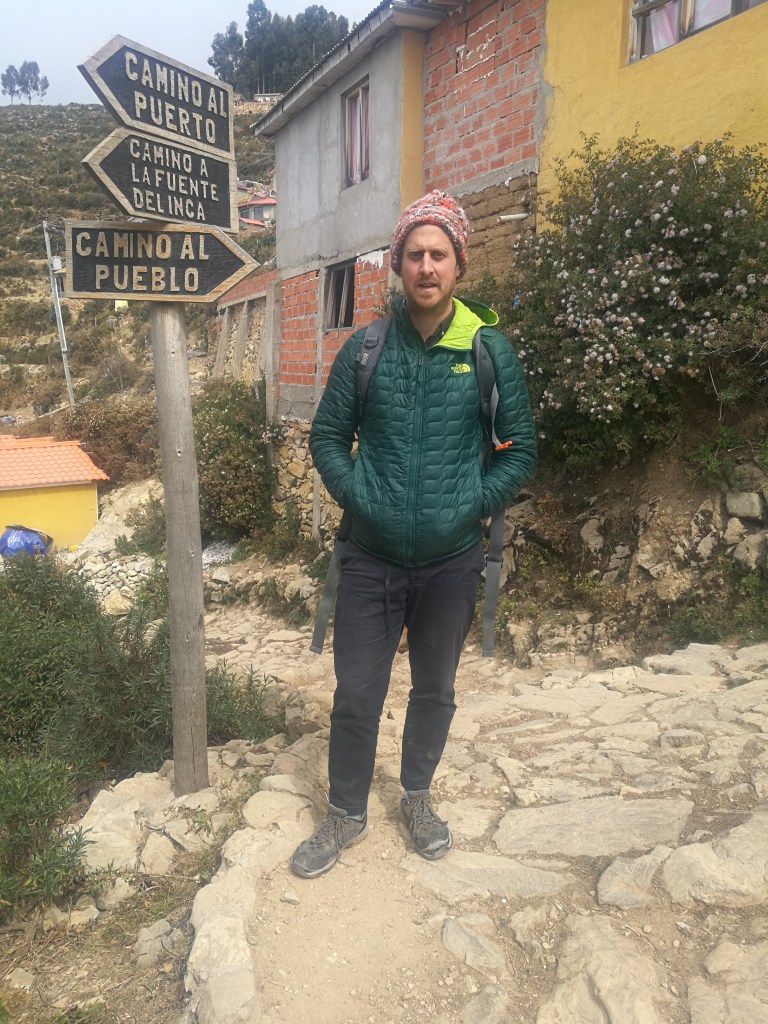
Some fellow travellers had taken their pursuit of zen to the next level and were perched improbably high up inside the farthest away of the Incan ruins, smoking something that may or may not have been grown on the island. As seems to happen on a daily basis out here, D made friends with a stray dog who followed us all the way to the top, urinating ad hoc on many of the things we wanted to photograph.

After a bit more rummaging around and trying to imagine what it would be like to actually live in this place (verdict: not like East Dulwich) we took the 4pm ferry back to Jokeacabana, soaking up some rays on the top deck (read: repeatedly slathering our pasty skin with sun cream to avoid lobsterifying instantaneously at such high altitude). We moved on the next day to Arequipa in Peru from where we were going to head off on a 3 day, 2 night “challenging” trek of the Colca Canyon. We survived it and it deserves its own backdated blog post which we may get around to writing before we head back to the UK (via Spain…just because!)

Iguazu Falls + Other Interesting Stuff

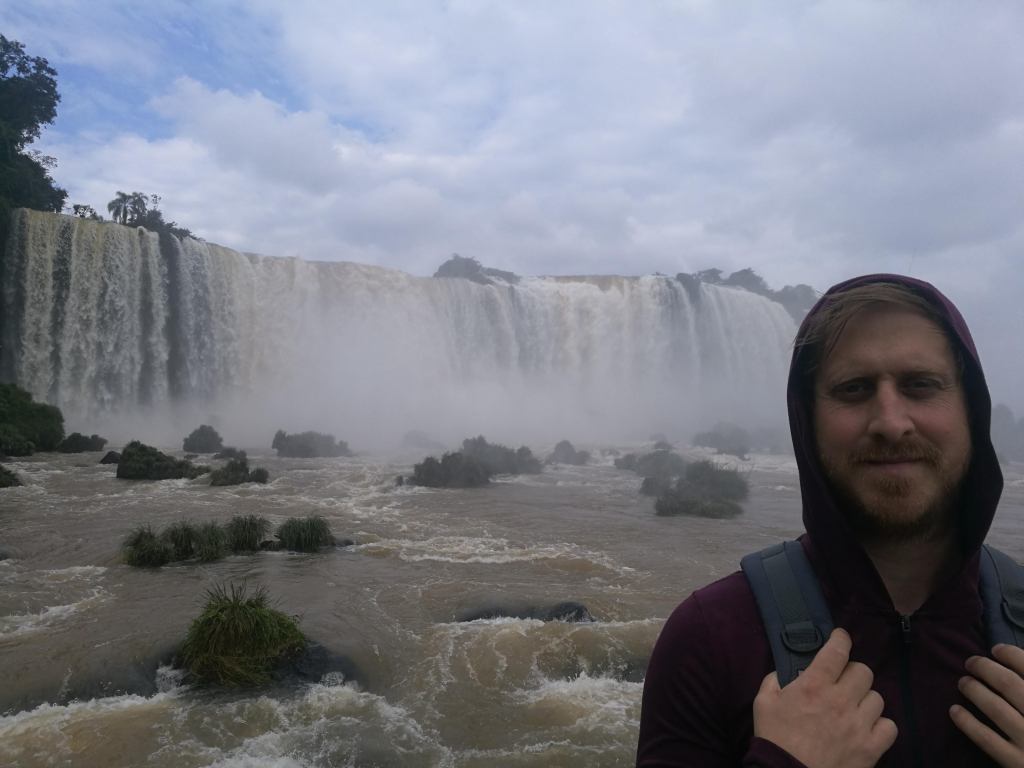
Iguazu falls. We really had no expectations about them beforehand. Having seen lots of waterfalls on our travels before, maybe we weren’t expecting to be too blown away. But WOW! This ranks as one of the best things we’ve seen on the trip so far. We’ll recount a few logistical bits and bobs and then rant about their amazingness after that.

Flying from Buenos Aires to Iguazu is cheap and easy. However, we decided to take an 18 hour bus for s**ts & giggles. Honestly, it was purely for saving on a night’s accommodation and around £20 for the bus versus the flight.

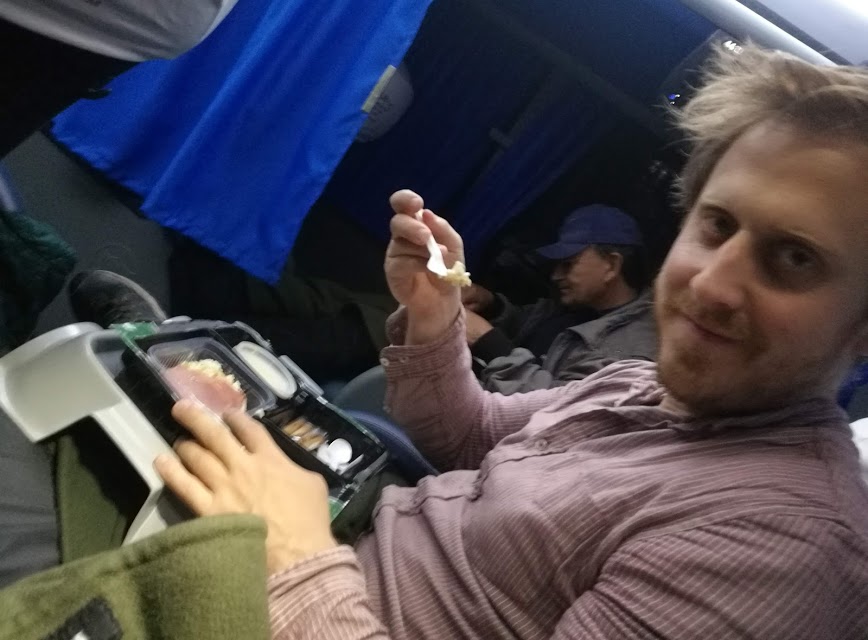
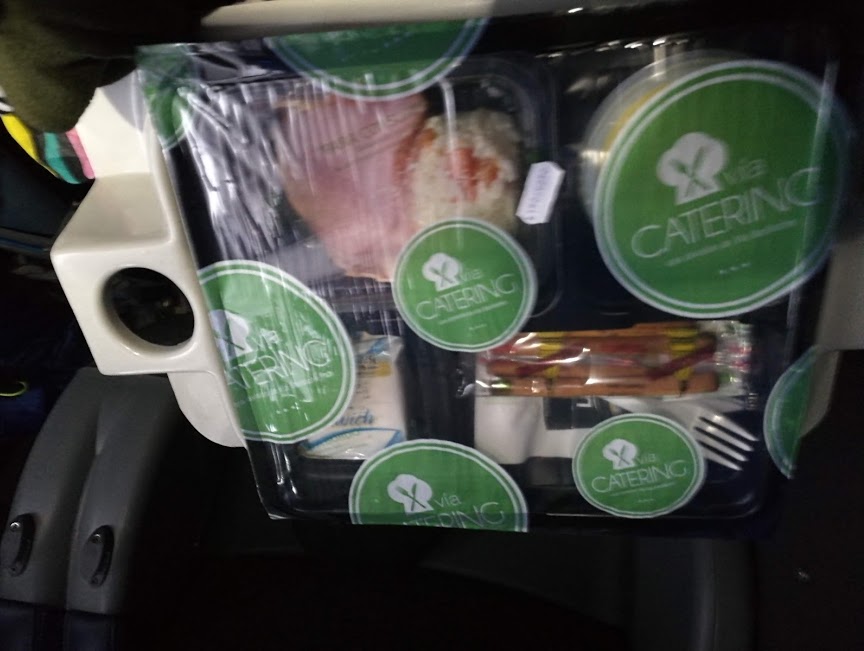
Retiro bus station is a bit drab and dreary, especially at night, and we were warned about keeping an eye on all our things. Our initial views were that the night bus might be a bit rubbish. However we were mildly surprised. We got camas (fully reclining seats) as opposed to semi-camas (err just seats) and we were even served dinner, with a choice of wine or coke. We also got breakfast! This was bizarrely some dry crackers and chocolate. That said it was a nice gesture. We slept through much of the trip and arrived in Puerto Iguazu feeling well rested.

We were given some advice that, if you are staying in Puerto Iguazu (in Argentina), it’s a good idea to book a cab driver to take you to Brazilian side as you get a very different view of the falls depending on whether you are viewing them from Brazil or Argentina. We found a good driver who was able to take us to all places we wanted to go – the massive Itaipu dam, the falls and the Parque das Aves (bird park) – for 2000 pesos.

*Important to note, you don’t need a visa to enter Brazil from Argentina for the falls if you’re British. Your passport gets stamped and that’s all.

Day 1

Itaipu Dam

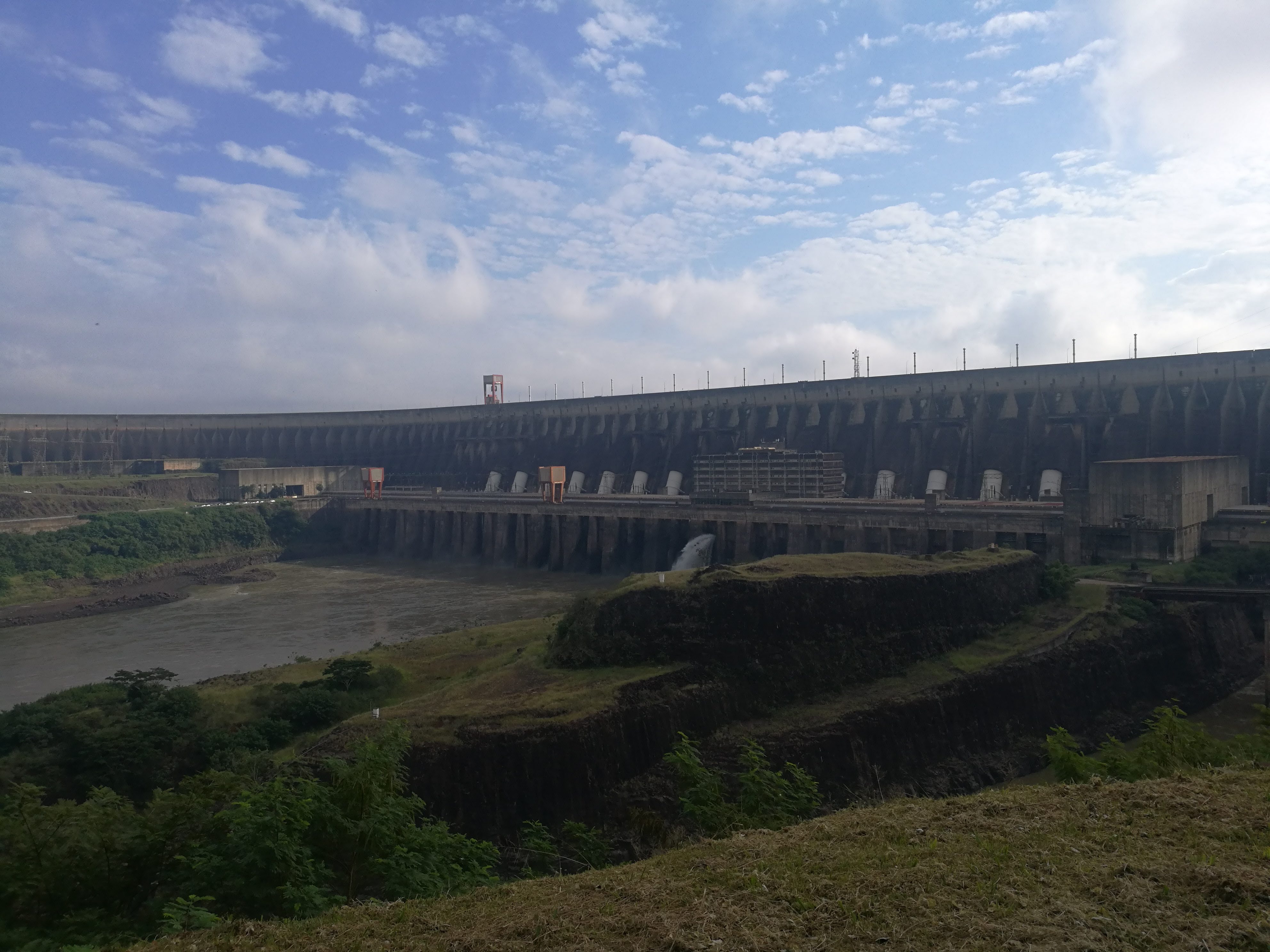
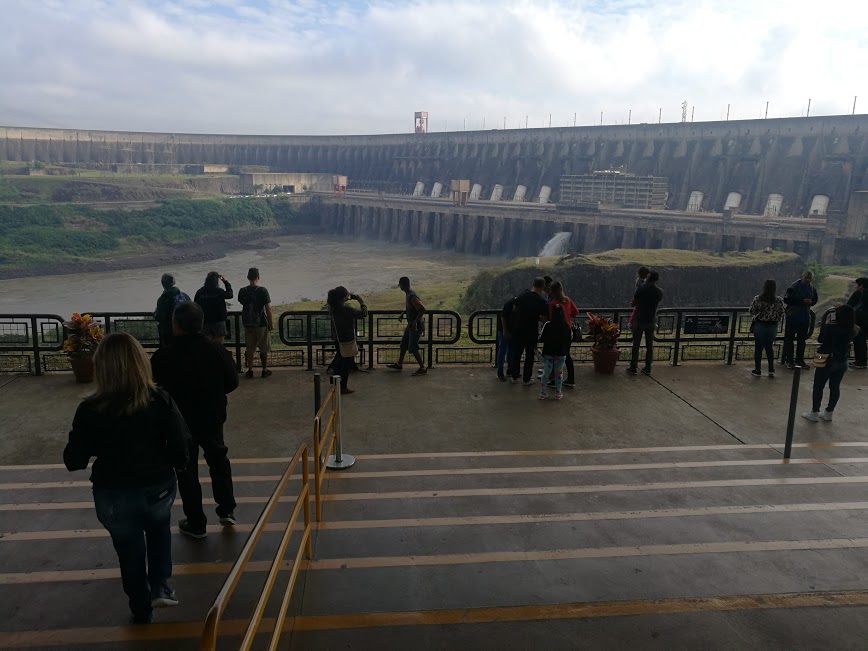
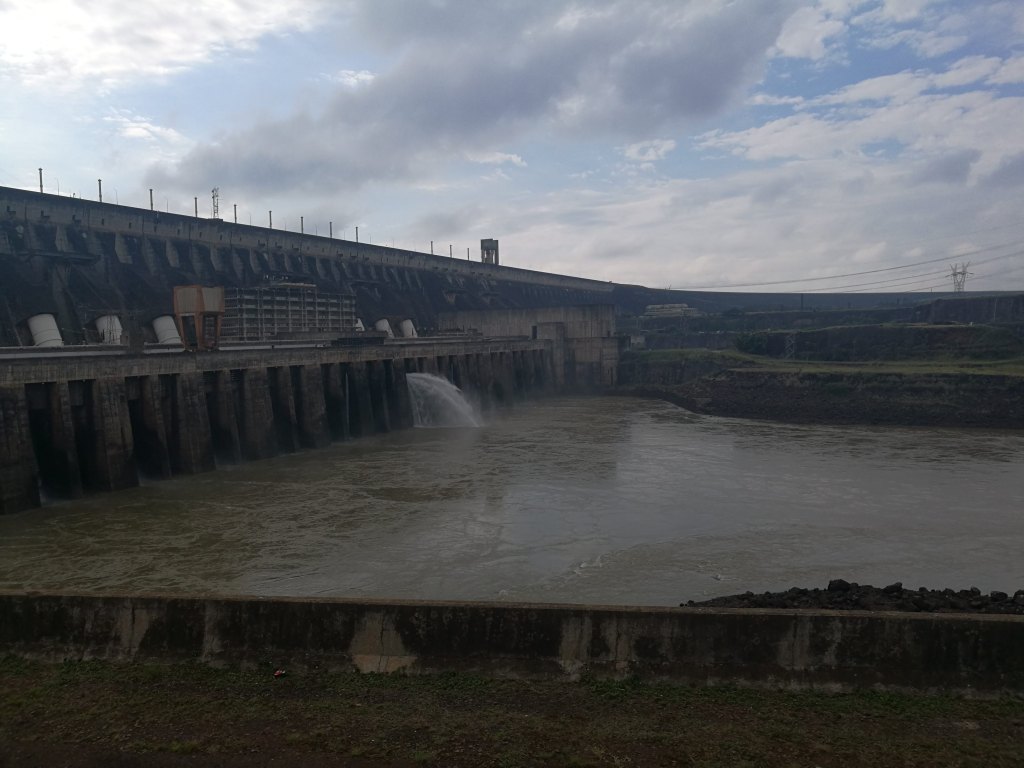
The Itaipu Dam is the largest producer of hydroelectric energy on the planet and has been named one of the seven modern wonders of the world. This mind-boggling human-made beast sits on the Paraguay/Brazil border and is a joint venture between the two countries, generating 15 per cent of the energy used in Brazil and 90 per cent of the energy used in Paraguay!

Unsurprisingly, tourists can’t wander around this piece of critical infrastructure willy nilly so you need to book onto a double decker bus tour. The dam complex is pretty damn (lol) vast and a bit weird – like Dr Evil’s lair. Gangs of workers either live on site or travel in for the day in trucks to patch things up and keep things ticking over. There are endless logos in prominent places emphasising that this dam is a joint gig between Paraguay and Brazil. The tour is informative enough but didn’t touch on the politics of the agreement (err disagreement) between these two countries over how much the larger of them pays the other one for the excess energy it produces.


When we looked into it afterwards we read that the agreement governing the power produced by this dam are hugely distorted in the favour of Brazil. Any energy that Paraguay creates that isn’t used has to be sold back to Brazil at production rather than market rate. Paraguay only uses 12.5 per cent of the 50 per cent i.e. 6.25 per cent of the total electricity created, meaning that they’re missing out on billions of income they’d get if they were allowed to sell to other countries such as Argentina. The President of Paraguay considers the deal so unfair that he has mooted appealing to The Hague to try to have the contract challenged in court. Brazil apparently gave some ground after he kicked off but a full renegotiation is planned for 2023 when Paraguay will surely seek fairer terms. Read more here and here.

Iguazu Falls – The Brazilian Side

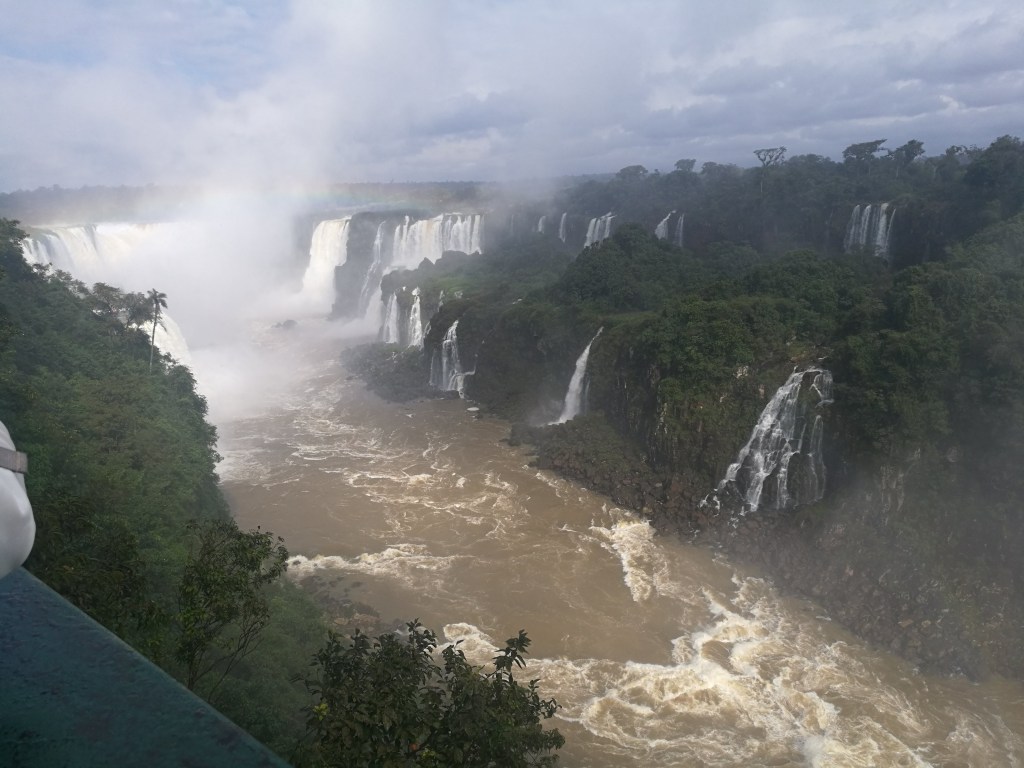
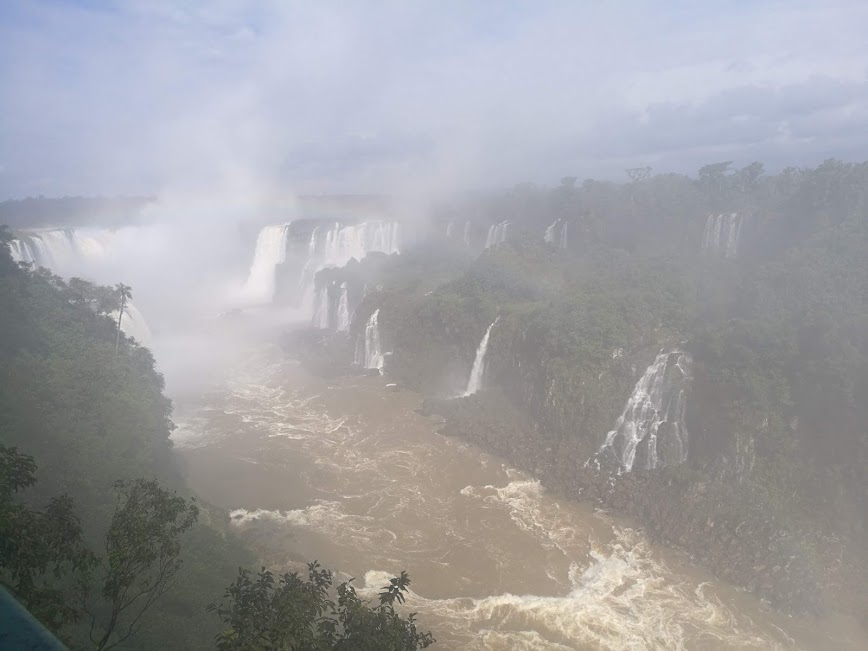
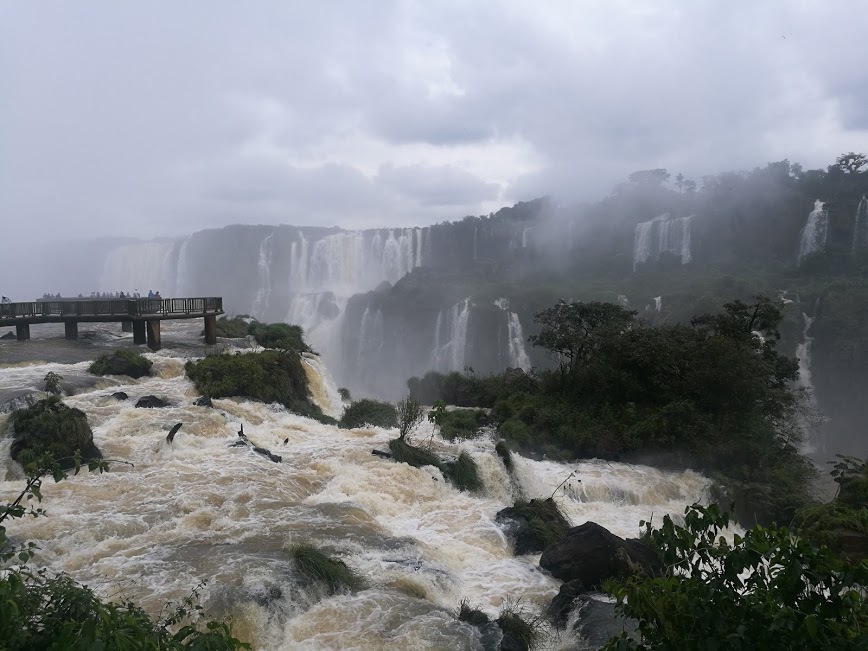
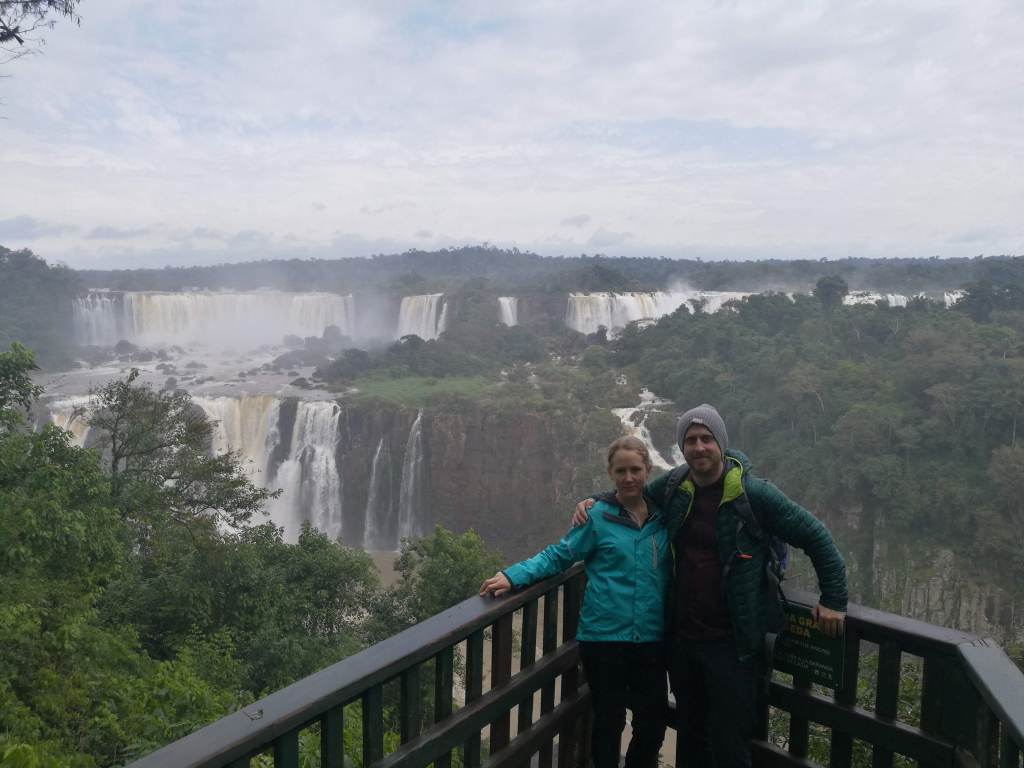
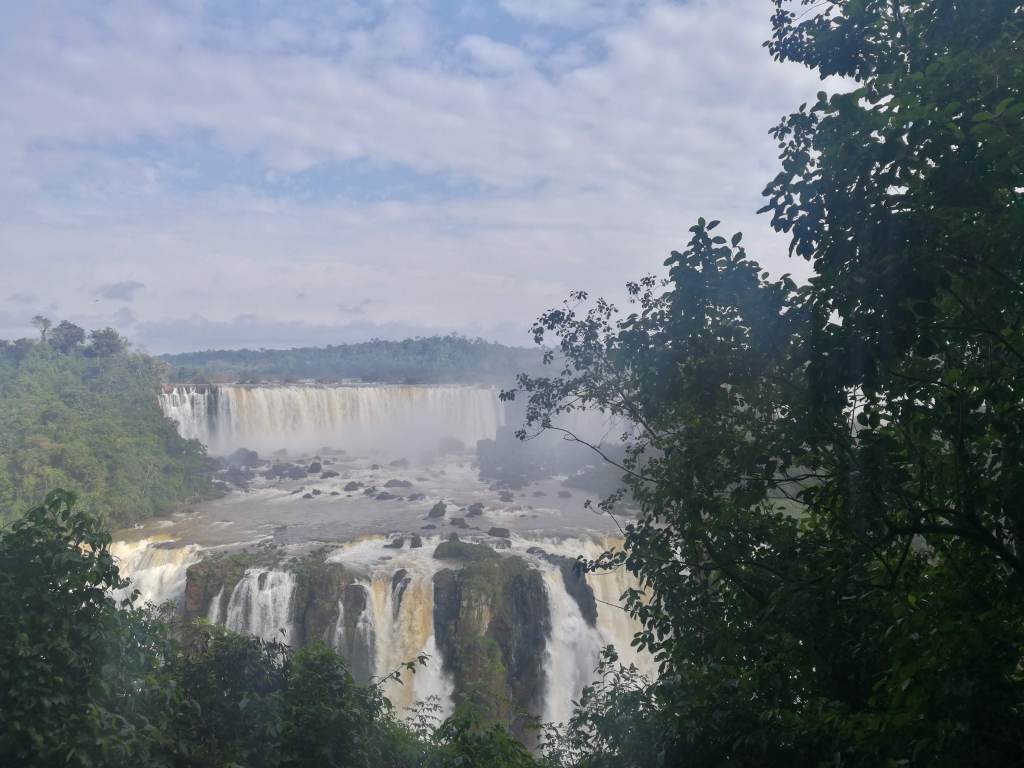
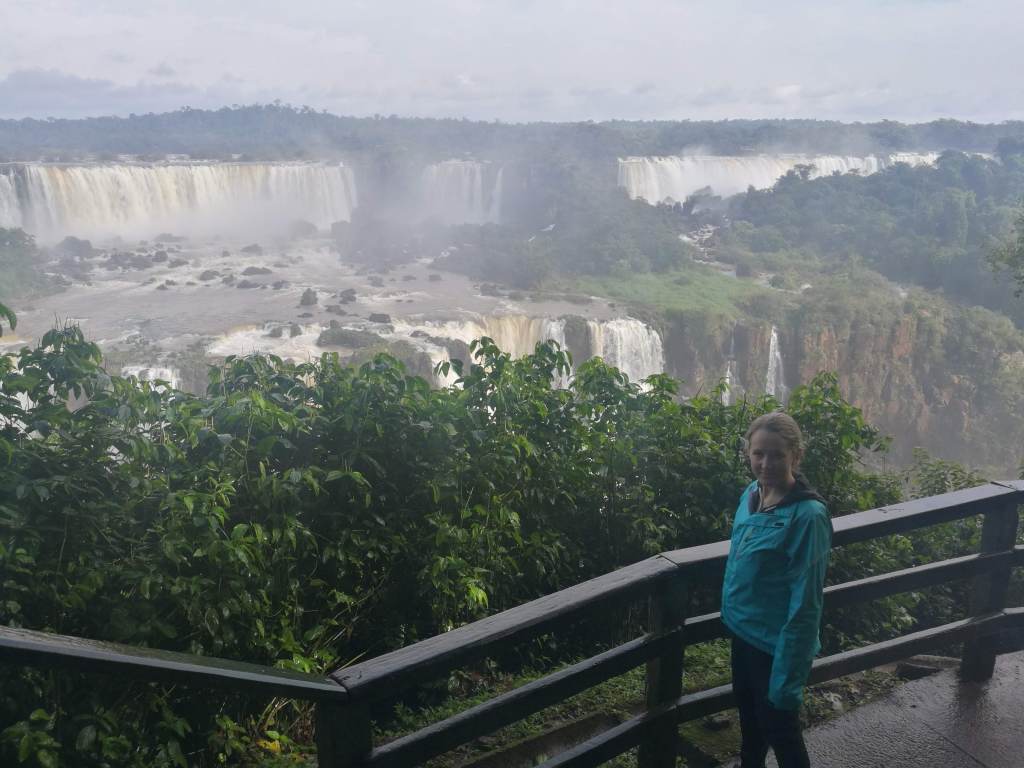
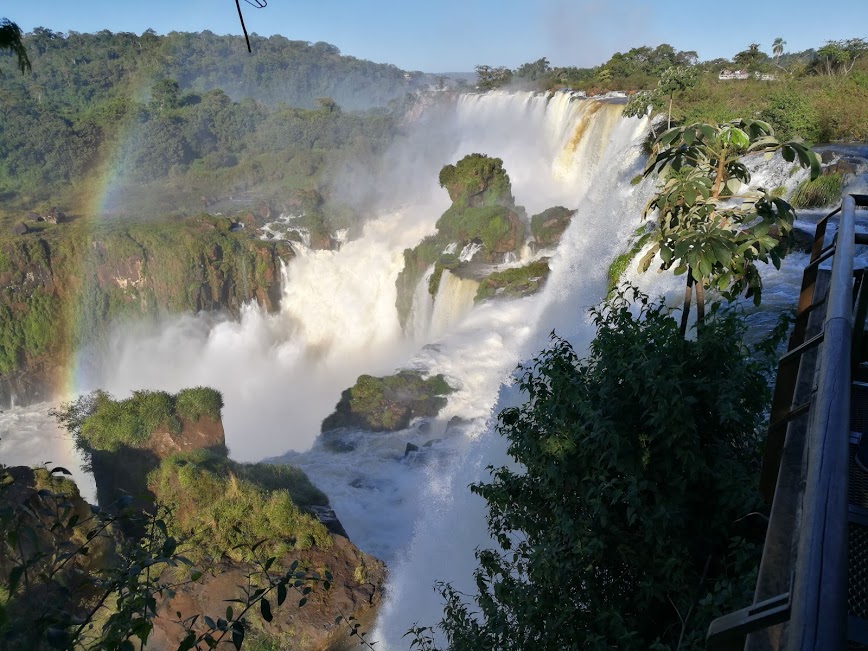
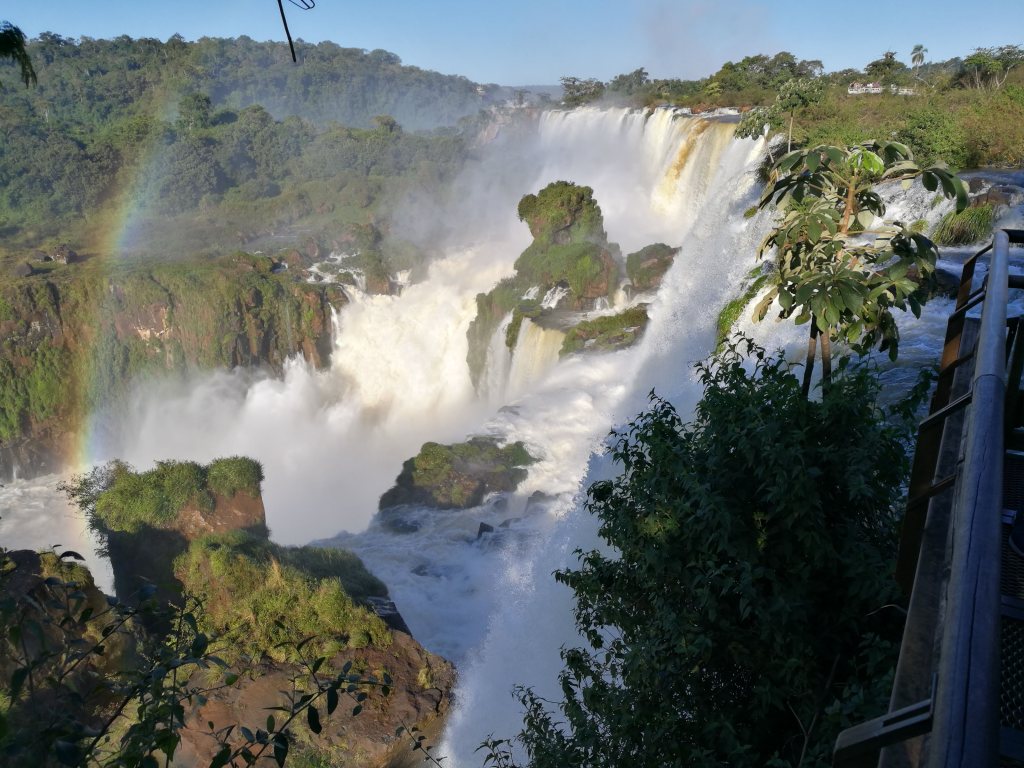
The views of the waterfalls were undeniably spectacular. The huge amount of water cascading down really was incredible with an uncountable number of waterfalls stretching across the horizon for as far as you could see.

The trail leads you through various viewpoints, interspersed with various “animals”- It’s very orchestrated as you’d expect but still feels raw and full of energy. The end point of the trail is very interactive and very special but I won’t spoil that. Here are some selected photos without the ending.


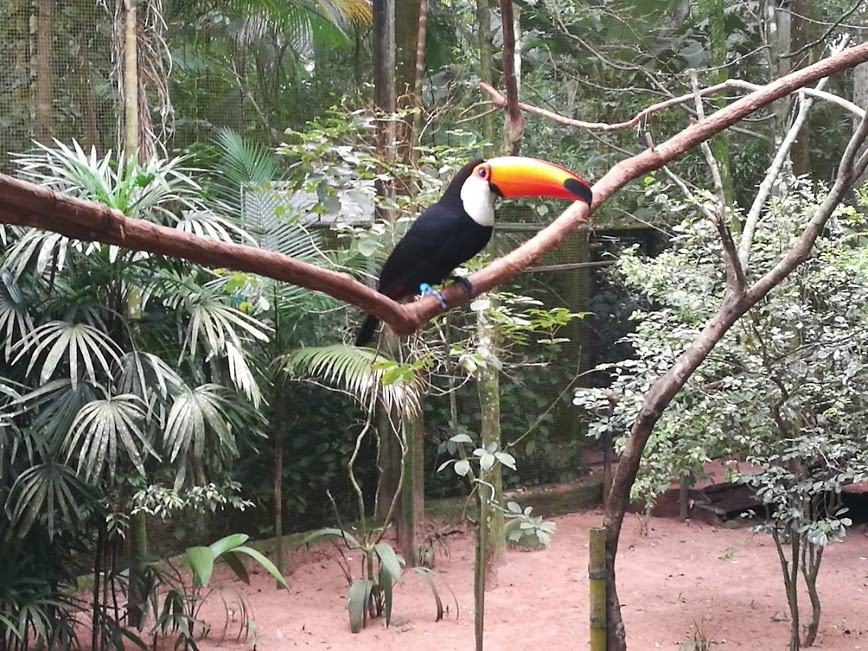
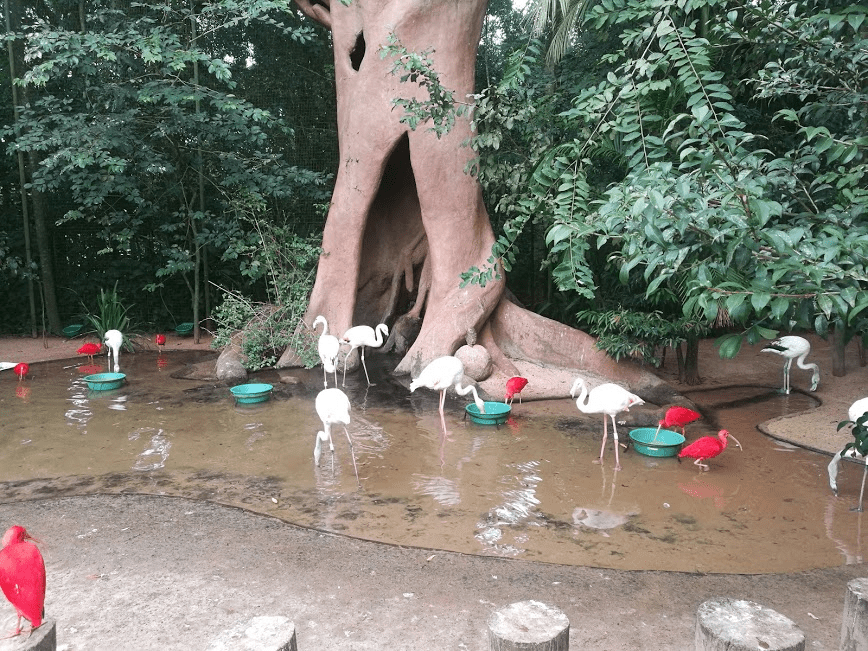
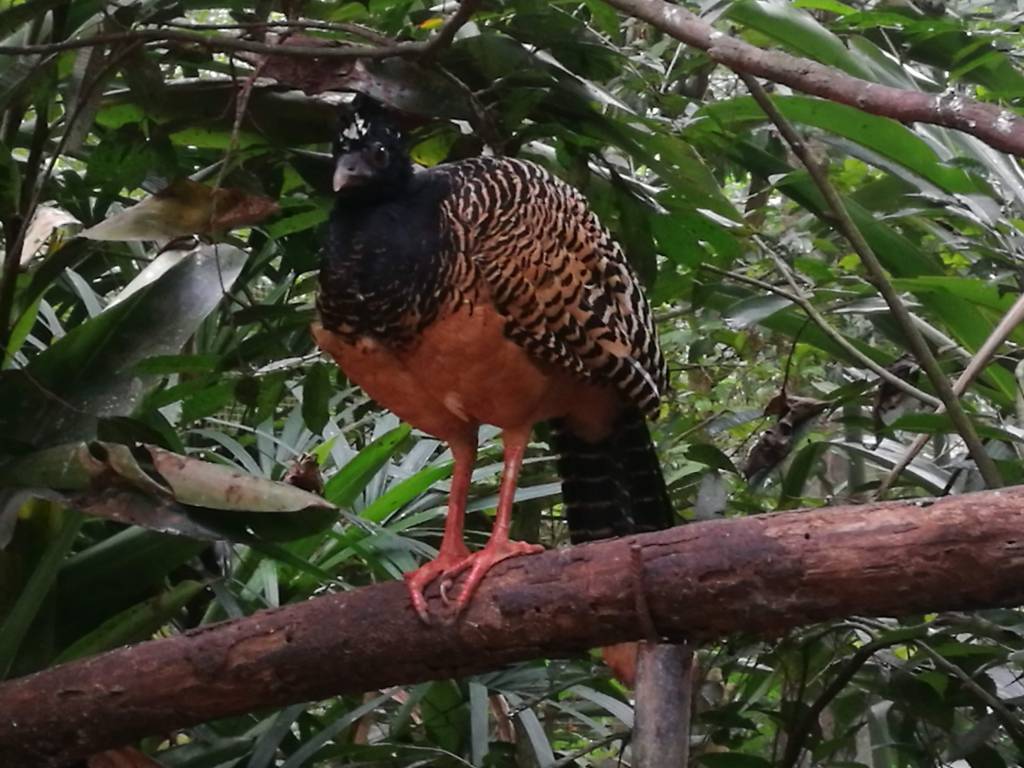
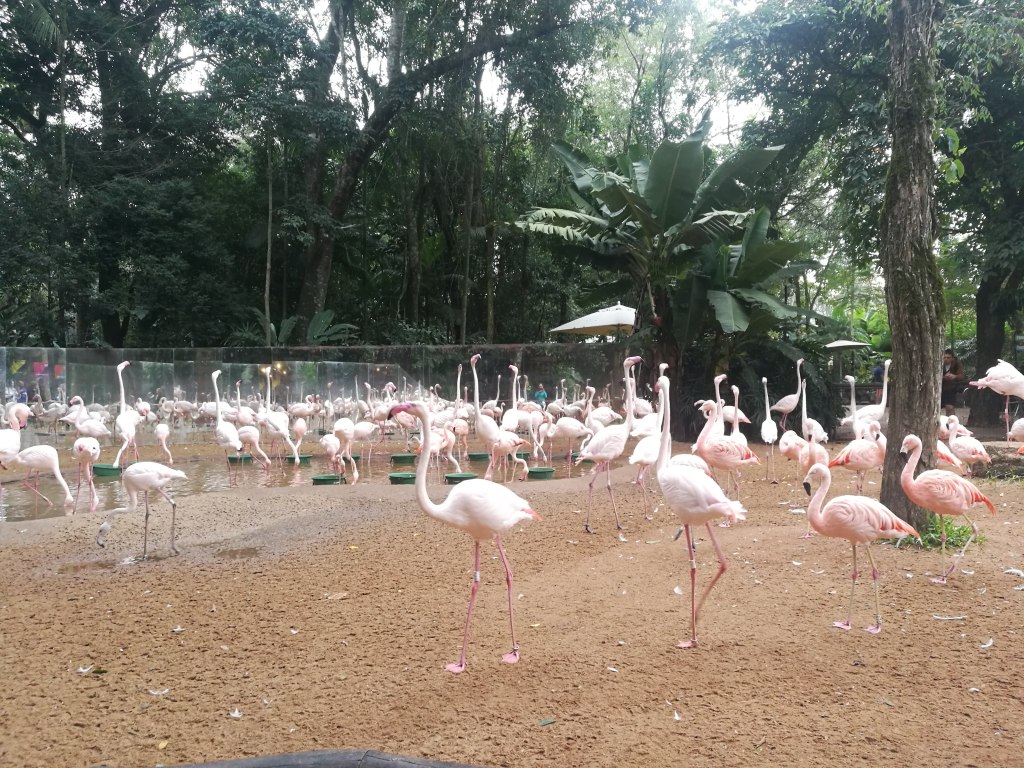
After deciding not to eat in the classically overpriced restaurant at the end of the trail, we headed back and went to the Parque Das Aves which is right next to the falls entrance. In keeping with the rest of the day it was incredible!

One element that the Brazilian side lacks is that one, for the most part, feels distant from the waterfalls, as if you’re missing something. The complete energy, smell, noise, sensation of being near a natural beast of power. This is where the Argentinian side, it became clear the following day, comes into play. Wowser in me trousers.

Parque Das Aves

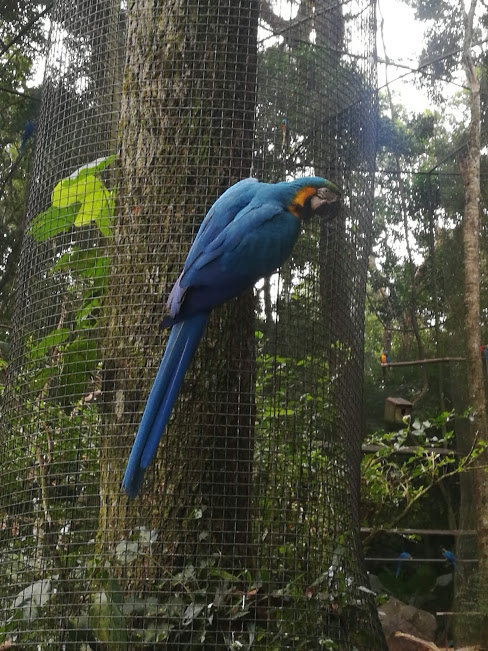
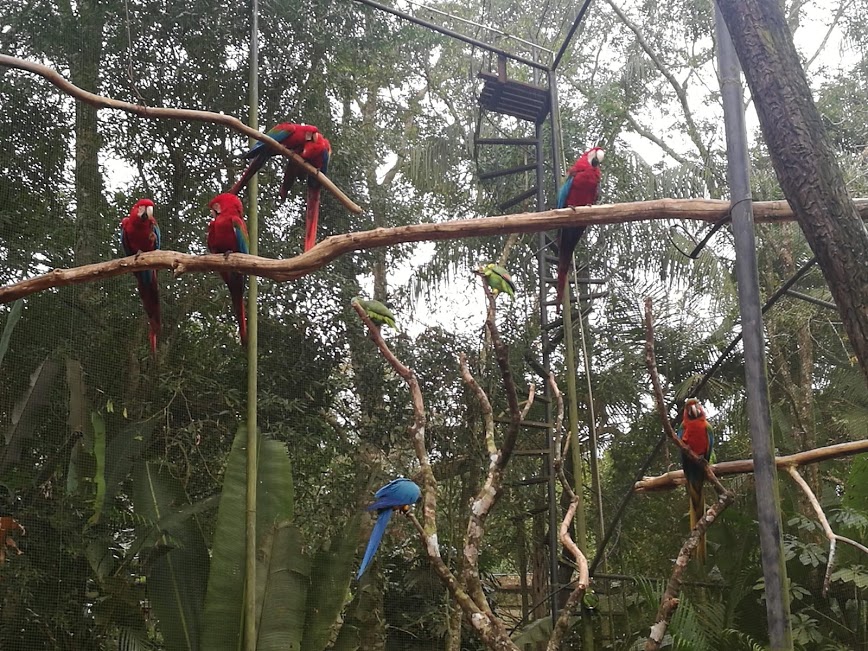
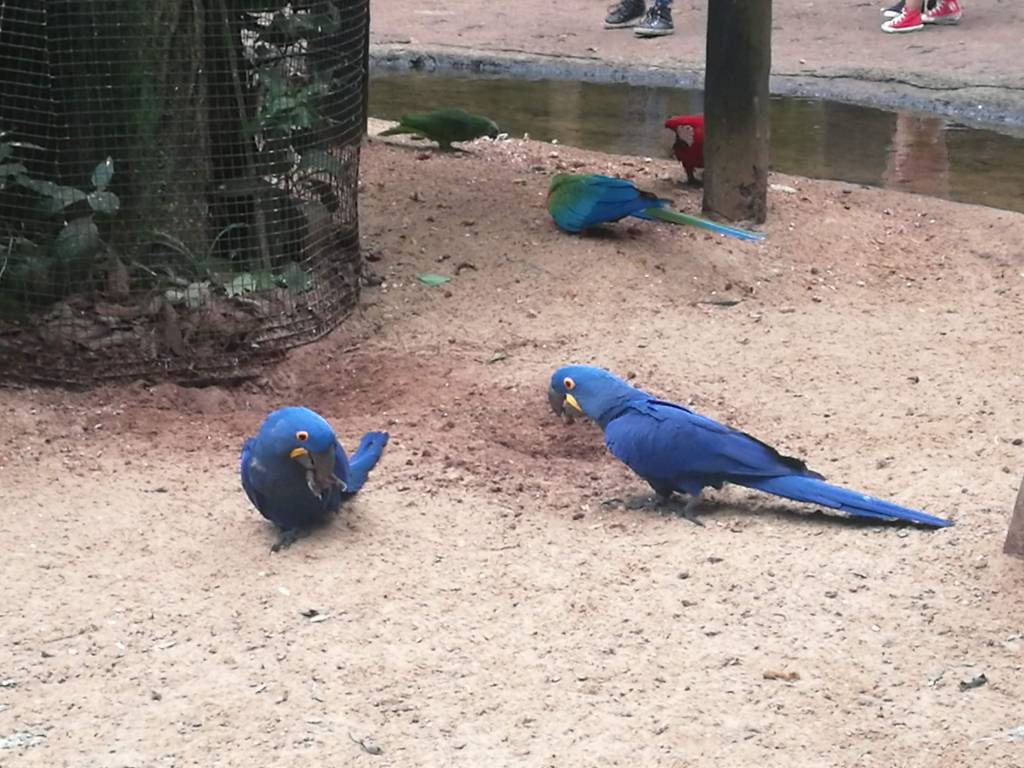
I should say I’m massively against caged animals, unless necessary. However this was pretty special and was, to me, the least bad version of caging animals – the cages had plenty of space and the birds could fly quite easily. Additionally, you can walk within many of the cages. In particular, the parrot cage is something worth mentioning – there are numerous types of colourful parrots in the cage which tend to divebomb at you, screeching madly, and dart out of the way at the last moment – a unique and exhilarating experience which I’ve never had before.

Day 2

Iguazu Falls – The Argentinian Side

*The Argentinian side you can get a bus to – no need for a taxi. Simply go to the bus station in Puerto Iguazu and there are frequent buses to the falls (“en el lado argentino”).

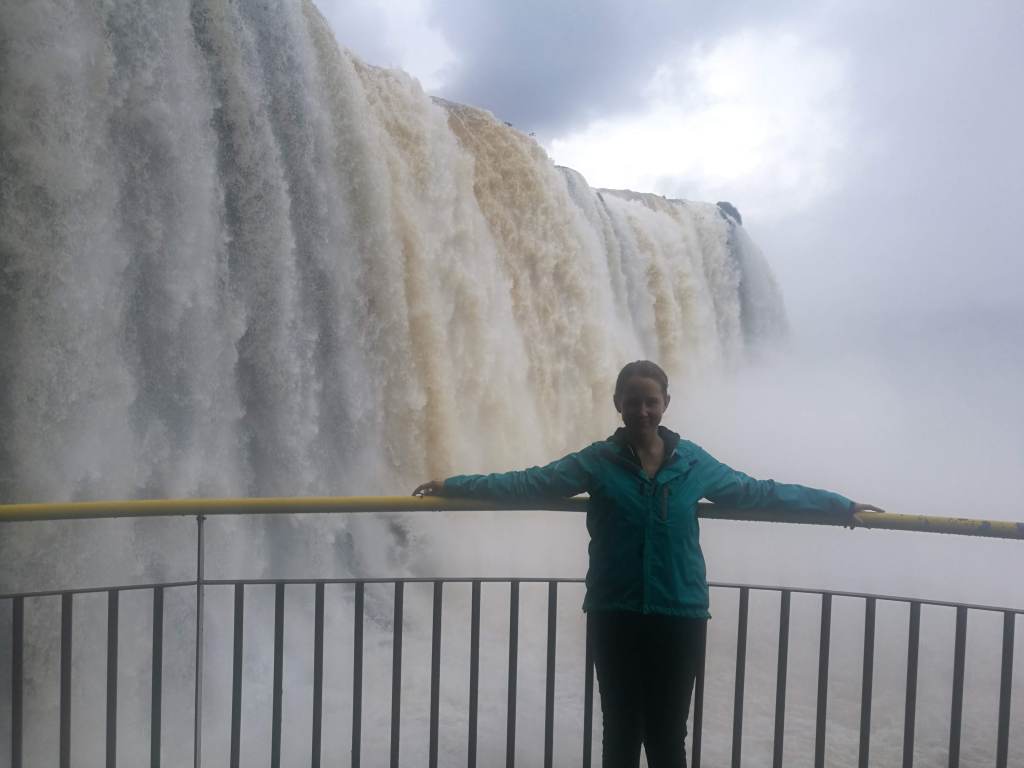
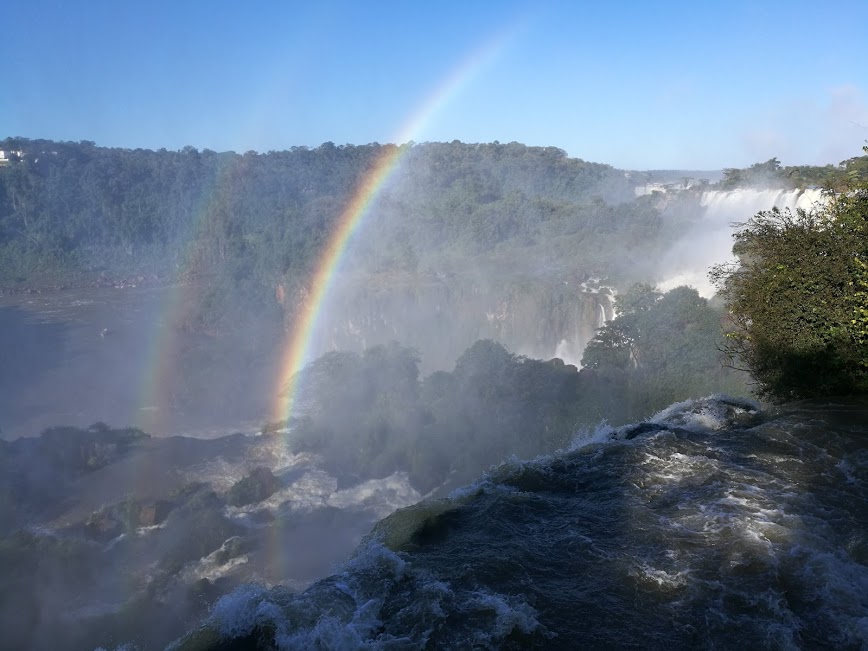
Once there it’s a similar cost to the Brazilian side but involves walking and it not linear as the Brazilian side is. On the Argentinian side you are able to get up close and personal with the falls which leaves you soaked but is spectacular and exhilarating. It’s an incredible experience and you need at least 3-4 hours to explore the different falls and have a proper ogling of the Devil’s Throat.

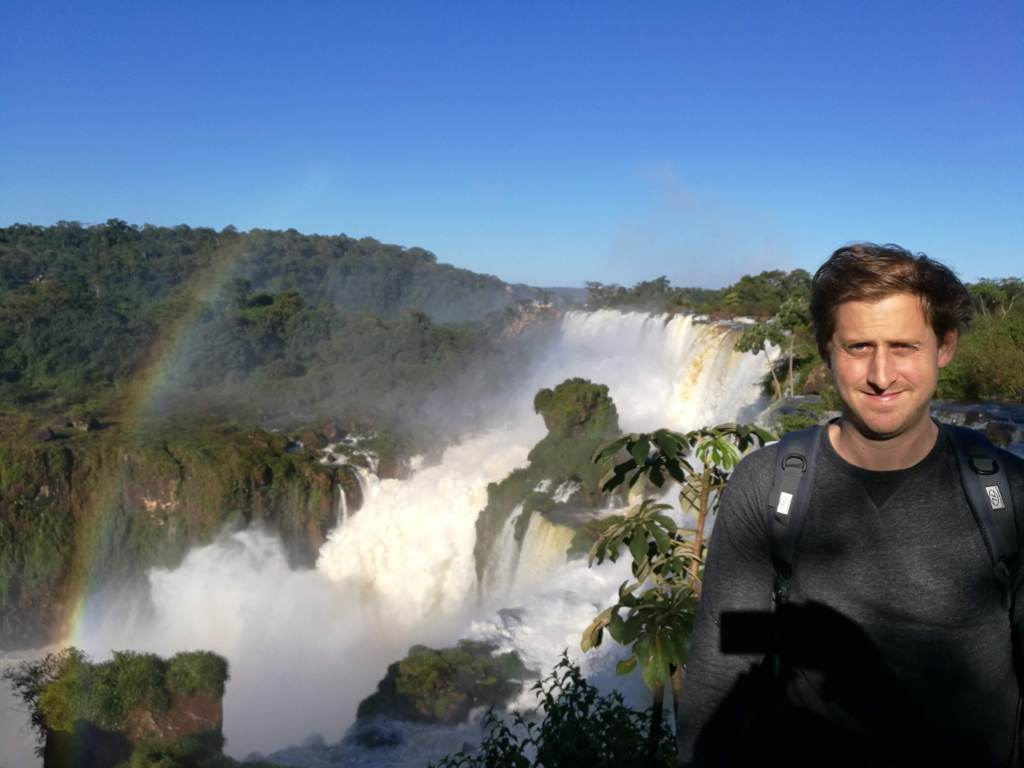
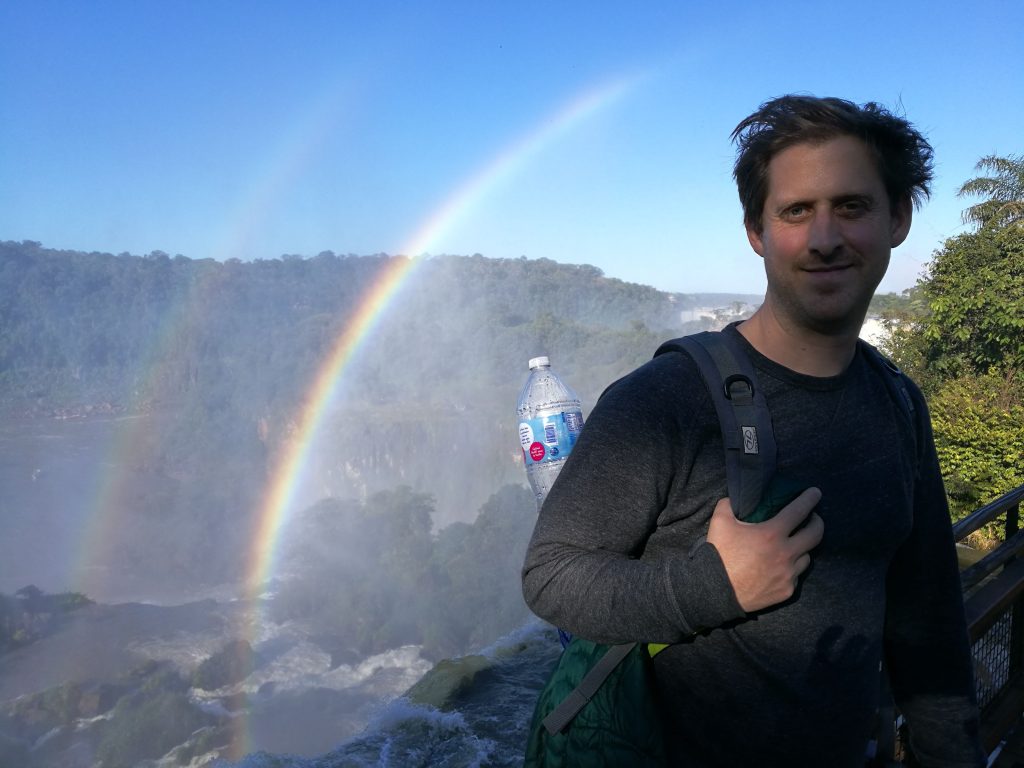
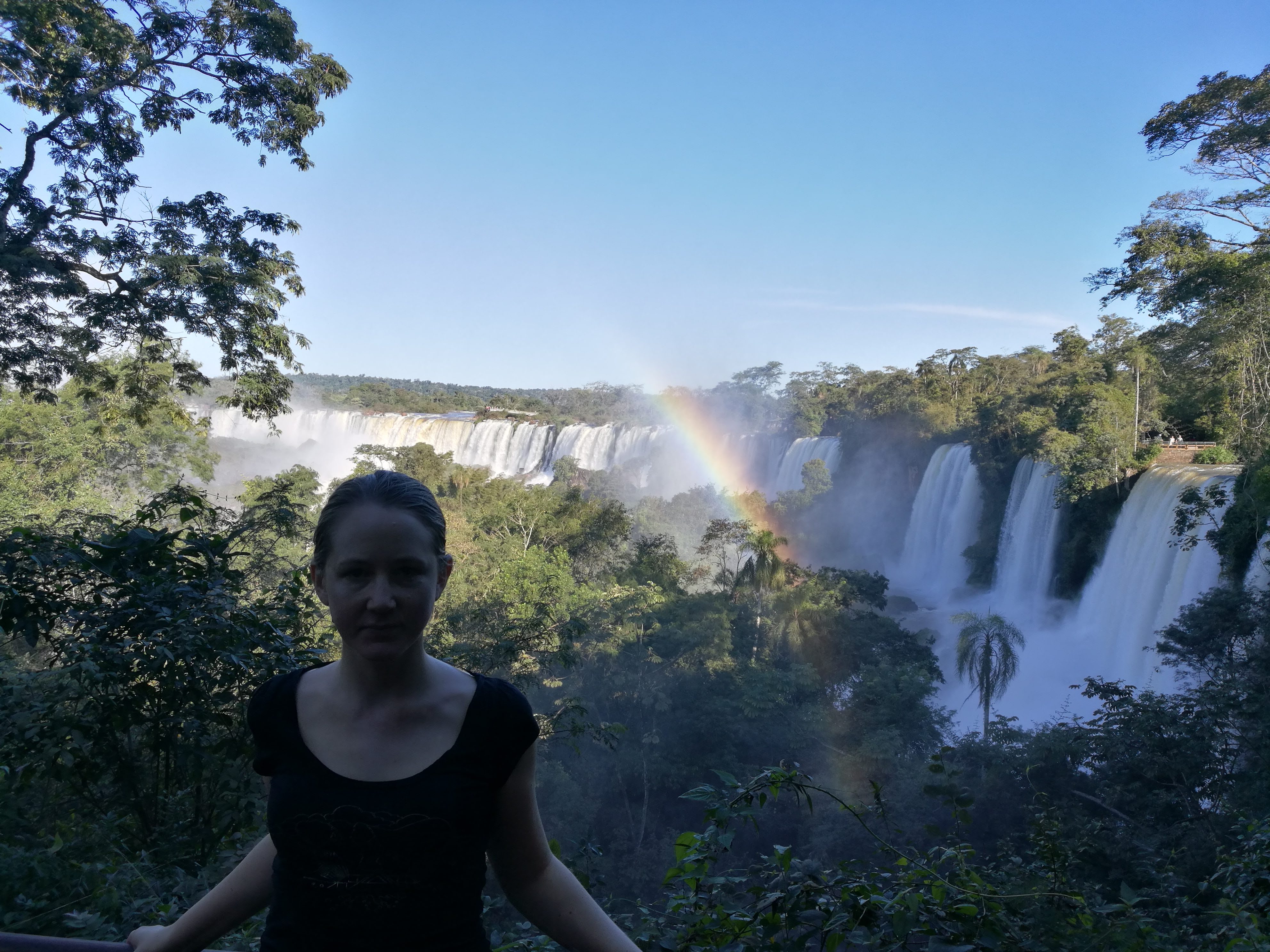
When there’s sun, you’re guaranteed a rainbow which makes the whole experience even more memorable.

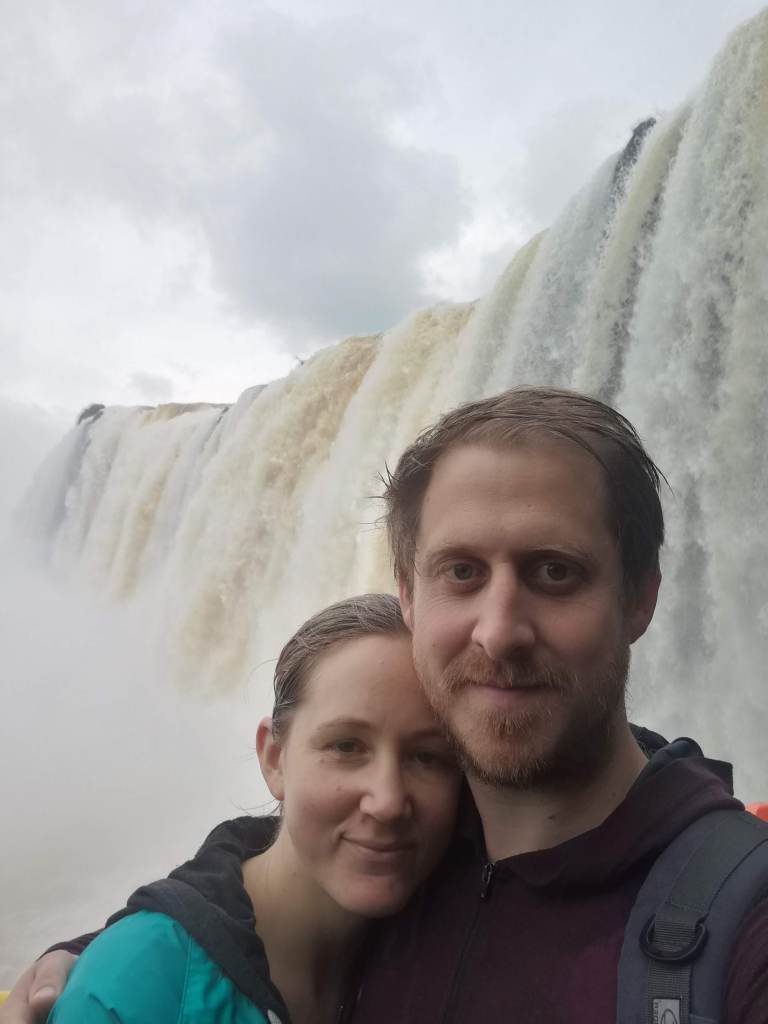
After Devil’s throat, we continued to walk around to see the other parts of the falls, less glamourous than the Devi’s Throat but still very impressive and unique. Turning a corner and seeing a new part of the falls from another viewpoint keeps things interesting. If you’re into taking selfies you can fill your boots here (and many people did). After we’d gawped at the falls enough, we jumped back on the tram to the entry of the park and then back on the bus to Puerto Iguazu.

The Argentinian side is more expansive than the Brazilian side, both in the options of seeing the waterfalls and the walking trails. The main differences are that on the Argentinian side the views are from above looking down onto the waterfalls, whereas on the Bazilian side you are looking at the waterfalls from the other side. On the Argentinian side you are significantly closer to the falls so you get more than just the view – the energy, noise, feeling the spray in the air etc. We were actually pretty surprised how close to the action you can get on the Argentinian side. Makes you feel pretty insignificant and tiny!

Without doubt, we’d recommend experiencing Iguazu – the falls are something so unique and breathtaking. Even though you have to go out of your way to get there from other areas of Argentina or wherever else you are in south America, they’ll leave a lasting memory.      


Salt flats and strange poses

Some things you notice or get thinking about when you’re travelling merit a stonking great write-up. It can help try to bring meaning to what you’re seeing and keep the experience alive once you’ve returned home. But others are all about the photos and need just a smattering of facts and a little explanation. Our trip to Bolivia’s salt flats at Salar de Uyuni falls into this second category.

A few facts. Bolivia’s salt flats are the largest in the world at 10,582 square kilometres. They are located at Salar de Uyuni, 3656m above sea level. The flats are used for satellite calibration as the surface elevation varies just 1 metre across the 10,582 square metres. And, for anyone interested in this kind of thing, Bolivia holds about 43 per cent of the world’s known lithium reserves – most of those are in the Salar de Uyuni.

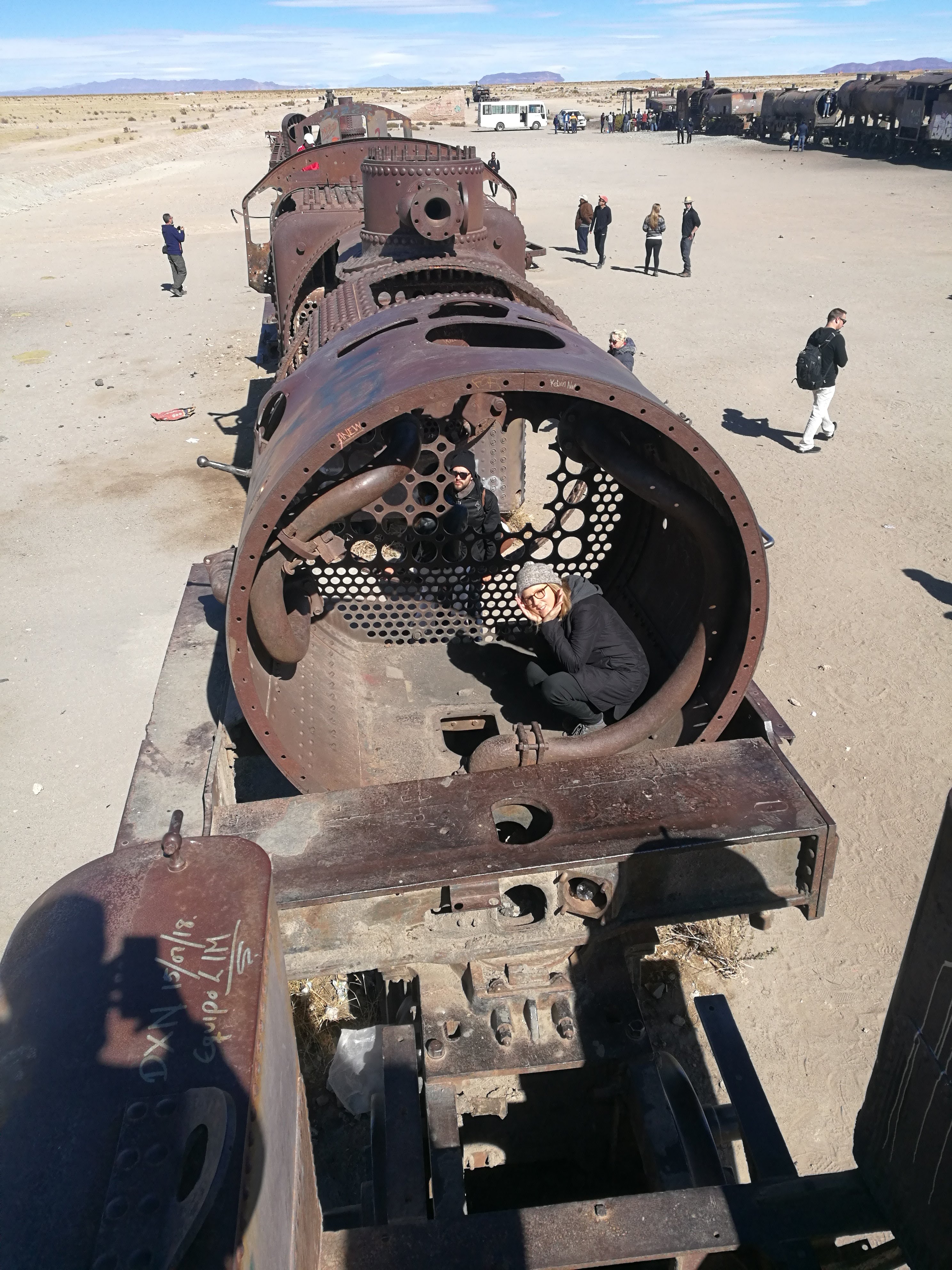
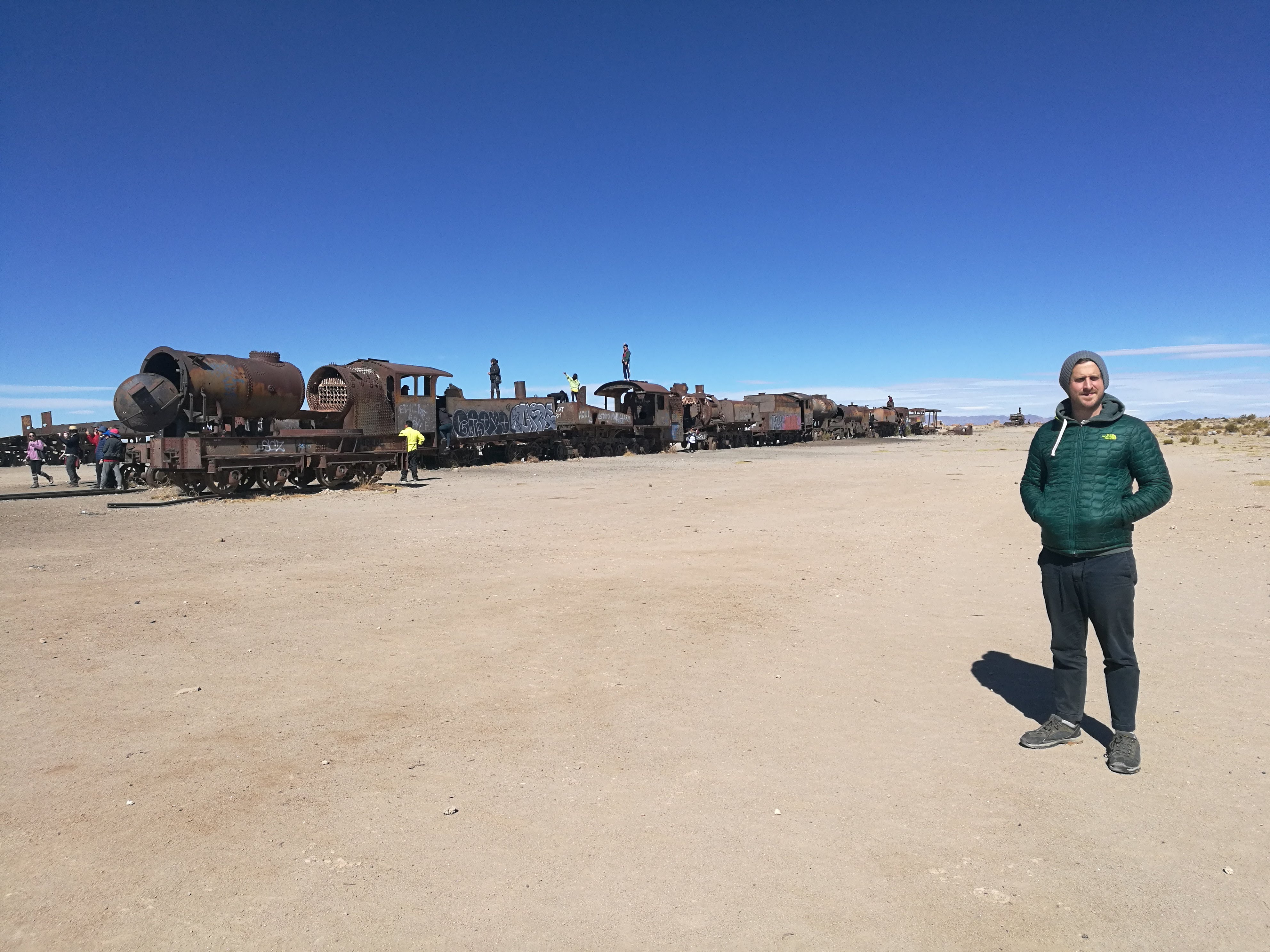
Our first stop was a ‘train graveyard’ that sits at the edge of the flats. The rusting engines, strings of abandoned wagons and wrecked carriages are testament to the failure of Bolivia’s early 19th century dream of setting itself up as a major South American transport hub. Nowadays tourists clamber in and out of the wreckage and redundant rails extend to nowhere. Fun to mess around here for a few minutes – anoraks may need longer.

We then headed further into the flats. Our vehicle had been squished in a pack of other tourist 4x4s at the graveyard, our lunch spot and on the highway to the flats. As we got onto the flats proper, each driver charted their own course, the throng broke up and the vastness of our surroundings became more apparent. We all remarked that we wouldn’t want to drive across this landscape for long. The featurelessness, the lack of road markings – or in fact any indicators of where you are – and the fact you can’t see any defined start or end point of the flats once you have advanced a few kilometres into them mean you need to keep focused and not nod off or engage in wacky driving through boredom.

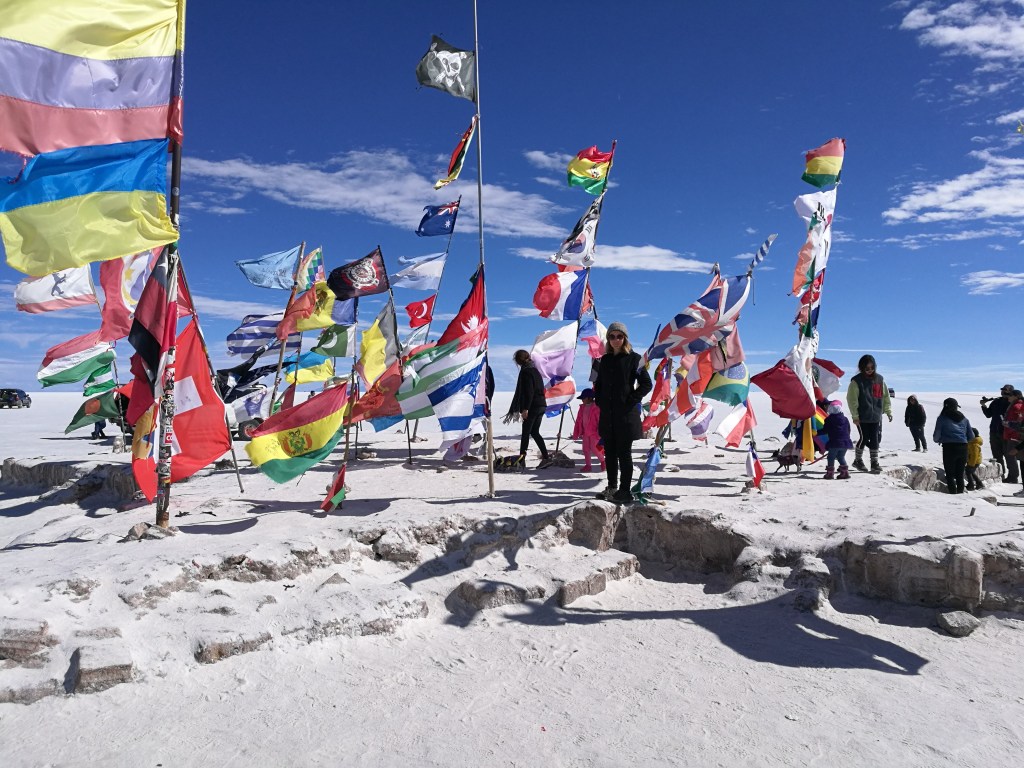
We had a look around an abandoned hotel made of salt – abandoned as the owners weren’t too fussed about removing waste (that of course otherwise won’t go away out here!) from the site. This caused predictable issues and they were shut down but dozens of flags fluttering outside still make it a decent place to take a few photos.

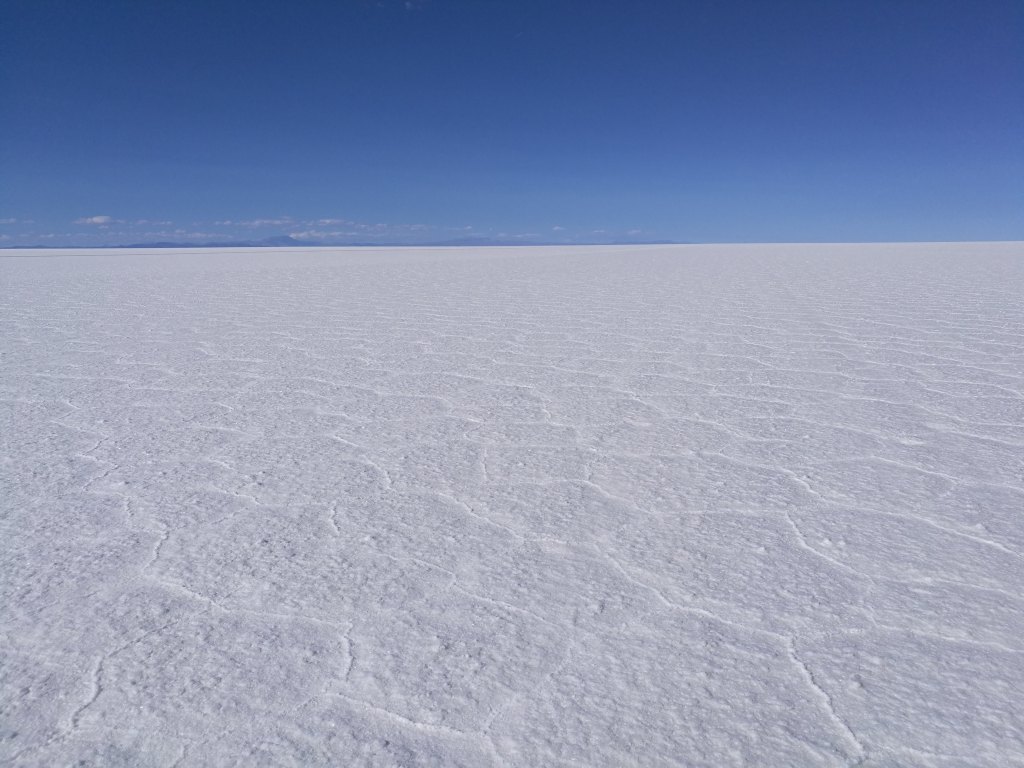
Standing on a patchwork of polygons was our first post-Iguazu reminder that nature is responsible for some weird and strangely beautiful things. Apparently these shapes are formed when water evaporates off the flats, leaving this giant bee hive effect.

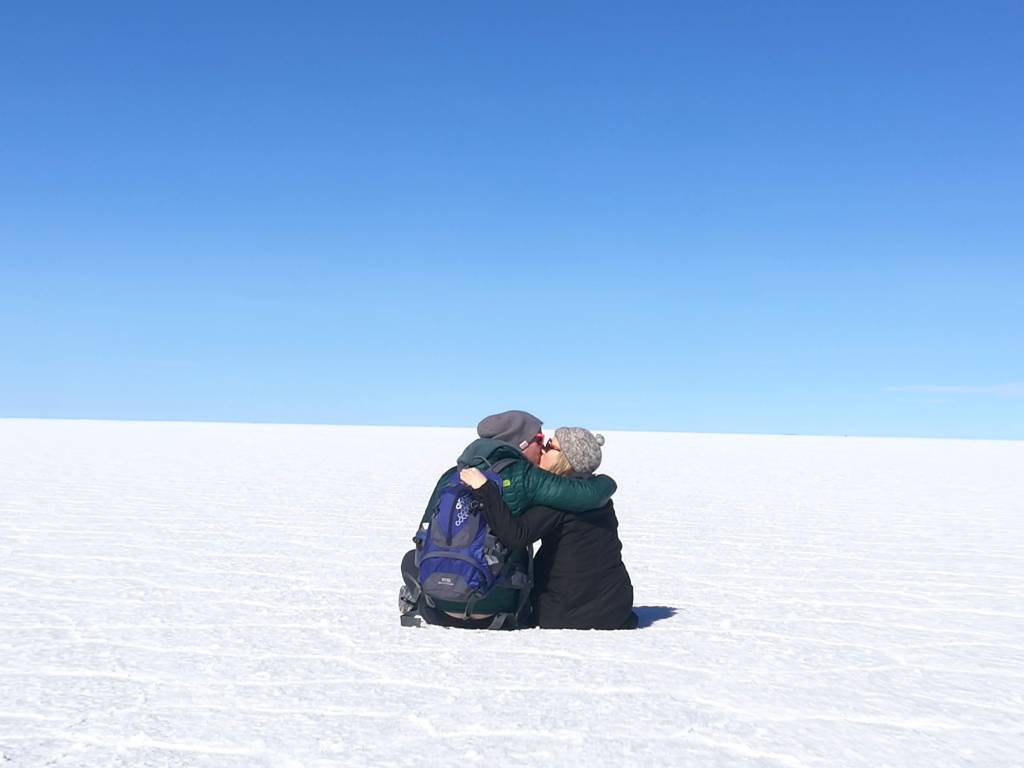
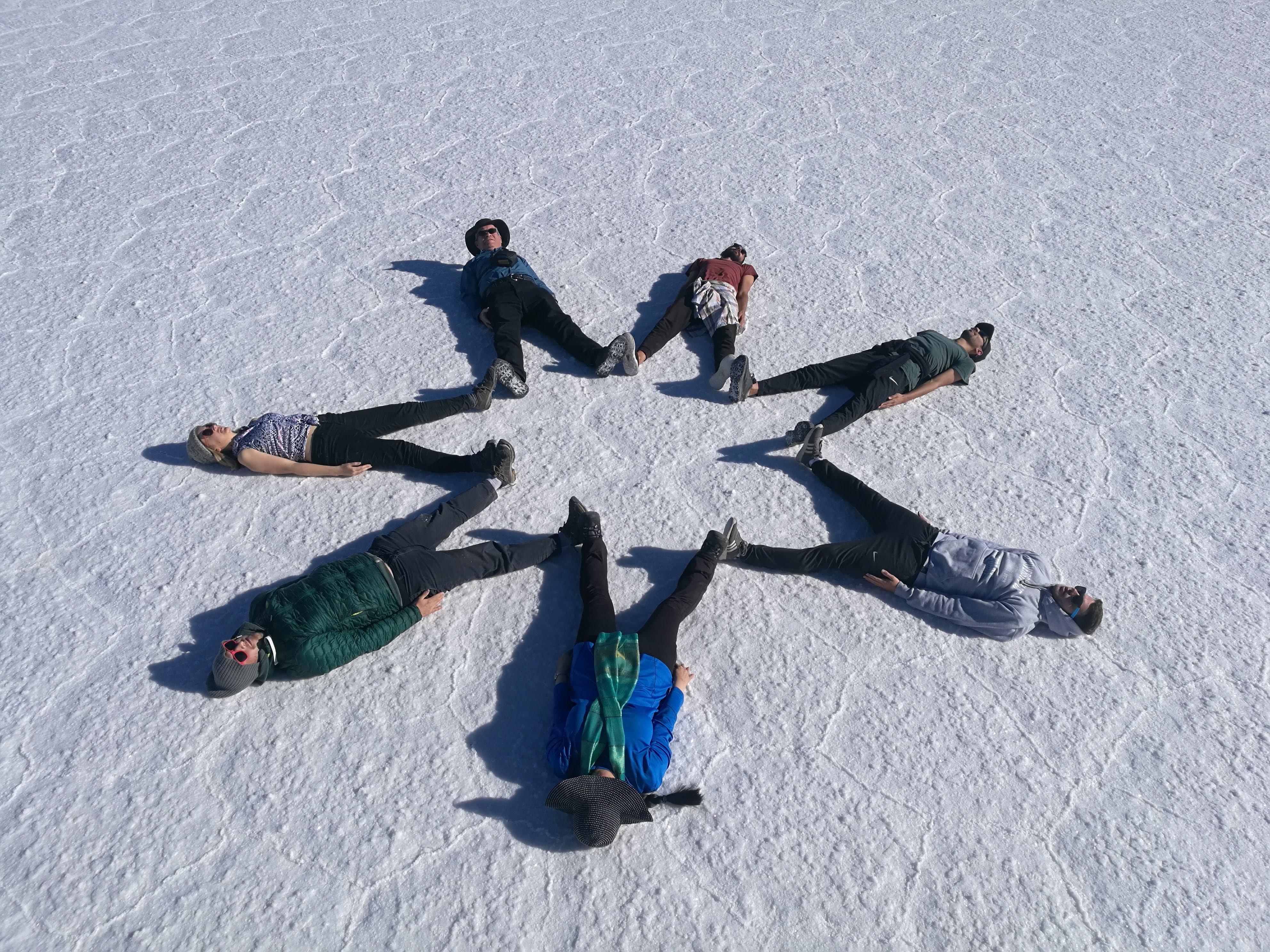
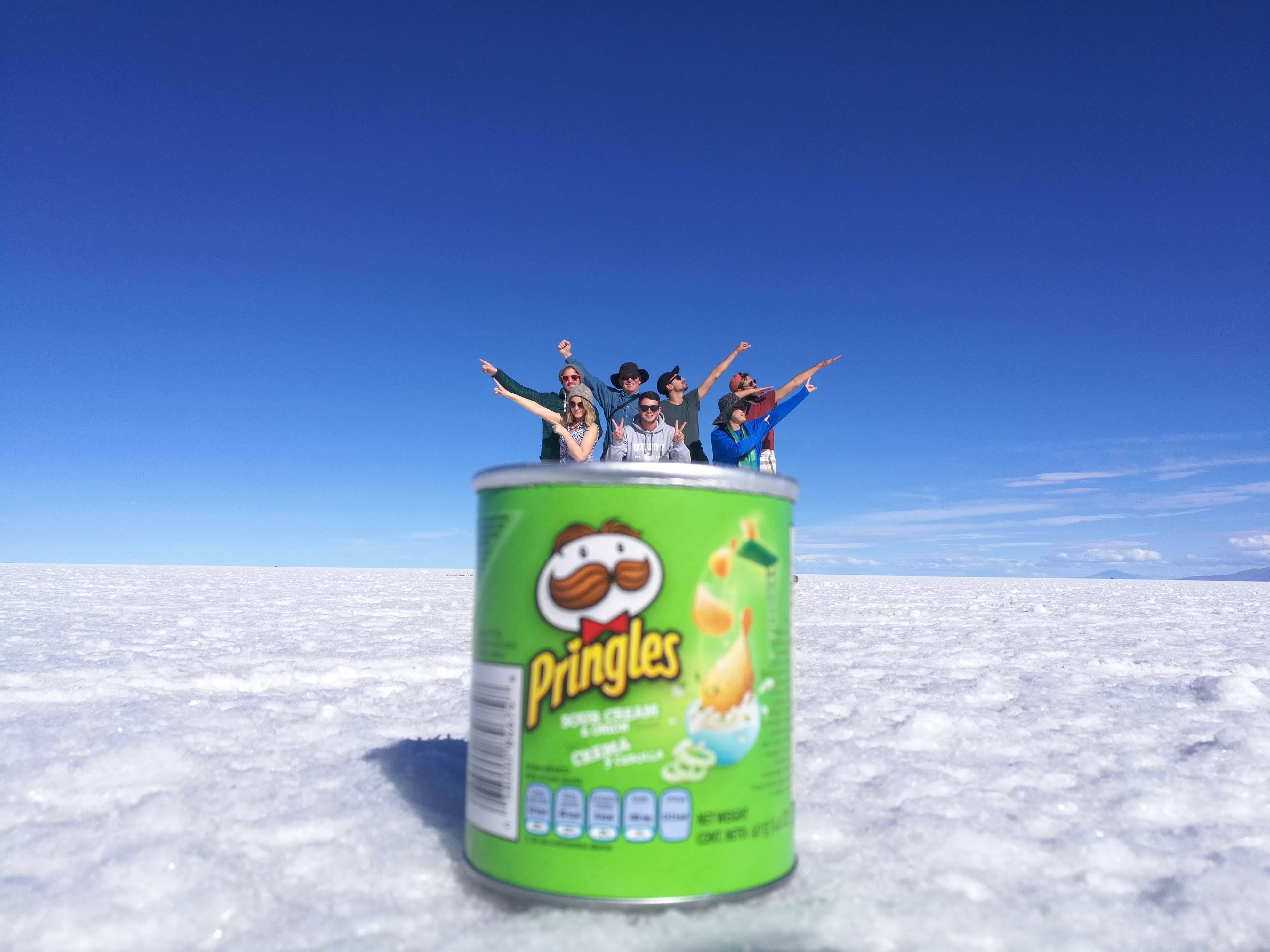
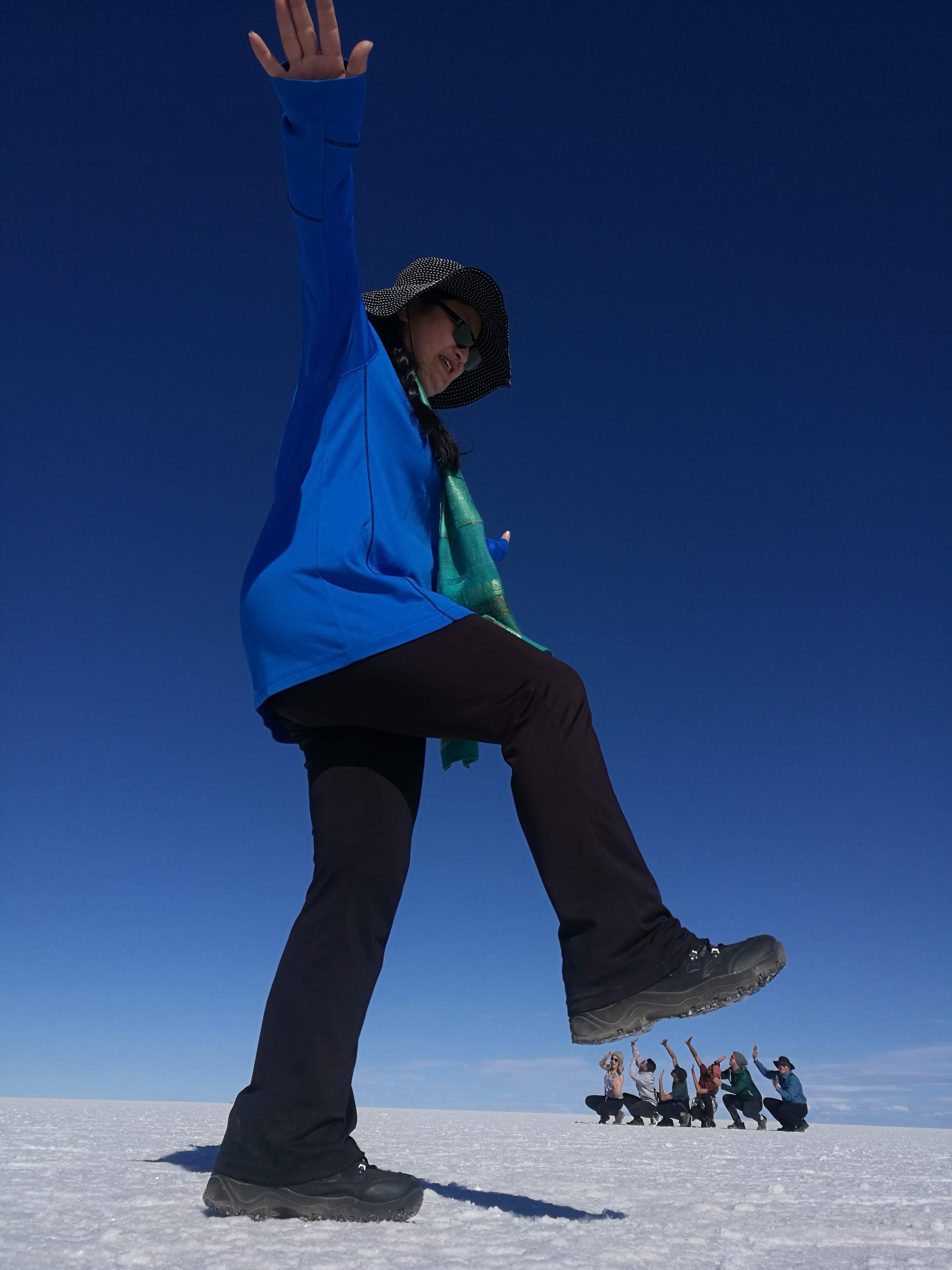
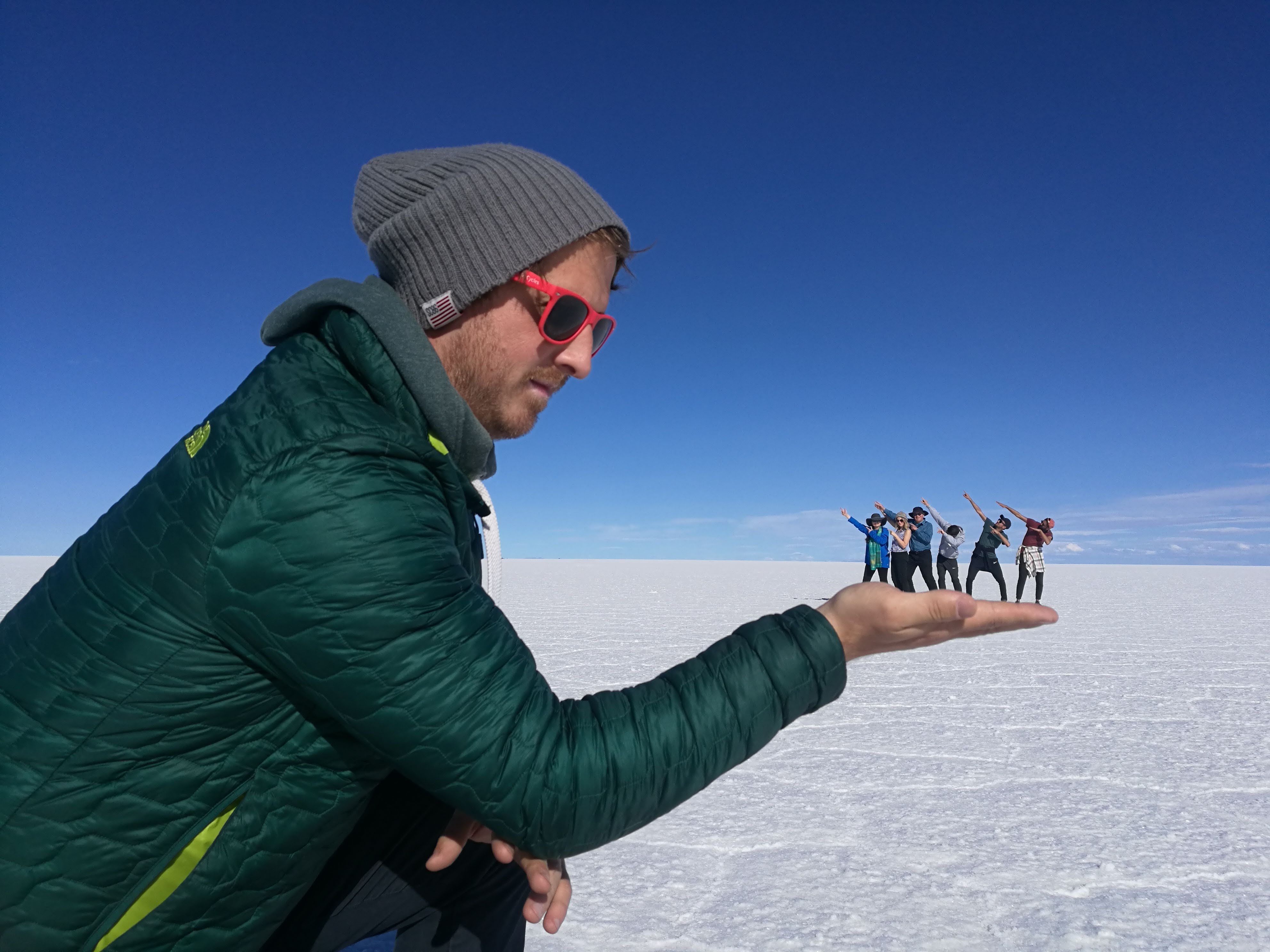
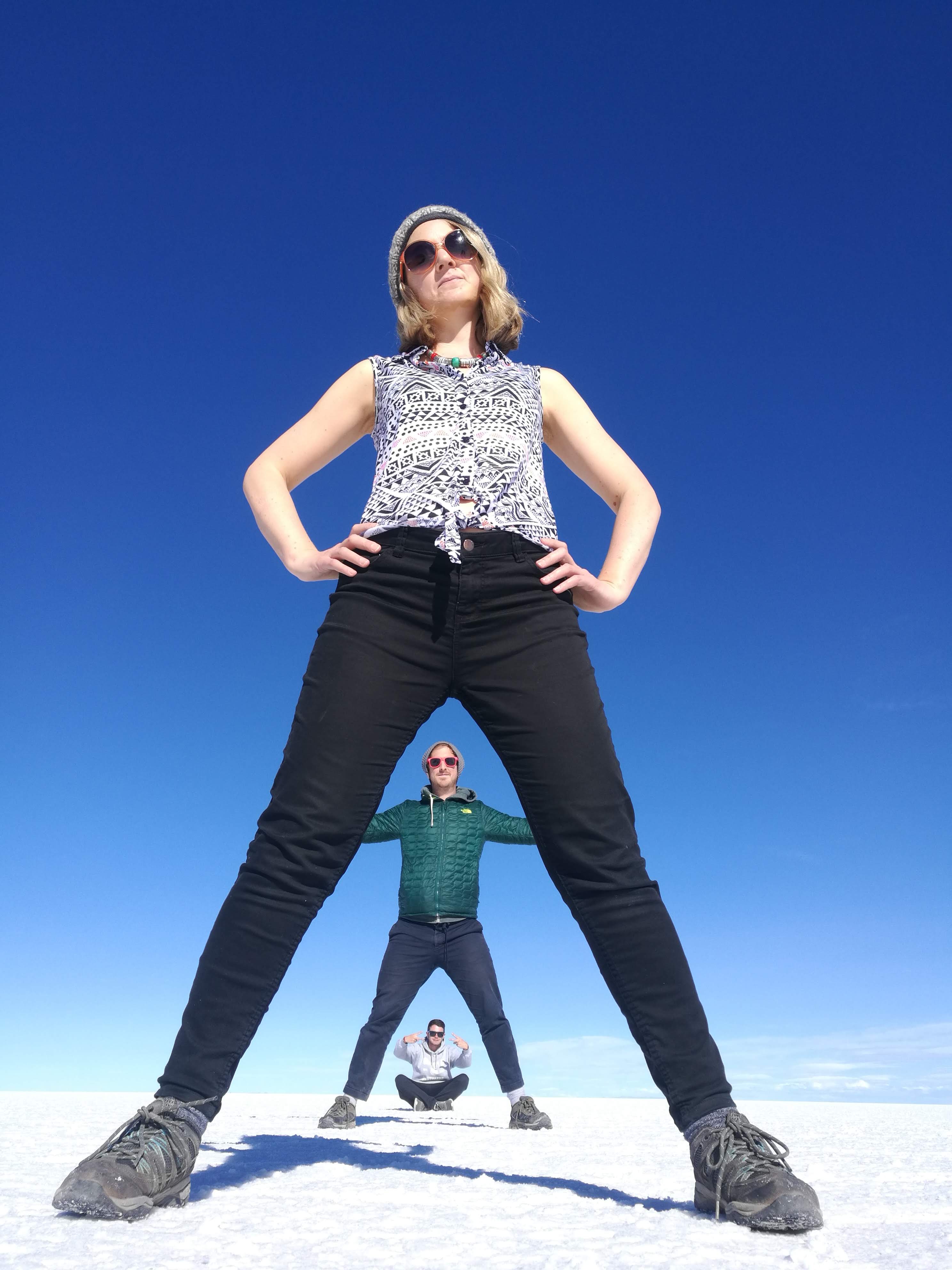
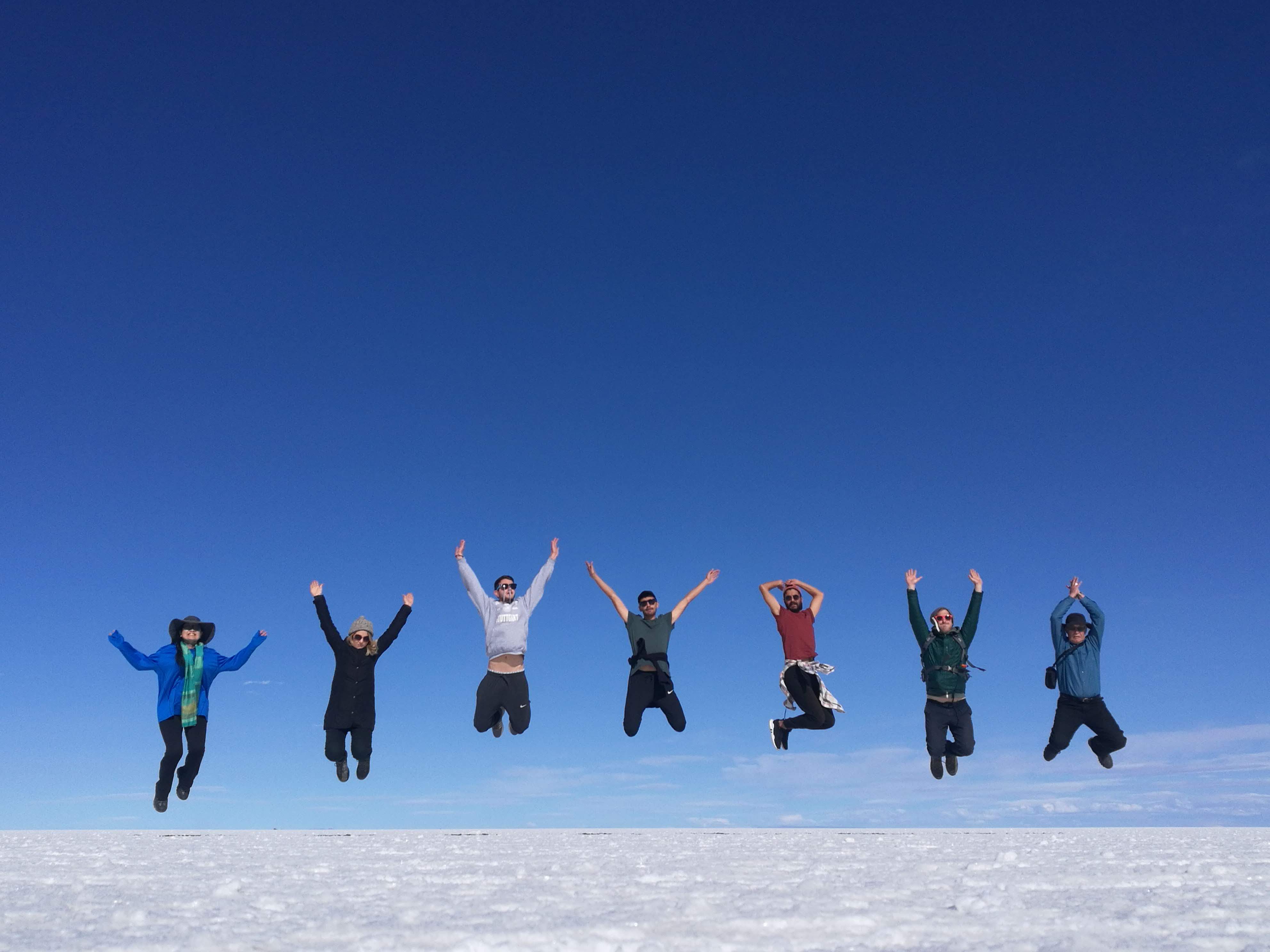
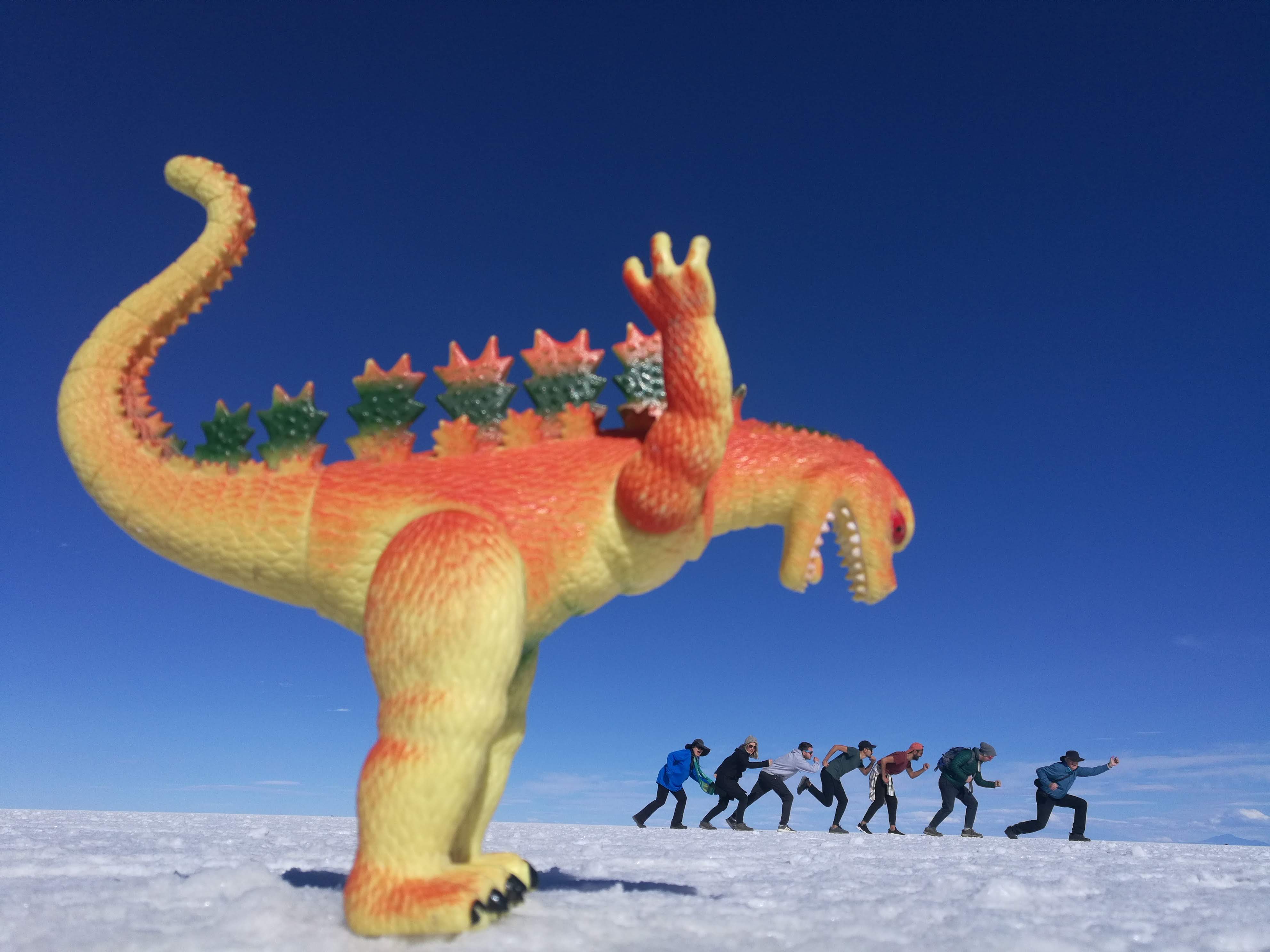
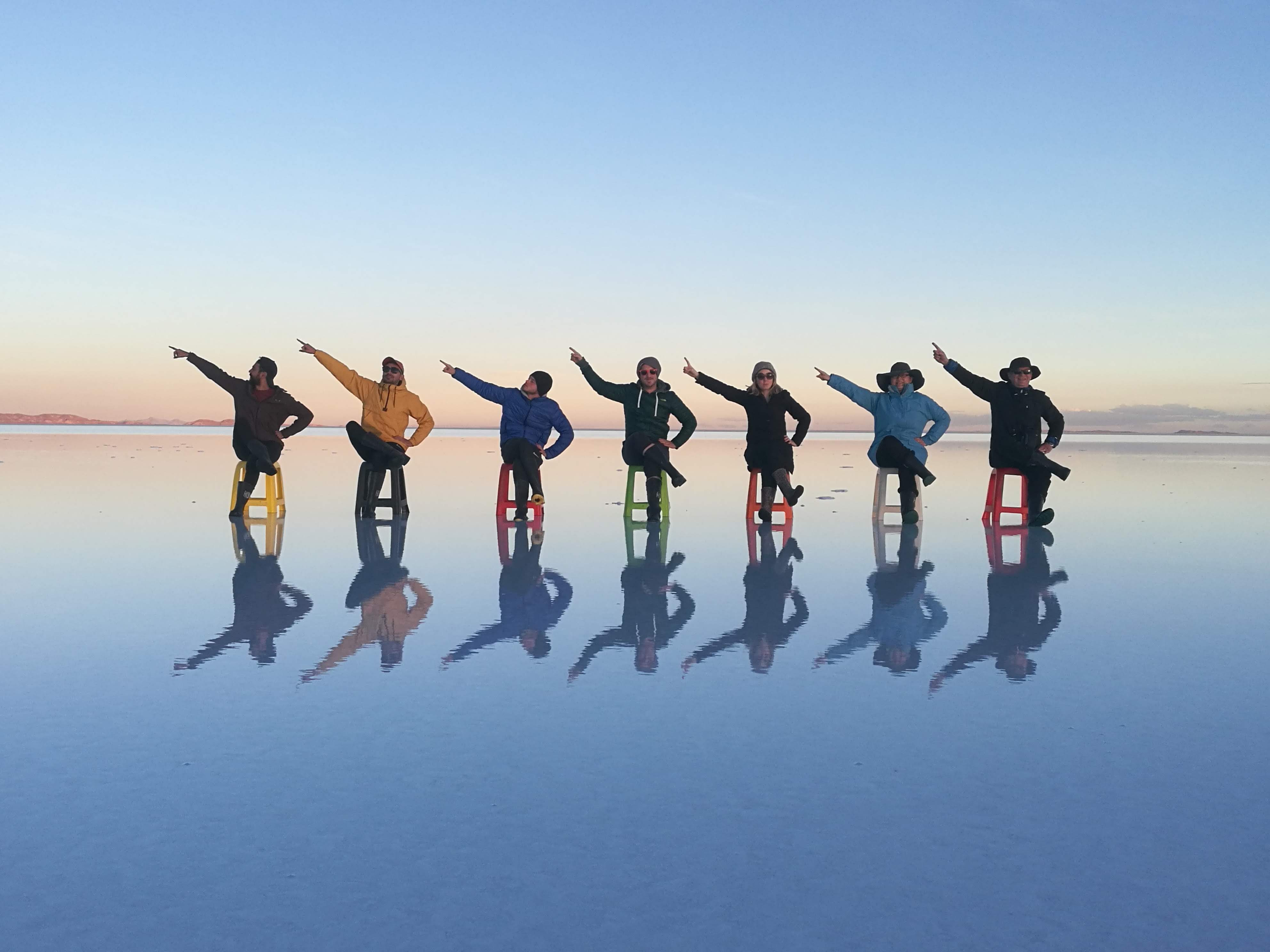
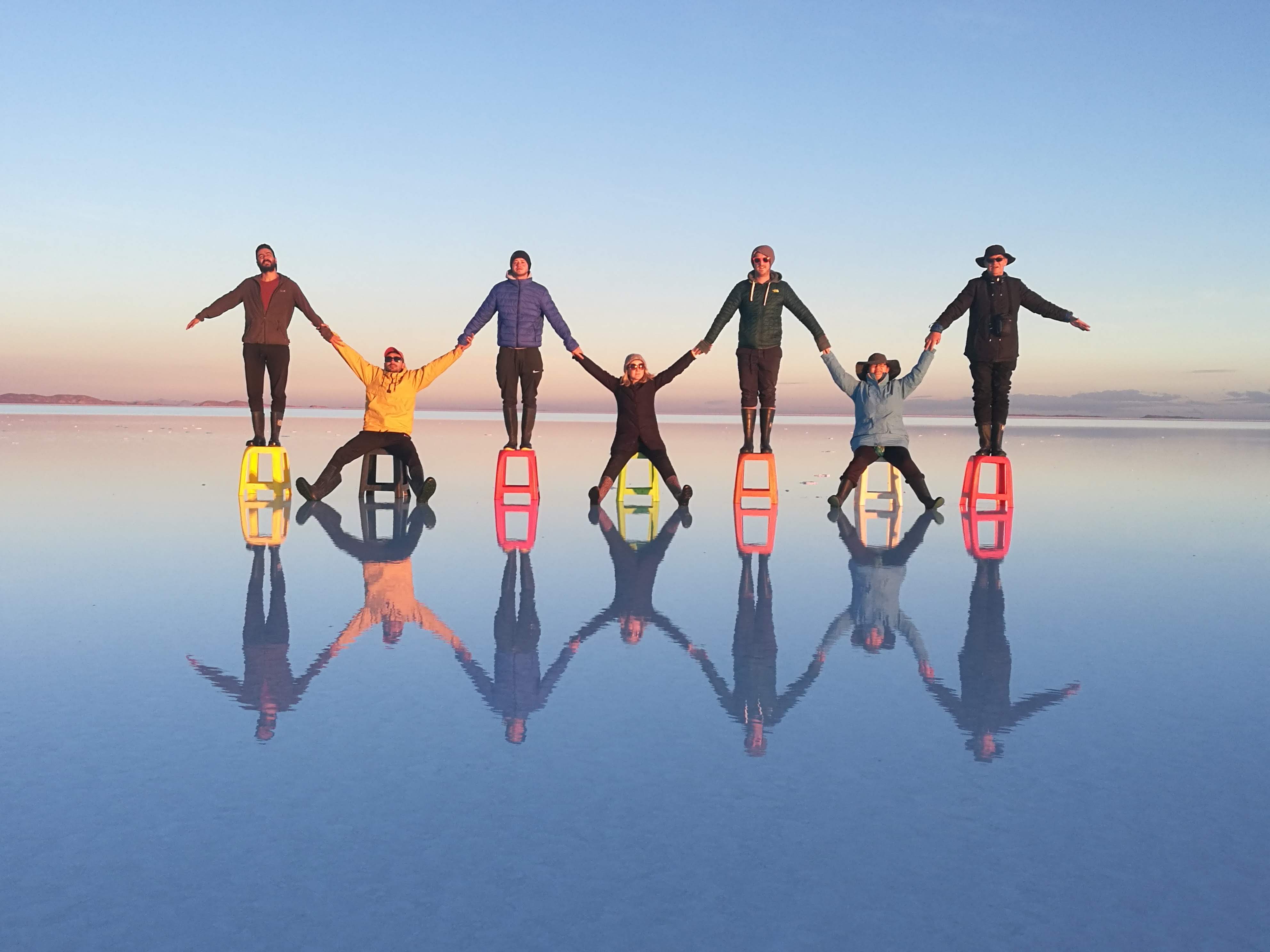
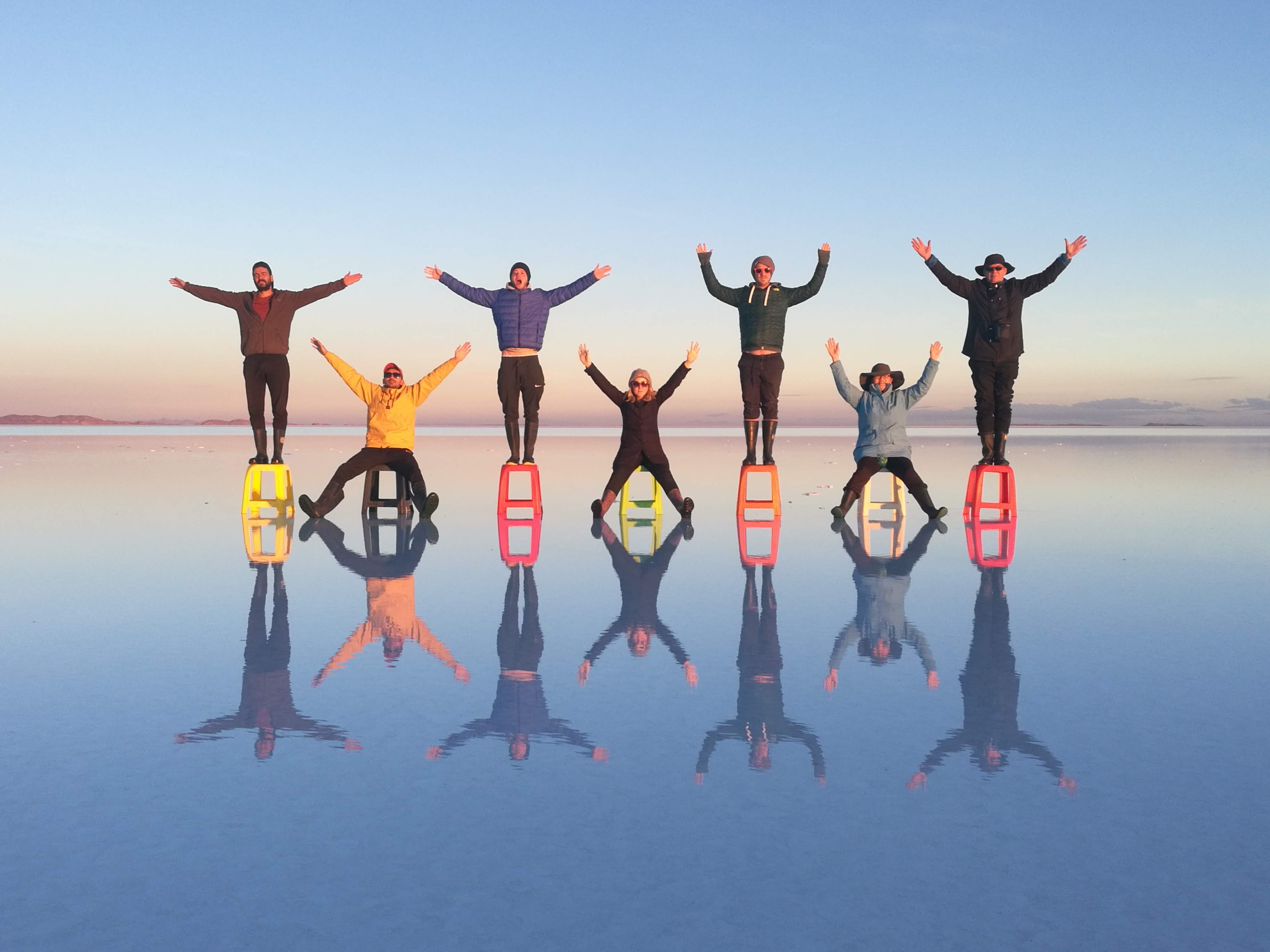
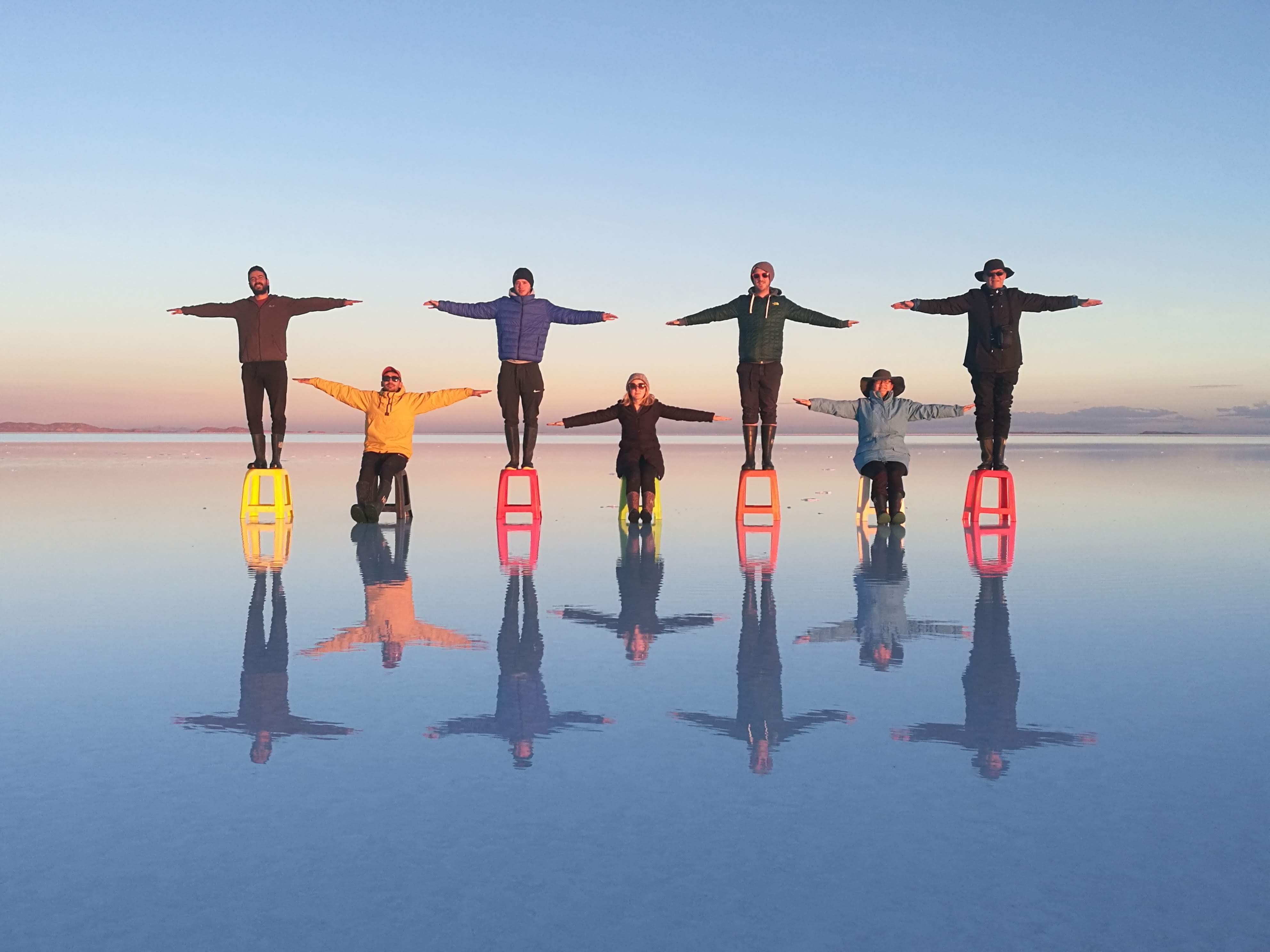
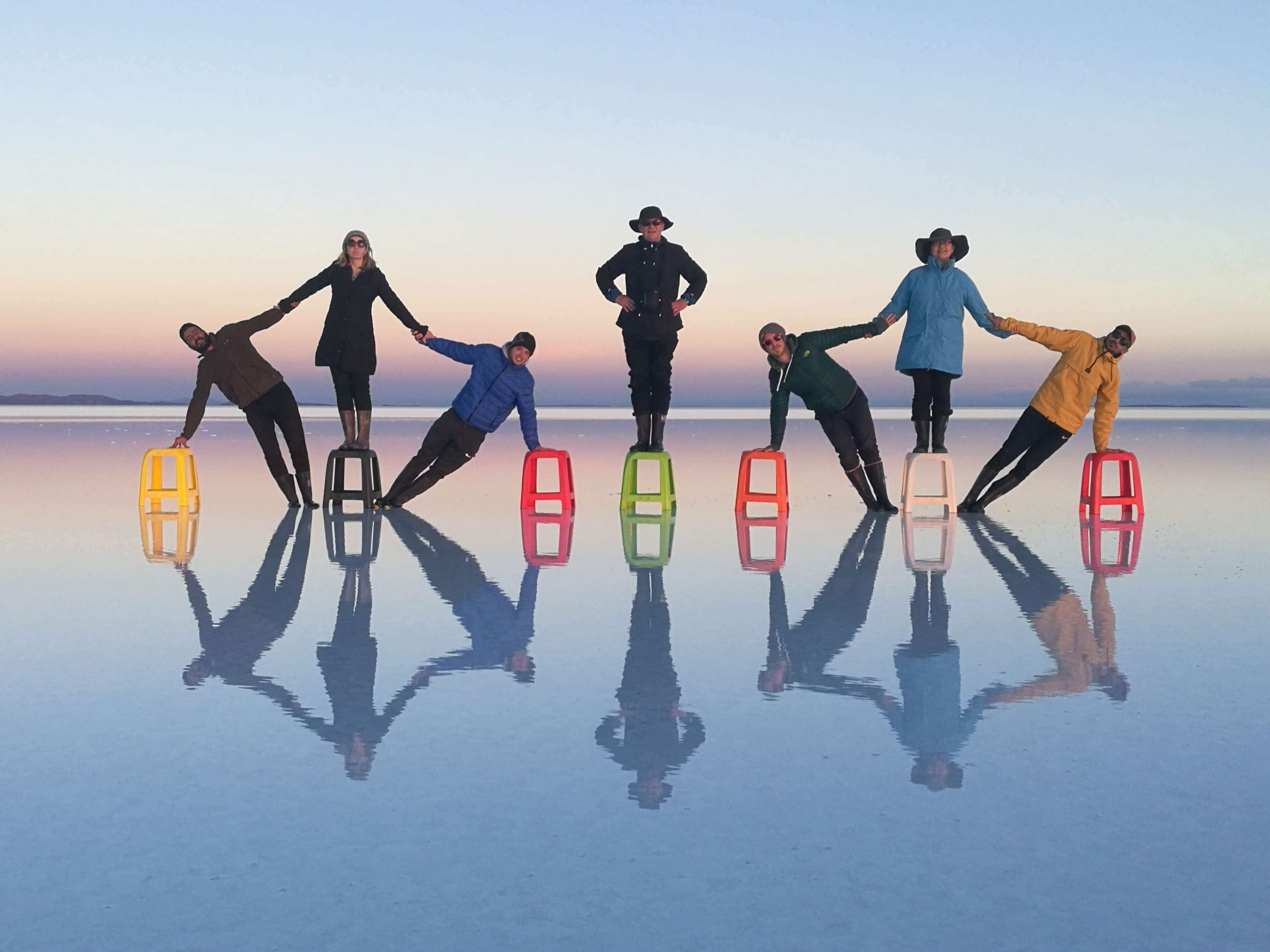
At this point our driver’s latent abilities as a trick photographer extraordinaire emerged. He bossed our party of seven into a variety of improbable poses. As we couldn’t see how things were working out at the time – he took our cameras and snapped the photos for us whilst we focused on the posing – we were all a bit bemused as our photo shoot stretched towards half an hour and our limbs began to seize up after contorting ourselves into another Ussain Bolt-inspired pose, bolstered by a variety of bizarre props.

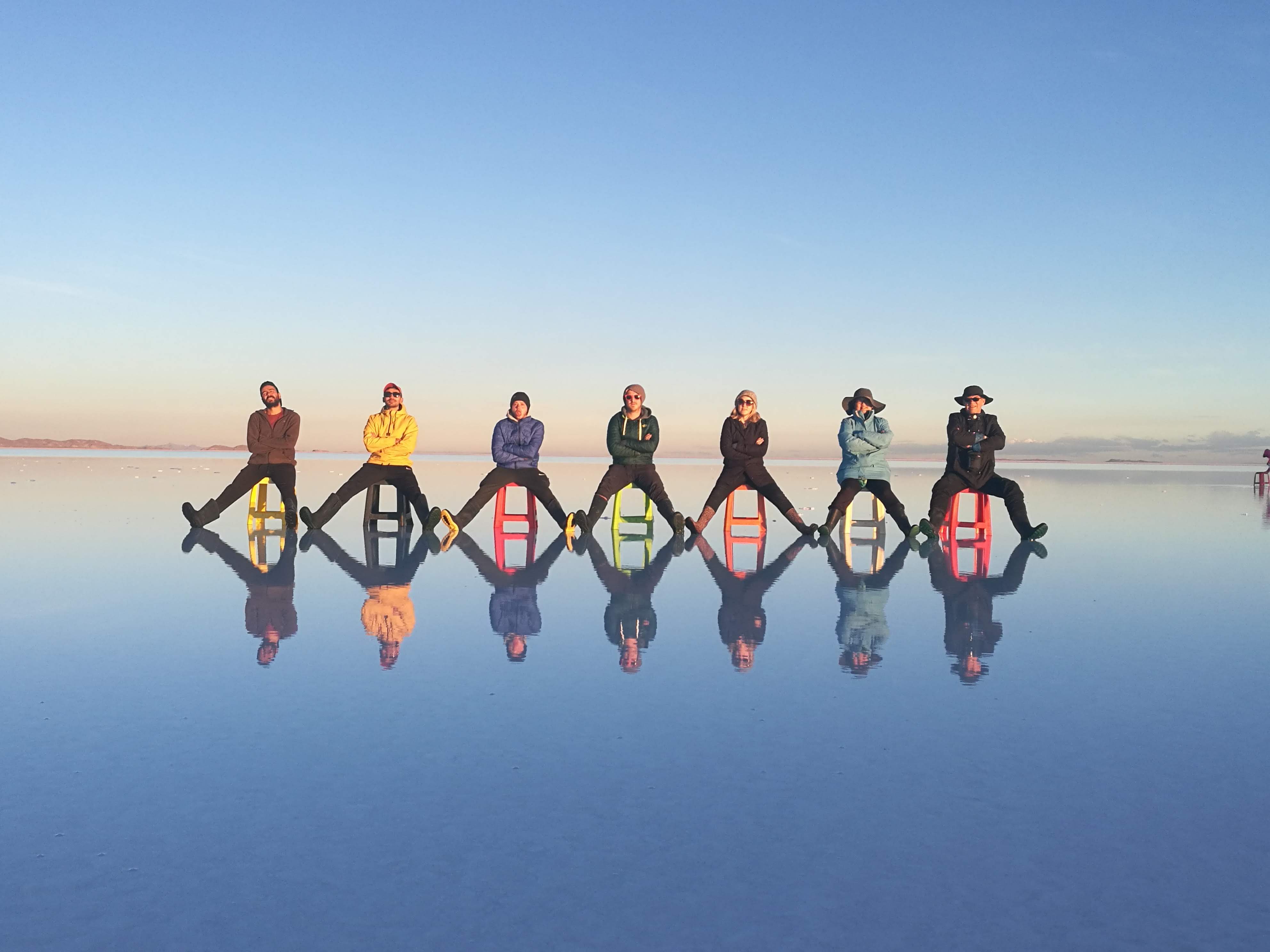
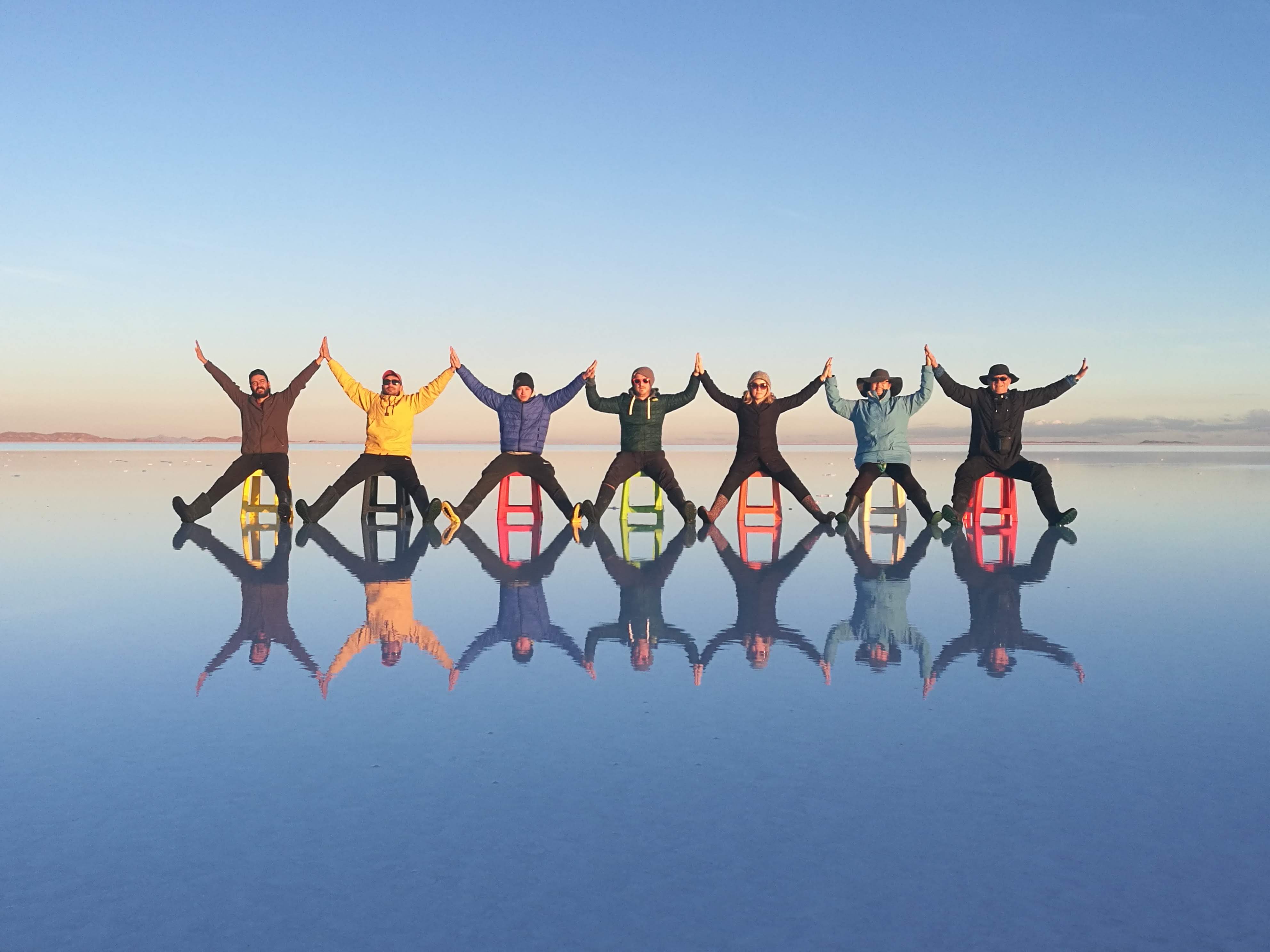
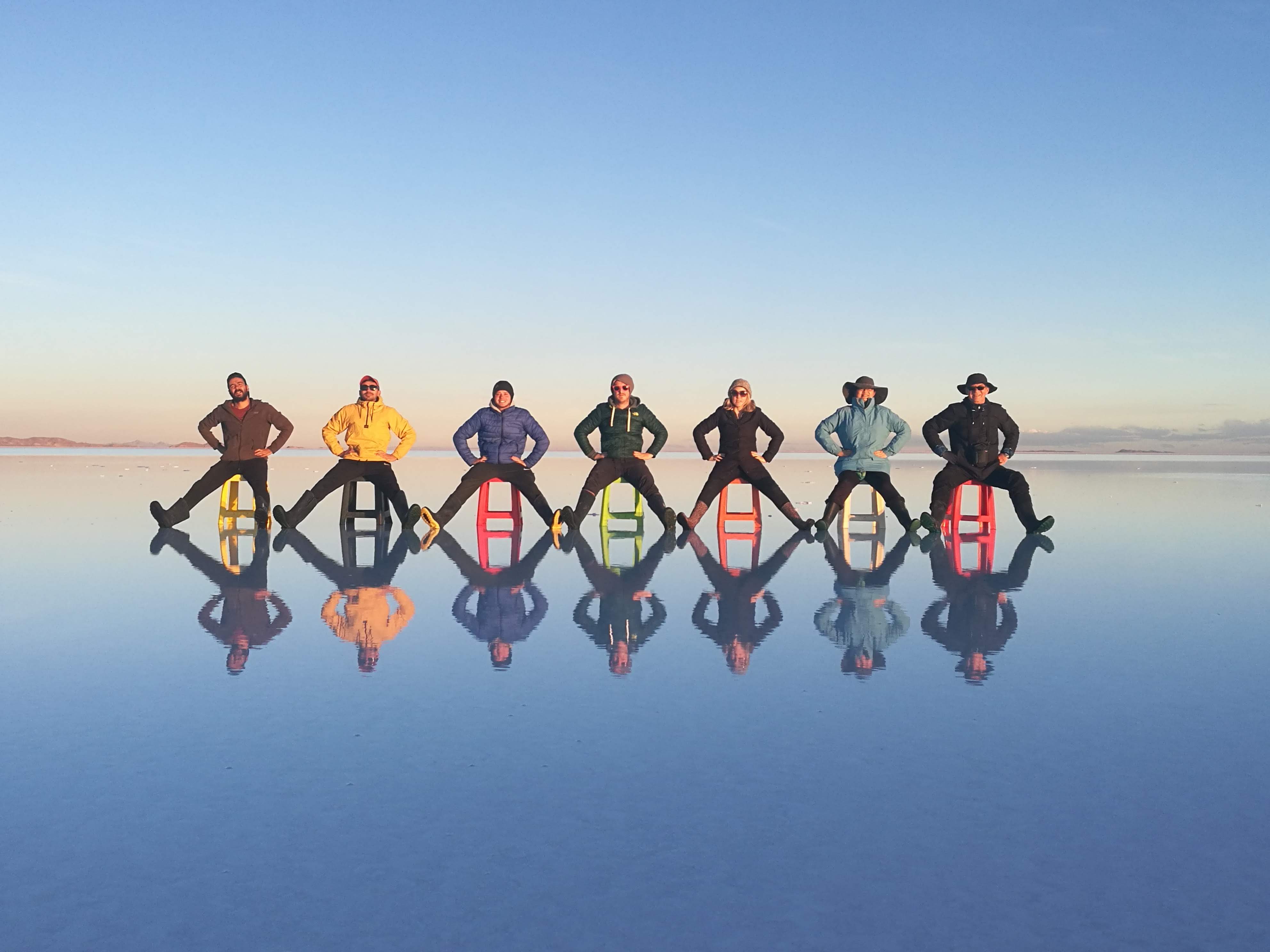
You’ll see the results are pretty unique and amusing. Little had we known we were being driven around by such a creative genius. After stopping off at fish island – one of the few spots in the flats with any vegetation and hence a few birds and viscachas (little rabbit things) – we headed to a waterlogged area where our maestro produced seven coloured picnic stools and set about positioning us frantically for more photos against the clock as the sun started to set. This was all good fun – by now we were used to his direction and after seeing the earlier photos we all knew he was skilled in getting results!

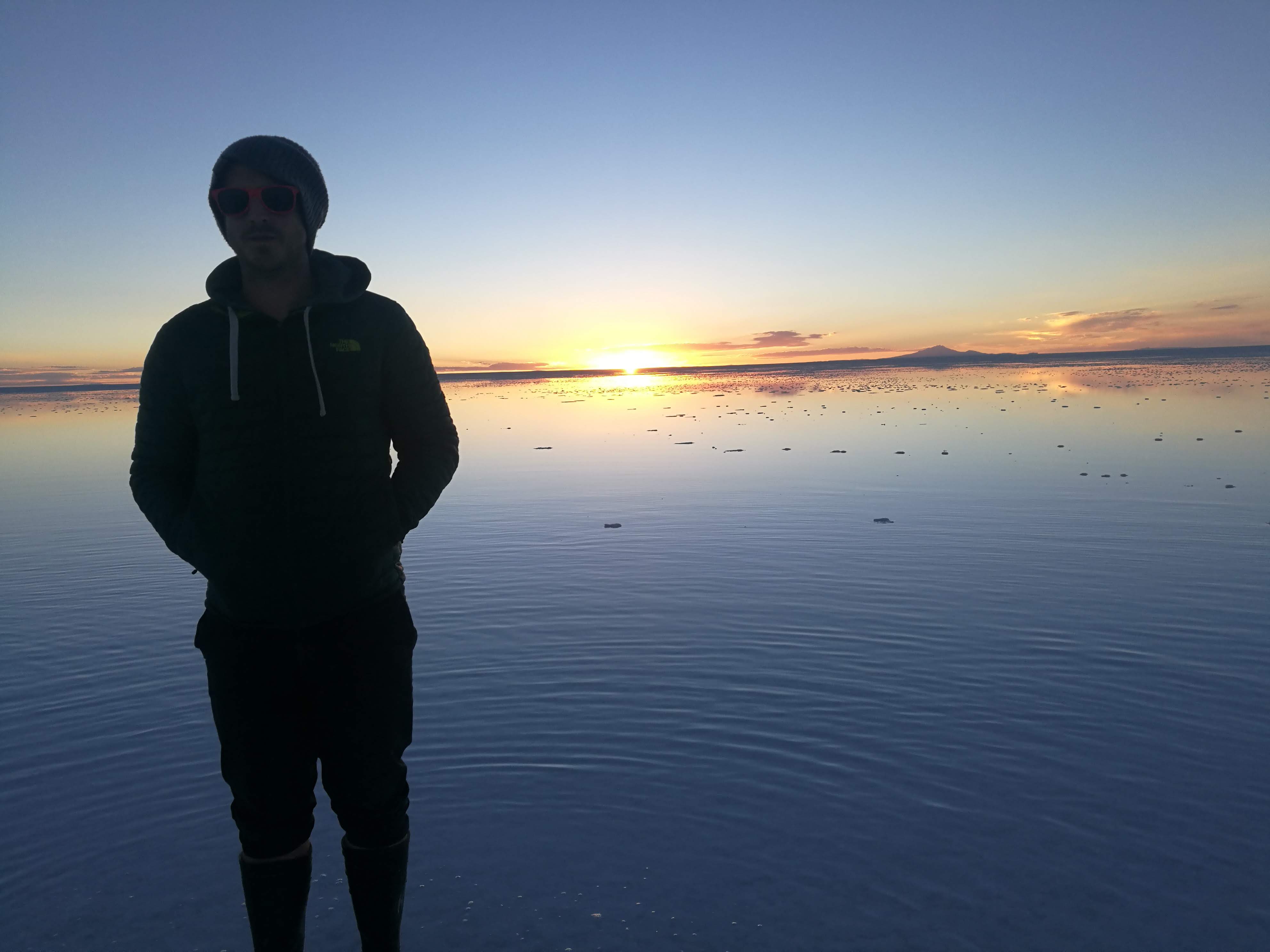
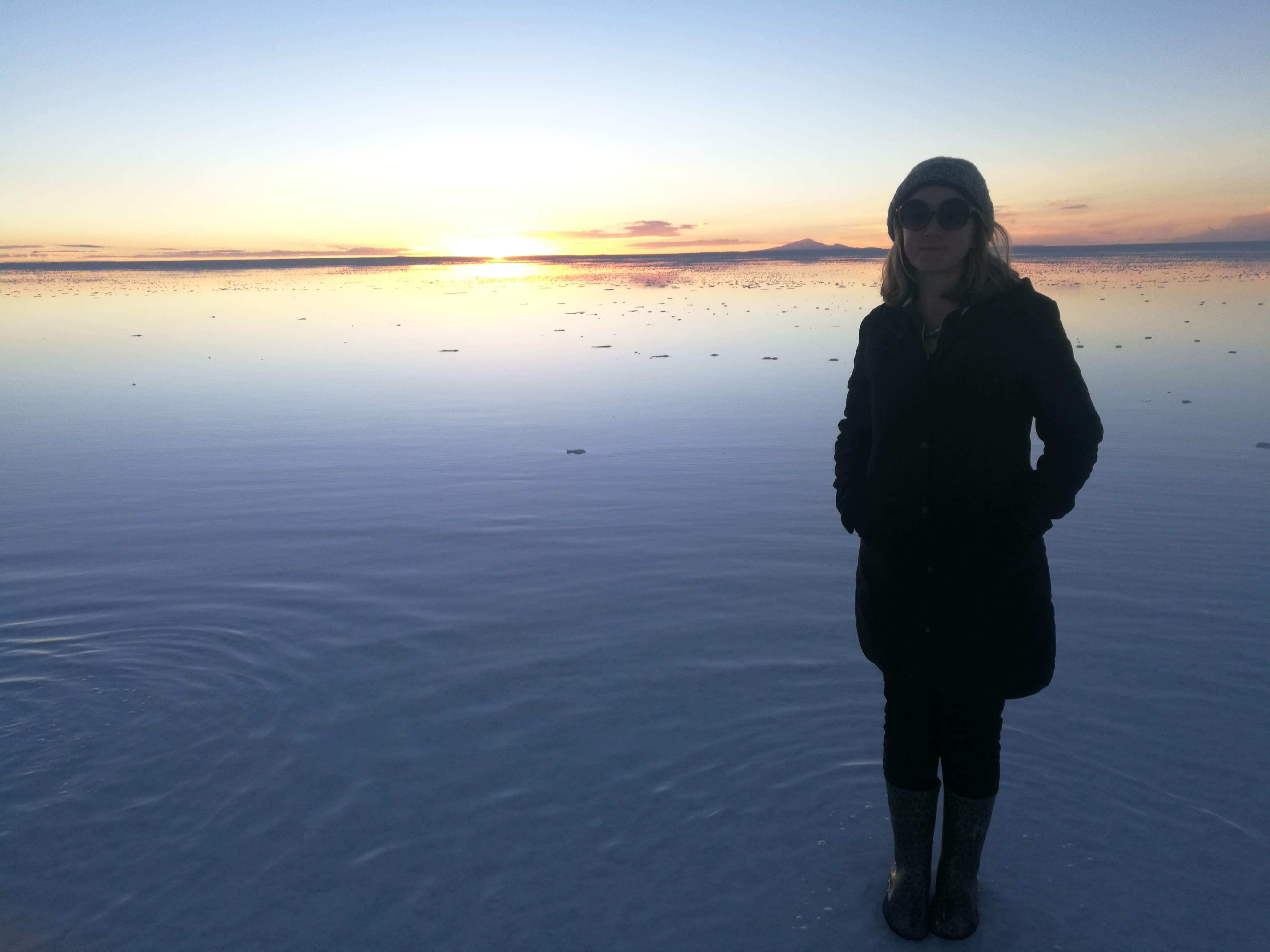
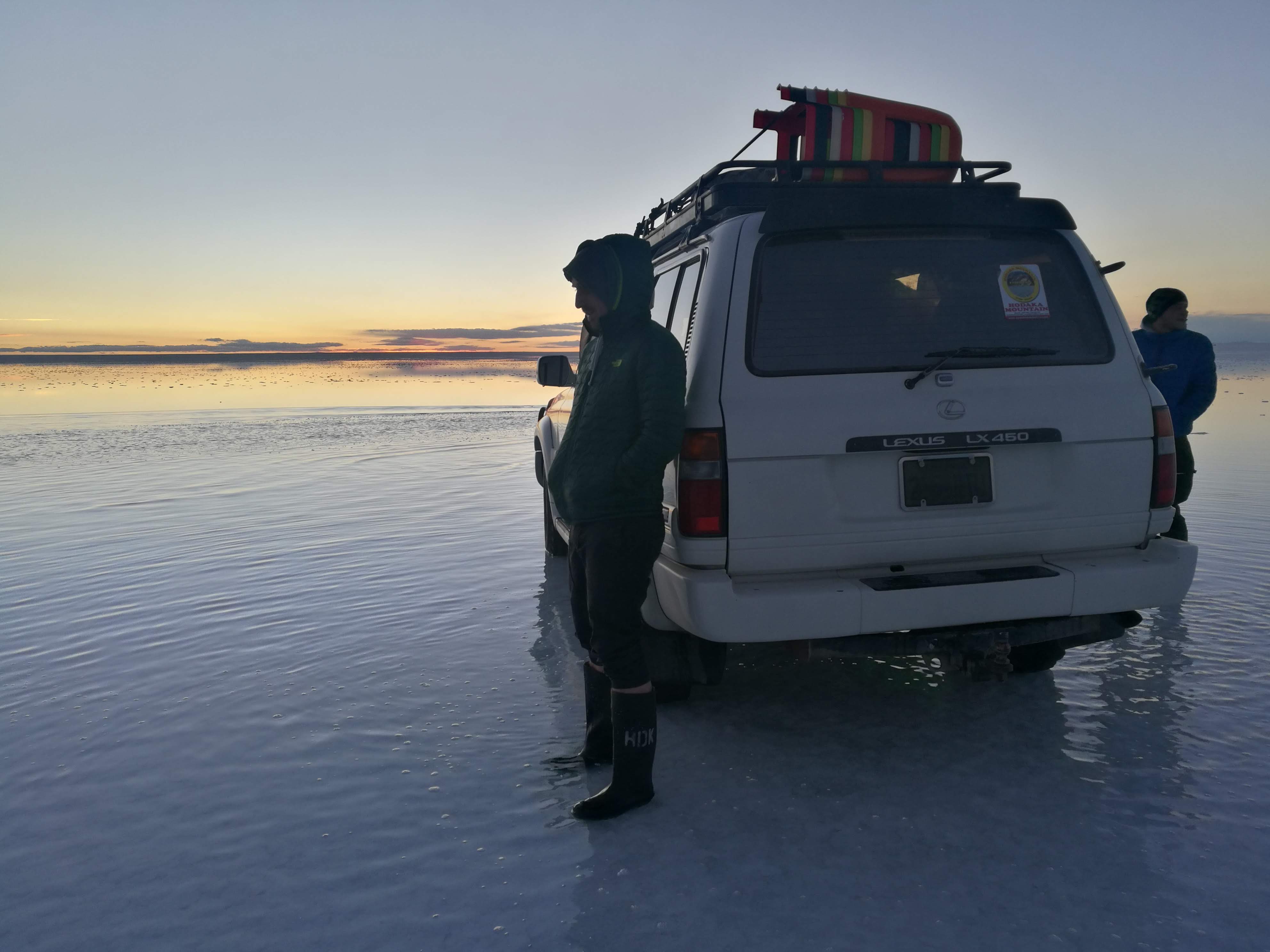
The sun setting across the flats was as mysterious, romantic and epic as the photos hopefully depict. We drank this view in, listening to the chatter emanating from other similarly entranced tourists huddled around the other vehicles dotted around. Our driver was keen to get moving quite quickly. We hadn’t realised that once the sun was gone, due to the total lack of lighting, signs or landmarks out here, he would be screwed in terms of getting us back onto the highway and back to Uyuni if he left it too long. He drove at quite a pace, following another vehicle through a couple of tyres dumped to shepherd vehicles towards the ‘way out’. We enjoyed swapping travel tips with our fellow travellers on the way back to town and, although knackered after a long day, were so pleased we did this. A really unique thing to do and we can’t think of anything like this that we have tried elsewhere on earth!

Why you should take the train in Bolivia

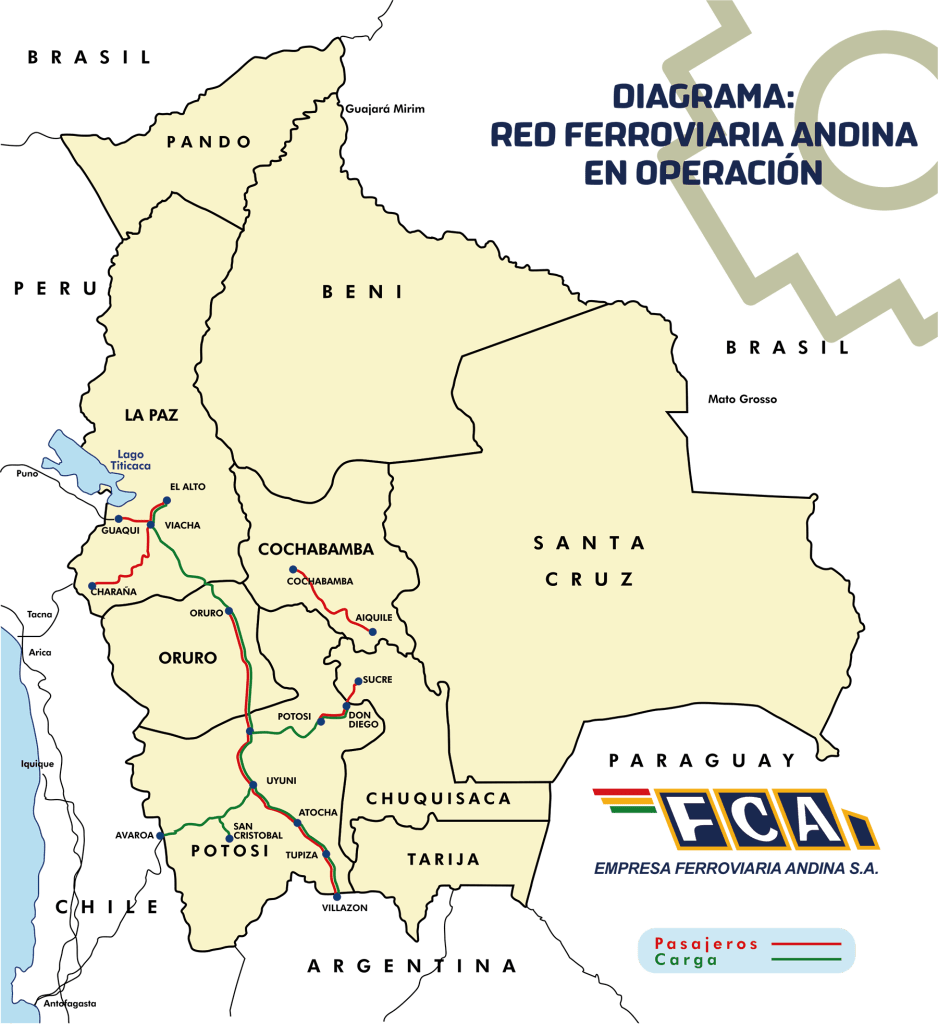
Tupiza is a dusty town in southern Bolivia built on mining and farming. We took a hair-raising minibus here from Villazon – the first town you get to after you cross the border from Argentina – and stayed a couple of nights. There are no big tourist draws unless a niche interest in the Wild West has lured you here and you fancy taking a tour to nearby San Vincente where Butch Cassidy and the Sundance Kid supposedly met their ends many moons ago. We used Tupiza mainly as a base where we could adjust to a higher altitude before heading yet higher. At 2850m it was a slight step down from La Quiaca – our final stop in Argentina – but lower than the places we would be staying over the coming month or so.

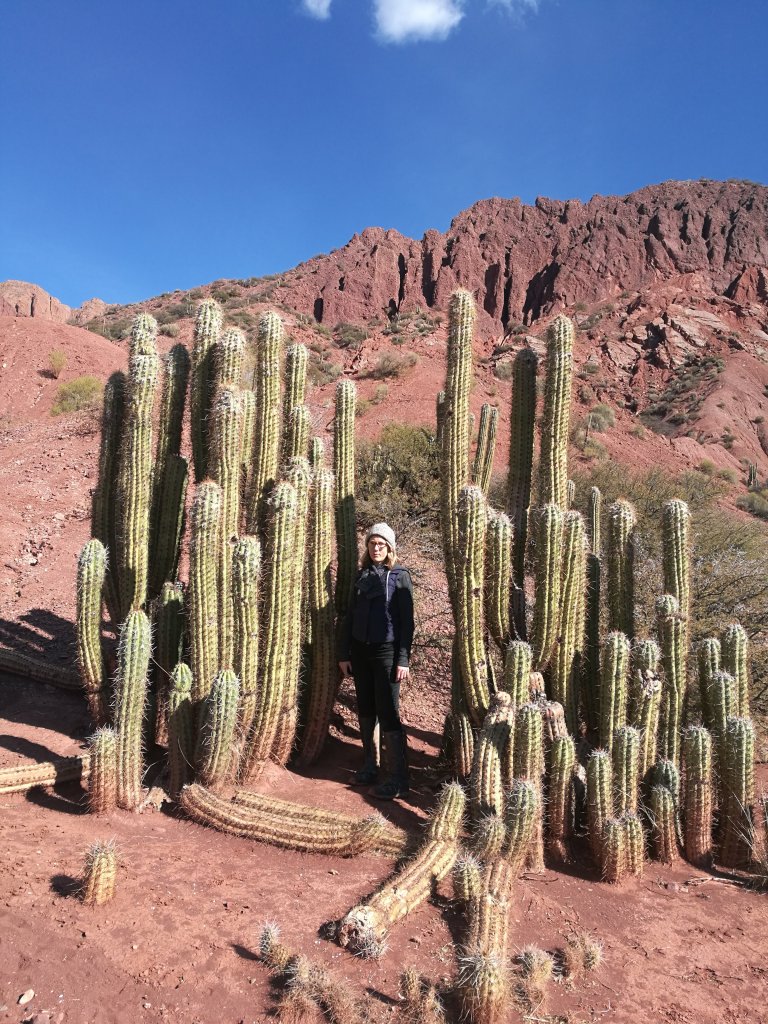
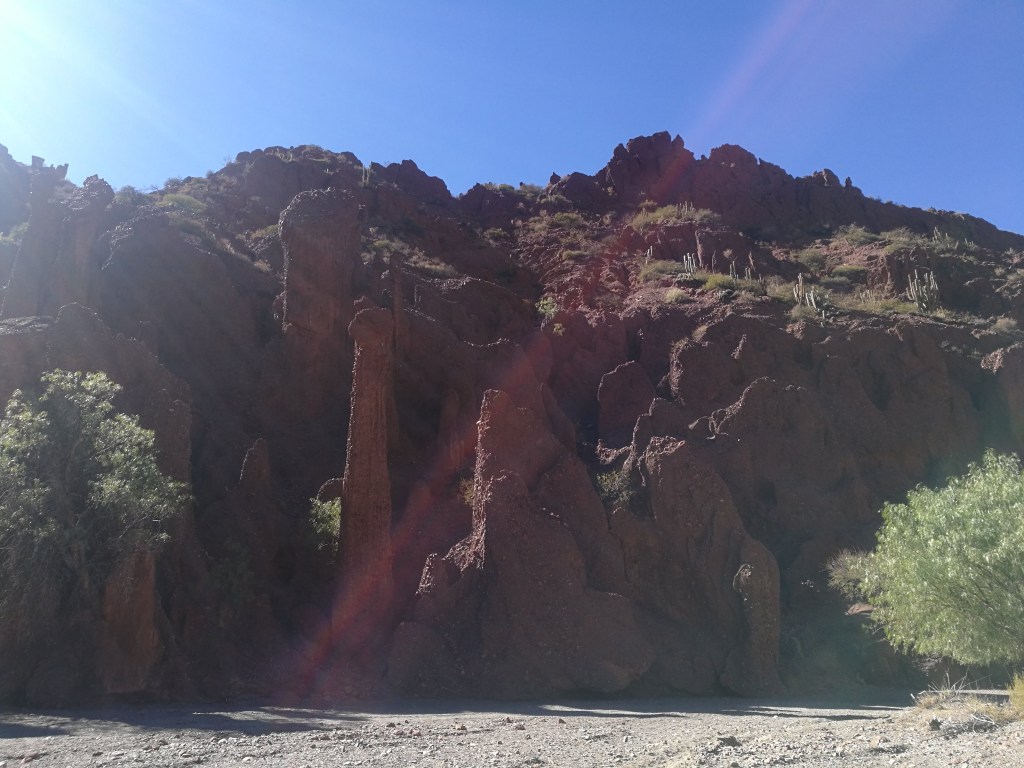
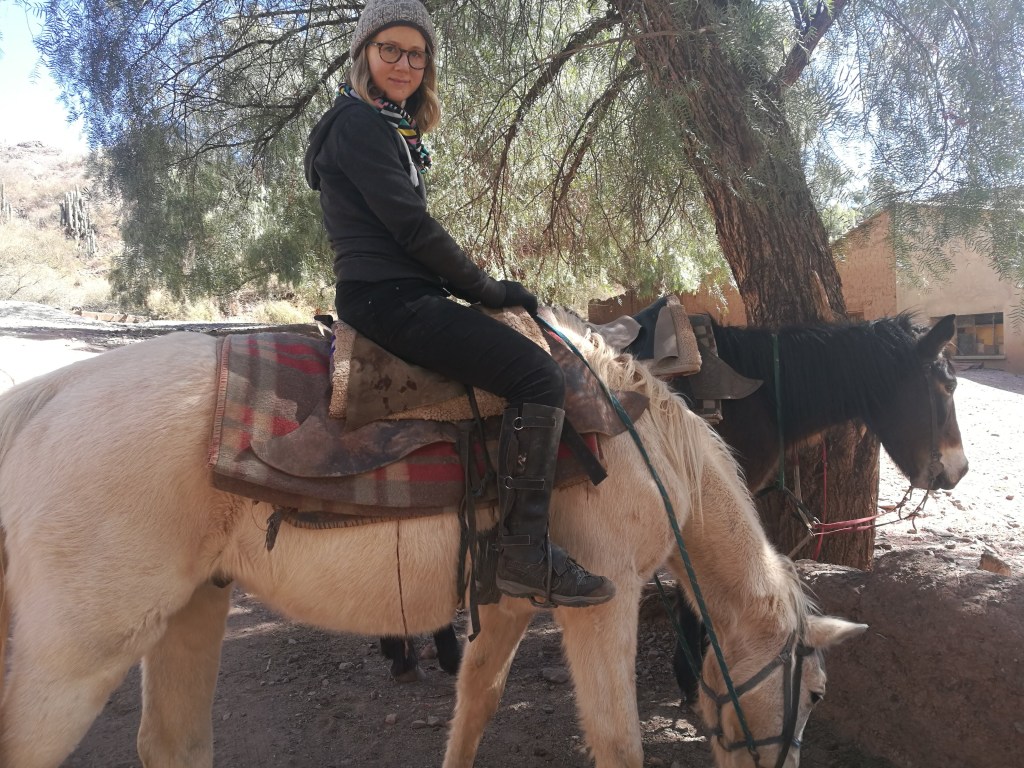
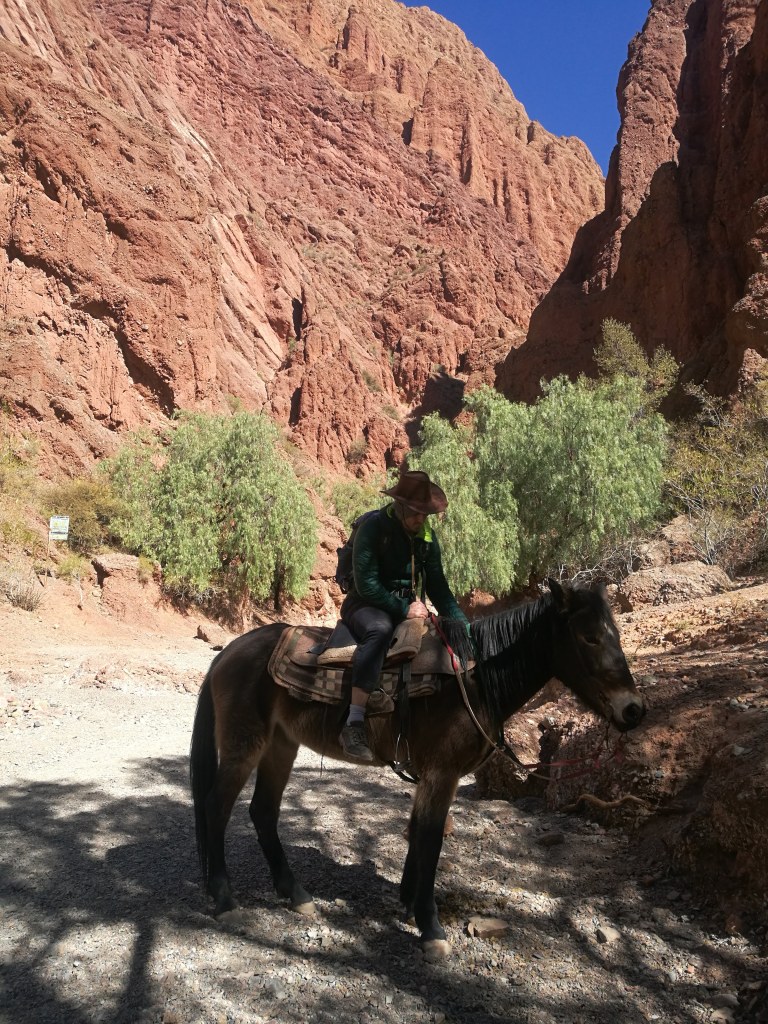
We did a bit of horse trekking amidst some stunning scenery just outside town and by the end we could both just about get on and off our steeds in something resembling a dignified manner.

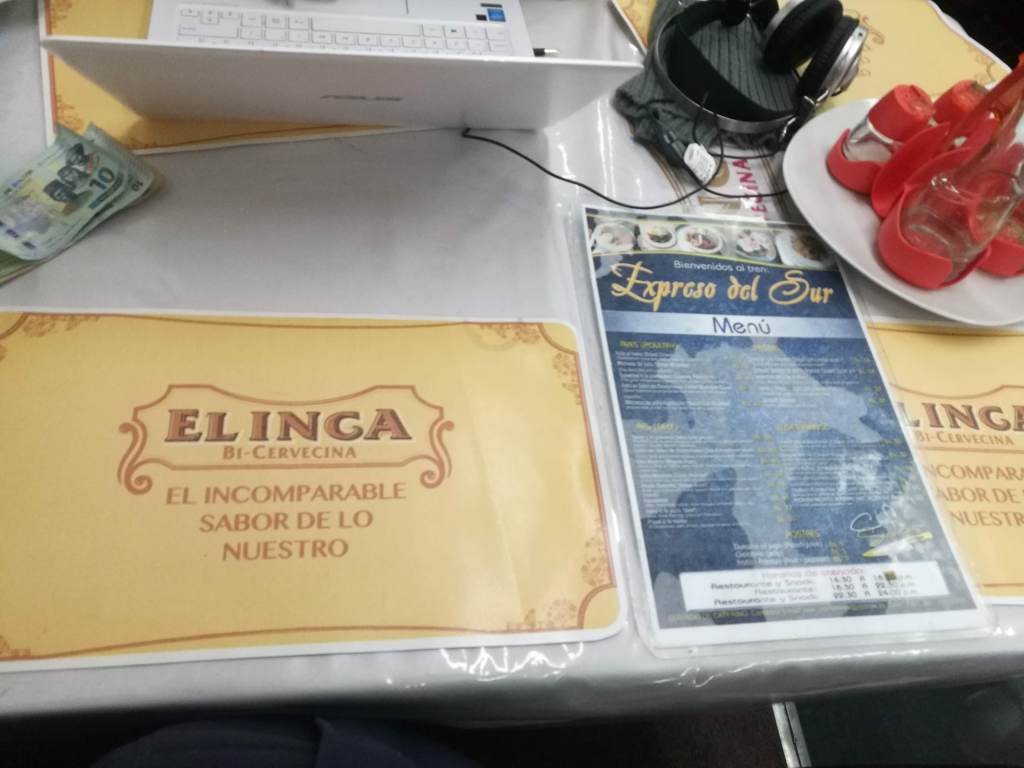
We also explored the local rabbit-warren of a market and took in numerous Copa America quarter finals – all of which seemed to end in penalty shootouts! The rhythm of the town seemed to match the arrivals and departures of the two train services – the Wara Wara del Sur and the Expreso del Sur – which is always interesting to observe if you’re not rushing to get one of the trains yourself.

Services are relatively infrequent and take over two times longer than the local buses to reach Uyuni – gateway town for the famous Salar de Uyuni salt flats. Despite exhortations to avoid them by some online siderodromophobes, taking the train was one of the best decisions of our trip so far.

At the station, once we’d given our backpacks to the guard in the luggage car in exchange for luggage tickets, we made our way to our allocated seats. Trying to remain true to our no wastage budget traveller ethic, we had booked into ‘Salon’ rather than ‘Executive’ class but the seats were still really comfy and with the heating on gently it was neither too hot nor too cold. The pan pipe interpretations of the Titanic theme and Bryan Adams classics emanating from the TV in the corner of the carriage were a bit shrill but the ambience was on the whole quite soothing and the perfect accompaniment to our dinner which was a giant omelette and chips shovelled into our mouths by hand (the vendor didn’t have a plastic fork).

About 30 minutes in, we noticed that lots of people had left their seats and not come back despite the train not stopping anywhere. Deciding that it was more likely that there was entertainment to be found elsewhere than that our fellow passengers had fallen through a hole in the floor of the train, we went to have a look and found A RESTAURANT CAR!!

A mini sound system, hot dinners being produced one after the other by an incredibly calm-under-pressure steward and cheap beer made for a lovely early evening atmosphere. We spent several hours in this welcoming pod, reading and trip planning before returning to our seats. Adam Sandler was oafing around whilst Drew Barrymore looked bored on a mercifully silent TV screen, the pan pipes having been given the axe. Most people dozed.

It was only at this point that we realised how slowly the train was going – maybe at 40mph – but also how remote and dark our surroundings were. The train’s headlamp and some light from our windows illuminated an endless expanse of rock, scrub and signs of people trying to eke out a living doing something or other on the land. But the astonishing view of the stars was something else. No clouds, no trees, no light pollution….the stars certainly didn’t look like this in SE22! The train company should big up this element of the journey more on its website (alongside the photos of gringos supping beer!!)

Of course, doing this trip in the middle of the day would be a totally different experience – you’d see more of the nothingness but you’d probably feel the effects of the sun beating down on the carriages with no respite out in the desert for hours. But it really was so magical to be able to see the stars while chugging along, the front of the train coming into view only when rounding a corner, that we’ll forget that we arrived an hour late into Uyuni and that our booked room had been given away to someone else 🙂

Las Malvinas

A big surprise during our time in Argentina was the prominence of the Falklands islands – ‘Las Malvinas’ in Spanish – in daily life and at places where Argentina’s identity as a nation is discussed, over 35 years after the conflict with the UK ended.

On day 1 we saw a huge ‘LAS MALVINAS SON ARGENTINAS’ (THE FALKLANDS ARE ARGENTINIAN) sign up inside one of the inner-city military compounds in Buenos Aires. This was a little surprising considering the Falklands War is so little discussed in the UK and the islands generally viewed as a bit of a far-flung, windswept obscurity back home. We’ve since seen lots of tactics – discussed below – being used by the government to keep alive the issue of who should own the islands. When it comes to our view on what should happen to the islands…there are good points on both sides so we aren’t making a definitive statement on that. Hopefully everyone can agree it’s a fascinating issue to study and that whatever happens in the future needs to be peaceful.

Argentina’s invasion in 1982 was, as explained so clearly in the museum we talk about later, arguably an attempt to shore up support for the dictatorship, coming just days after huge anti-junta protests across the country. That the future of the islands was hijacked by a now-discredited, even hated regime is a cause of great regret to the present authorities, it seems, with this big mistake undoing years of supposed slow and careful soft power work under Perón and others to win the islands back peacefully.

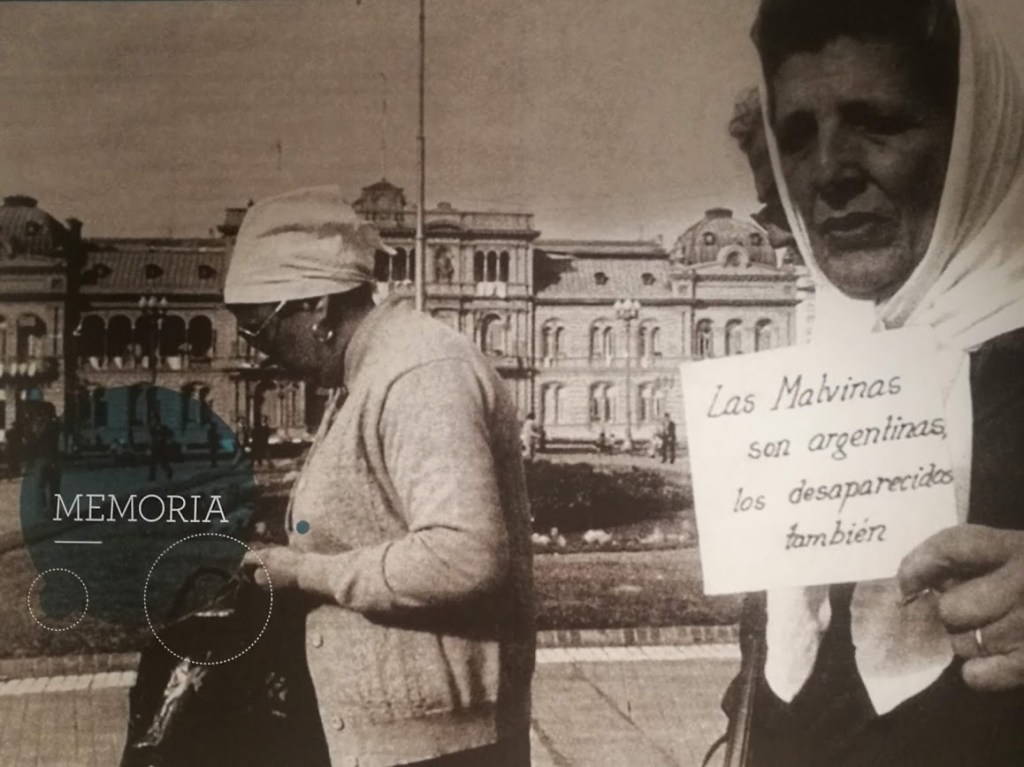
The Falklands issue has been kept ticking over by the Argentinian government with more activity coming post the 2001 economic crash. Training peoples’ minds on an external enemy or injustice is of course a strategy used by those in power the world-over to deflect attention from domestic problems and encourage nationalist sentiment by shifting the focus to powerful narratives about a country’s future. An added twist in the Argentinian case is that even some of the staunchly anti-junta mothers of the disappeared rallied behind the dictatorship’s campaign to win the islands back.

‘The Falklands are Argentinian, the disappeared as well’

Anyway, what specific tactics have we seen being used?

  • 50 peso bank notes featuring a map of the islands being introduced to mark the 33rd anniversary of the war in 2015
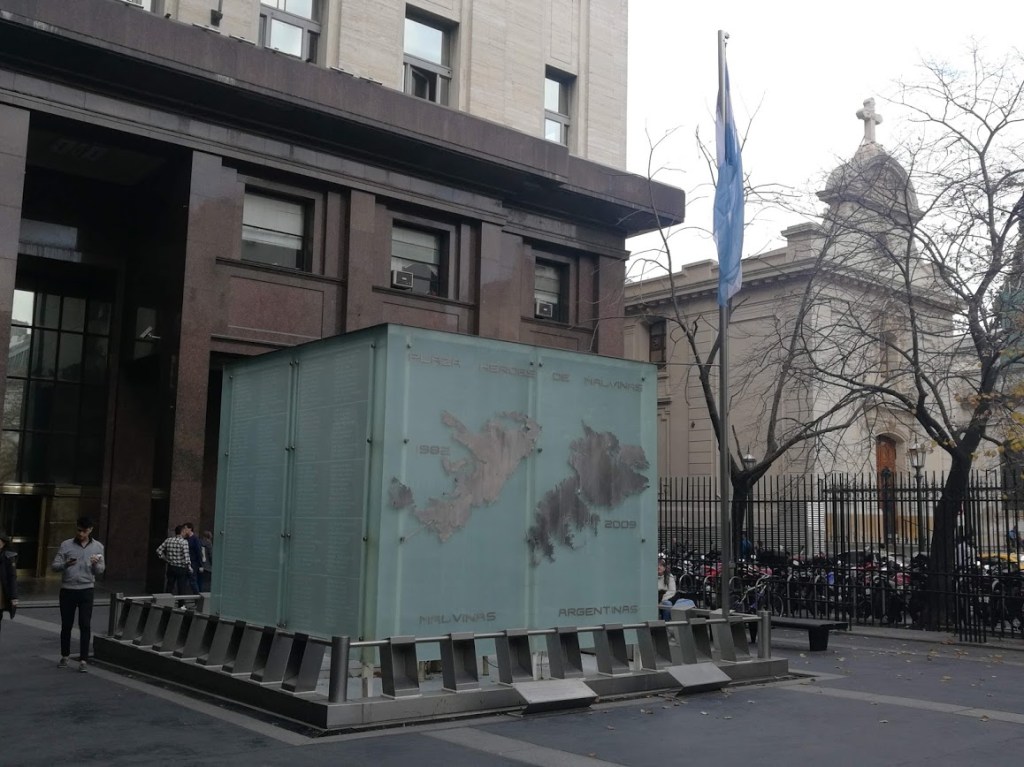
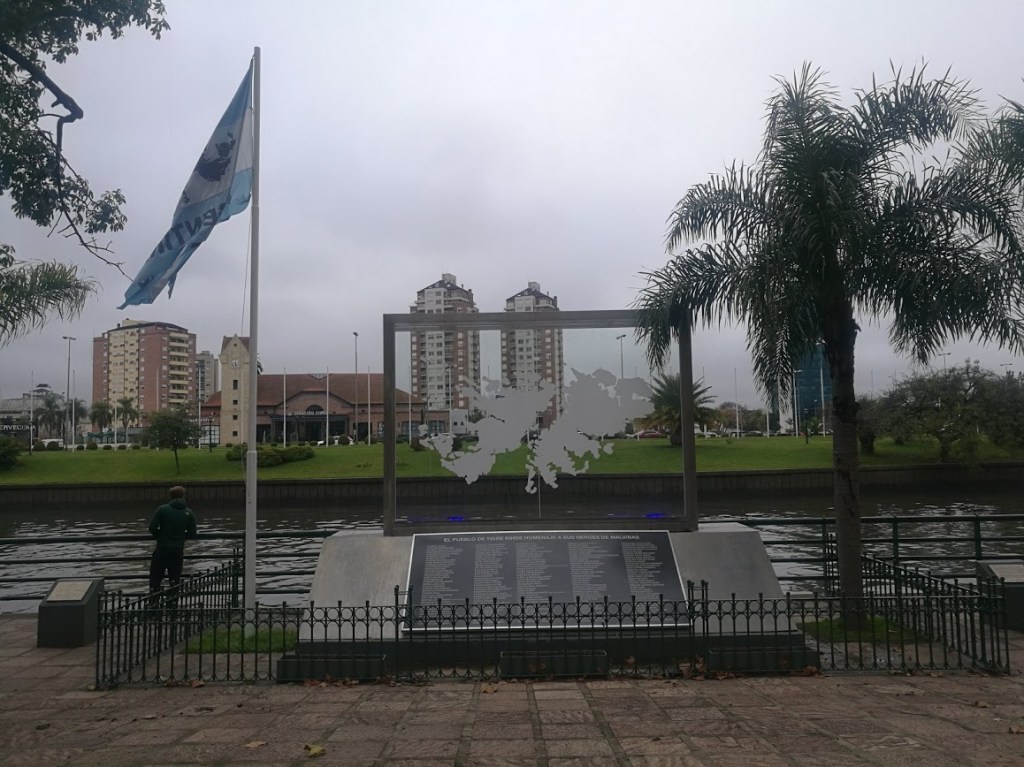
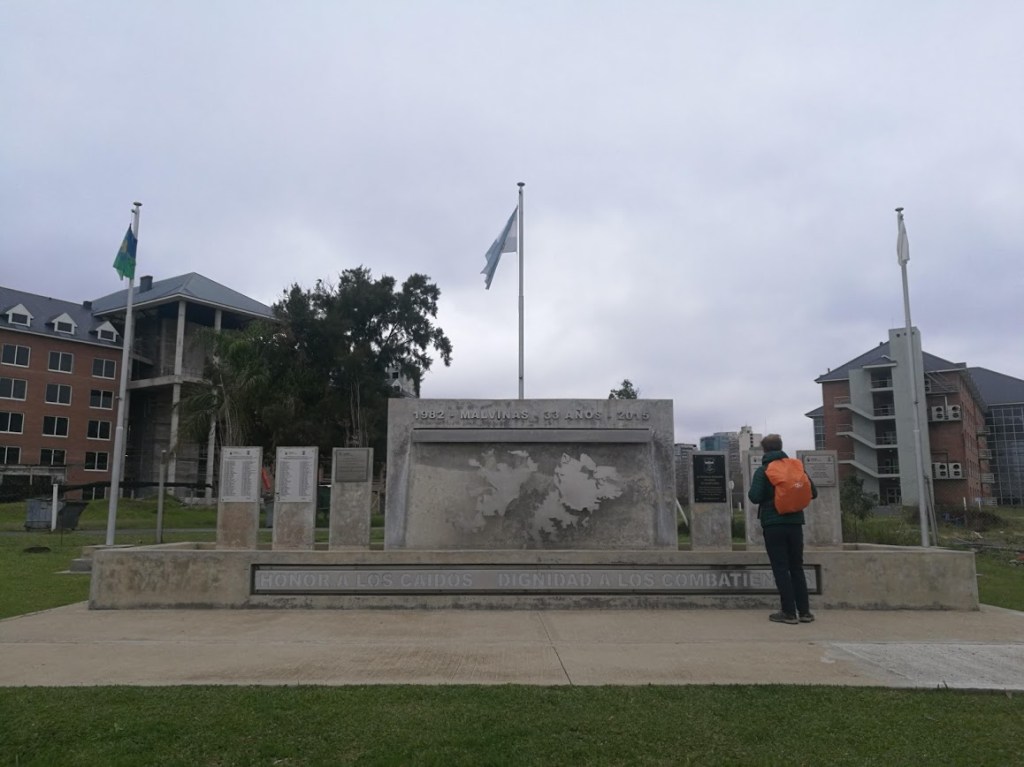
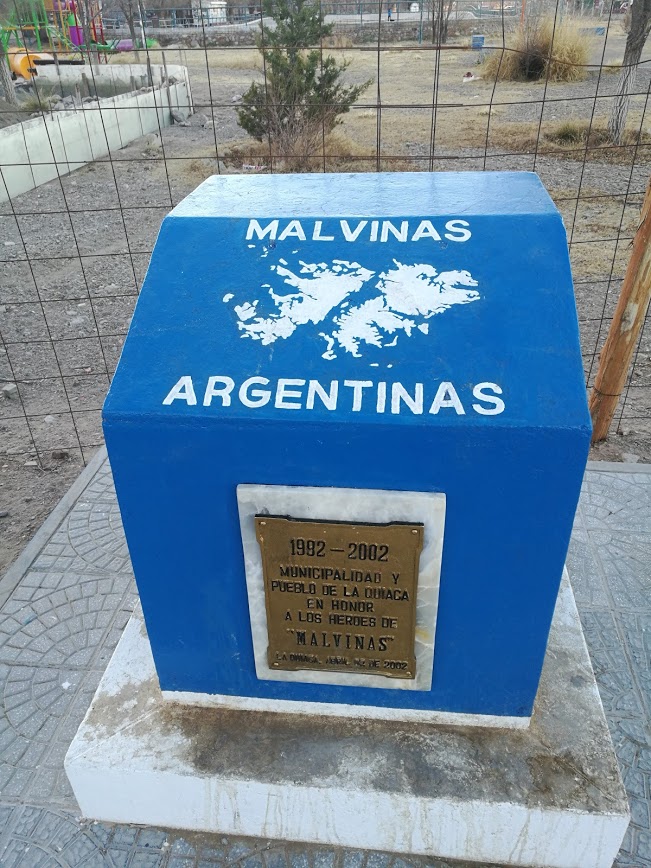
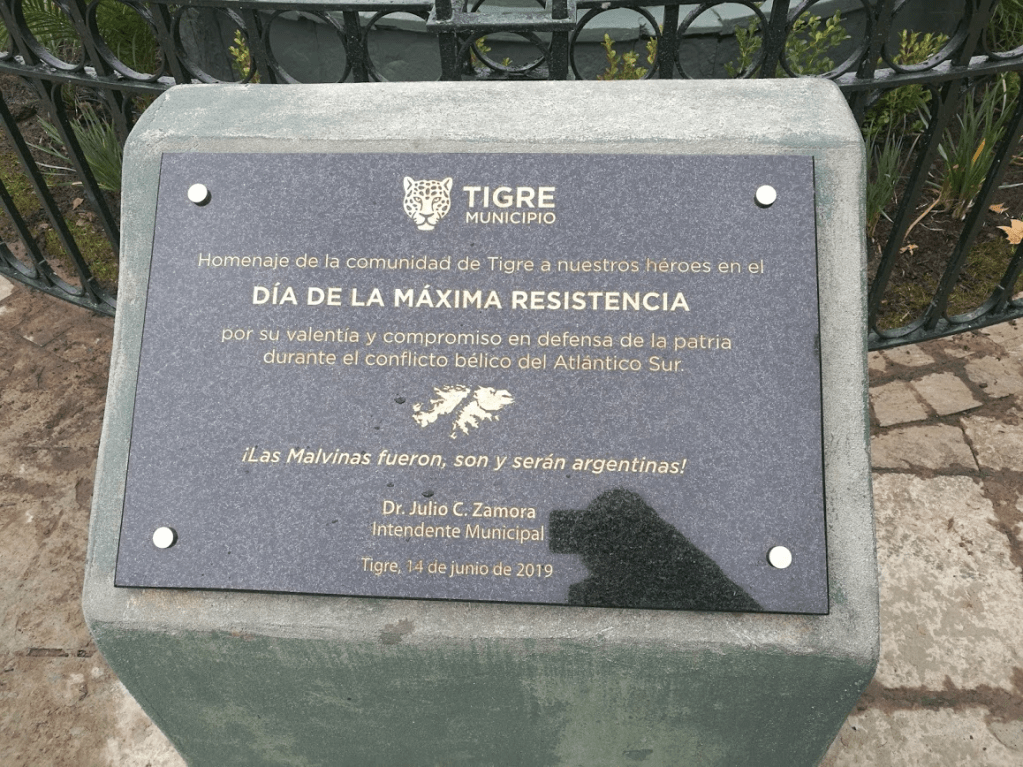
  • A glut of apparently new memorials to the fallen heroes of the war – we stumbled upon the opening ceremony for one in Tigre, a small delta town 45 minutes away from Buenos Aires. This involved a large gathering of veterans and others in uniform. The memorial was being opened to mark the 38th anniversary of the ‘Day of Maximum Resistance’ – the day when Argentinian troops continued to fight after Argentina had officially surrendered. It reads ‘The Falklands were, are and will be Argentinian’. We also found memorials in most other towns and cities we visited.
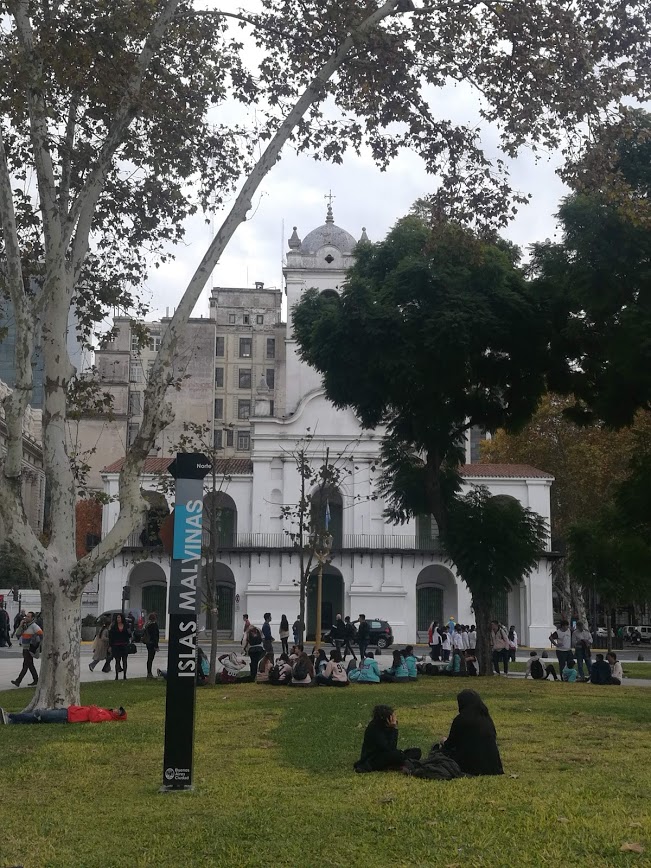
  • Information pillars quite incongruously placed in public parks in Buenos Aires giving details of the geography, flora and fauna on the islands
  • Public art on spare bits of wall all over the city depicting heroic wartime exploits

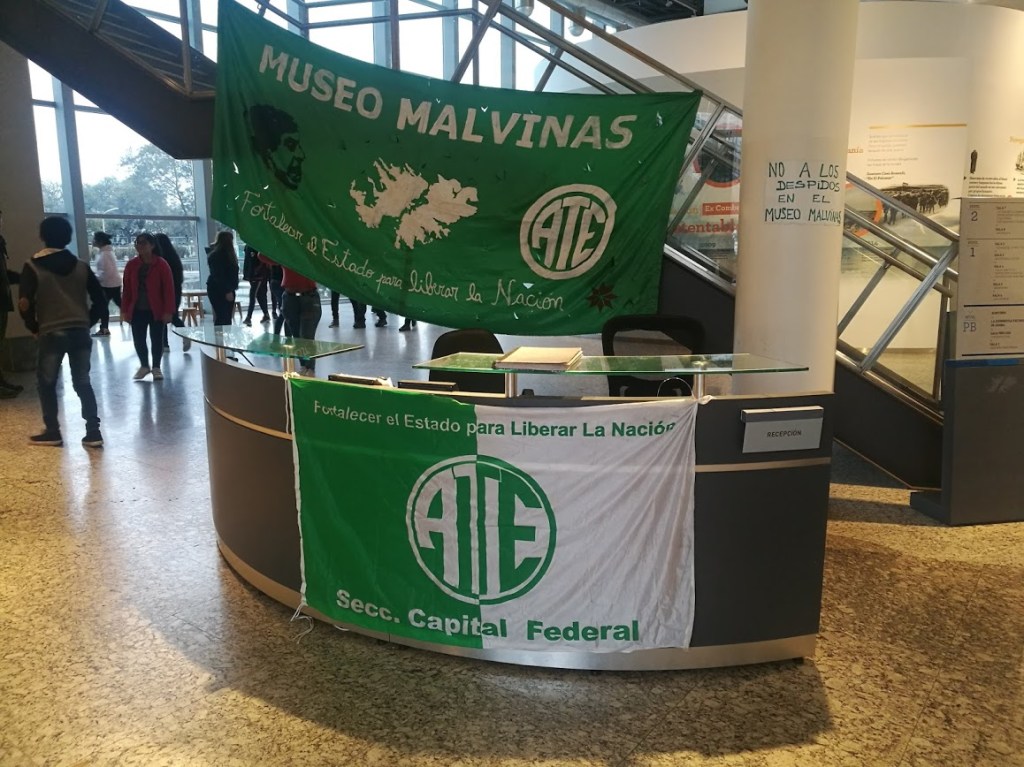
But the jewel in the crown is the US$20m ‘Museo Malvinas e Islas del Atlantico Sur’ (Museum of Falklands Islands and South Atlantic), a project inspired by former President Christina Kirchner. It opened in 2017 and you can read a bit more about how it came into existence here.

This three-storey memory warehouse had so much interesting content we ended up visiting twice. A professionally-shot, highly emotive welcome film sets the tone. Laughing children wearing white play on a beach. They put a message in a bottle and float it out to sea and seem to be yearning for it to return. They listen studiously to their forebears explaining the islands’ history and geography. The symbolism of all of this is not subtle! The islands are incorporated into a longer-term narrative where the current situation of British control is portrayed as an aberration, a blip. Nature is the focus, perhaps as the humans have said in referenda in 1986 and 2013 that they want to remain British and as apparently Argentinian solders were baffled upon arrival to find a place totally unlike Argentina.

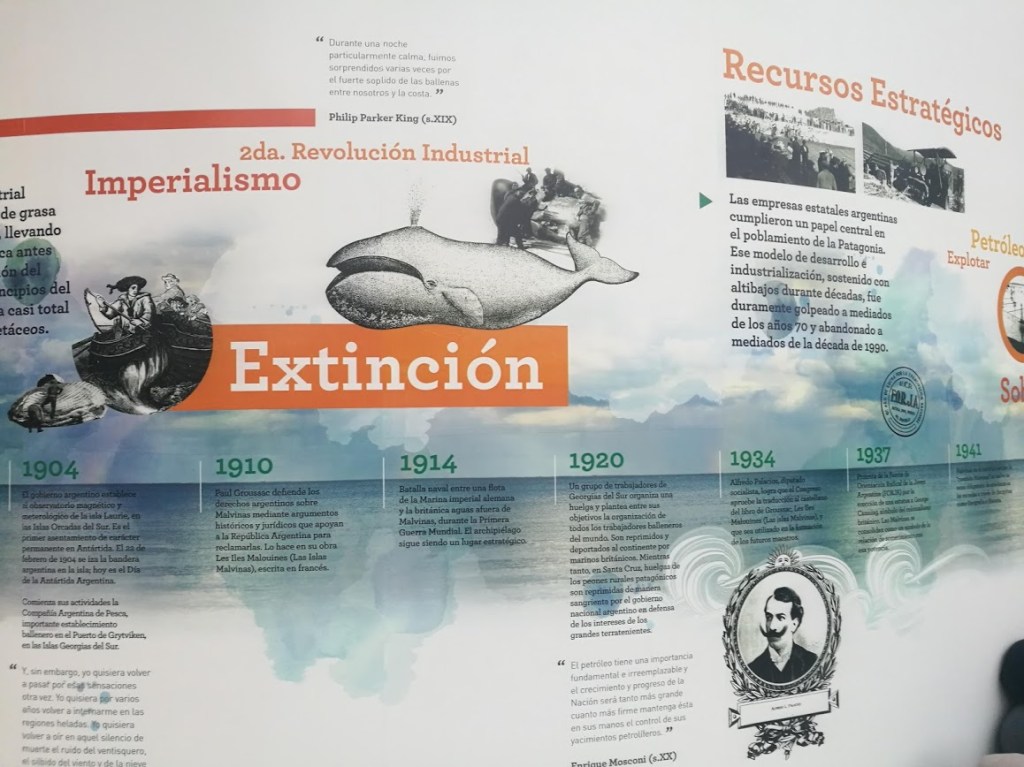
Another overarching message is around Argentina being a maritime nation, leaving the possibility of future renewed claims on other South Atlantic remote islands as well as the Falklands looking more reasonable than they otherwise might. It’s a powerful film and an immersive experience thanks to the darkened pod within which you watch it. You feel almost re-born when you emerge. The pod on the outside is plastered with a huge timeline stretching back thousands of years where visitors are invited to put into perspective the recent struggles over the islands, the failed invasion and the dictatorship. Appropriately ‘re-set’, you are then (genuinely) entertained and educated as you traverse the museum. A lot of money has been spent on this place and it’s highly effective.

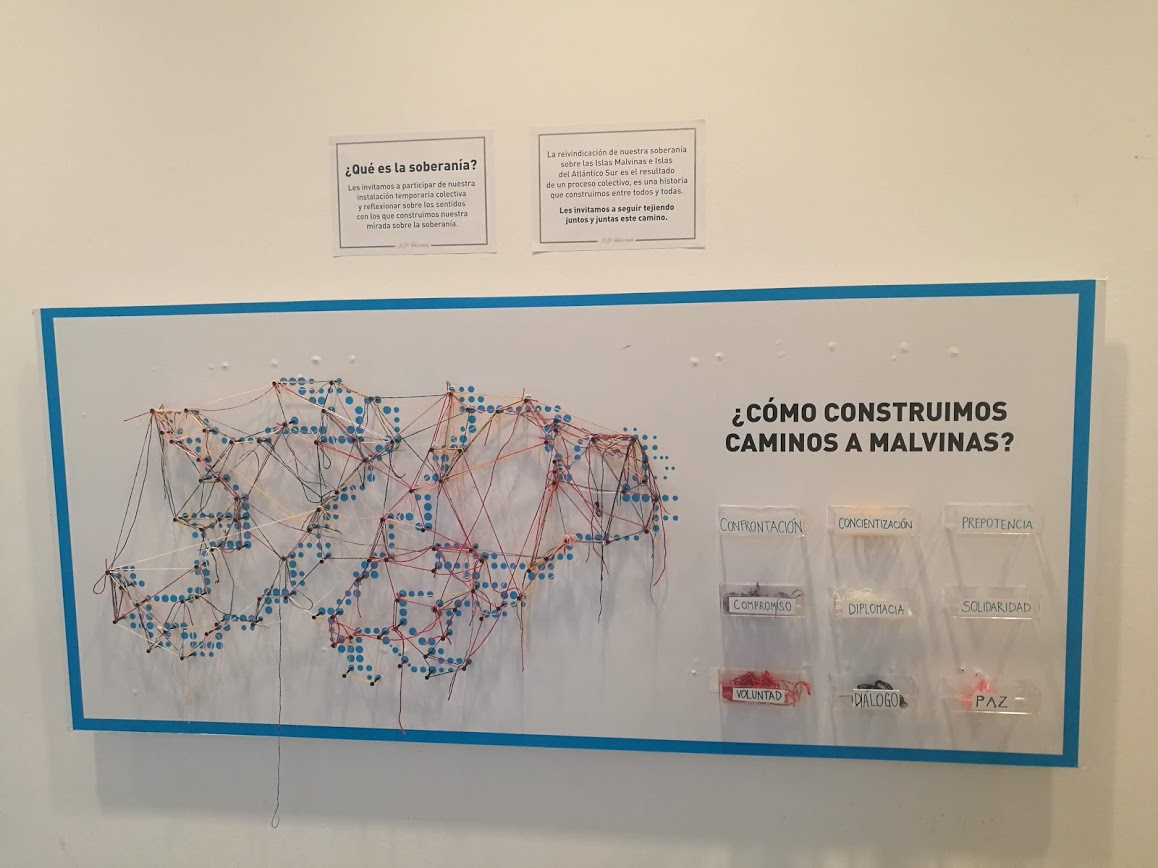
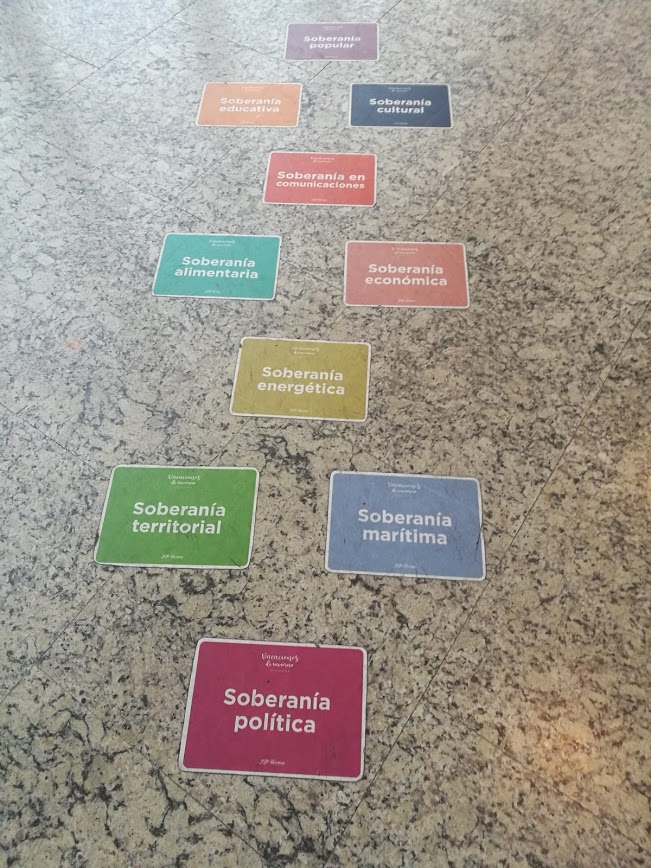
Visitors can contribute to discussions of ‘How do we build roads to the Falklands?’ by threading different-coloured strands of yarn onto pegs on a Falklands map. You can choose either compromise, diplomacy, dialogue, confrontation, cooperation and so on. You’re also prompted to reflect on the different dimensions of sovereignty at play in the Falklands question – economic, political, relating to energy, the natural environment etc. It’s worth saying that the outline of the Falklands islands is everywhere, so much that by the time you leave you may be able to sketch it from memory.

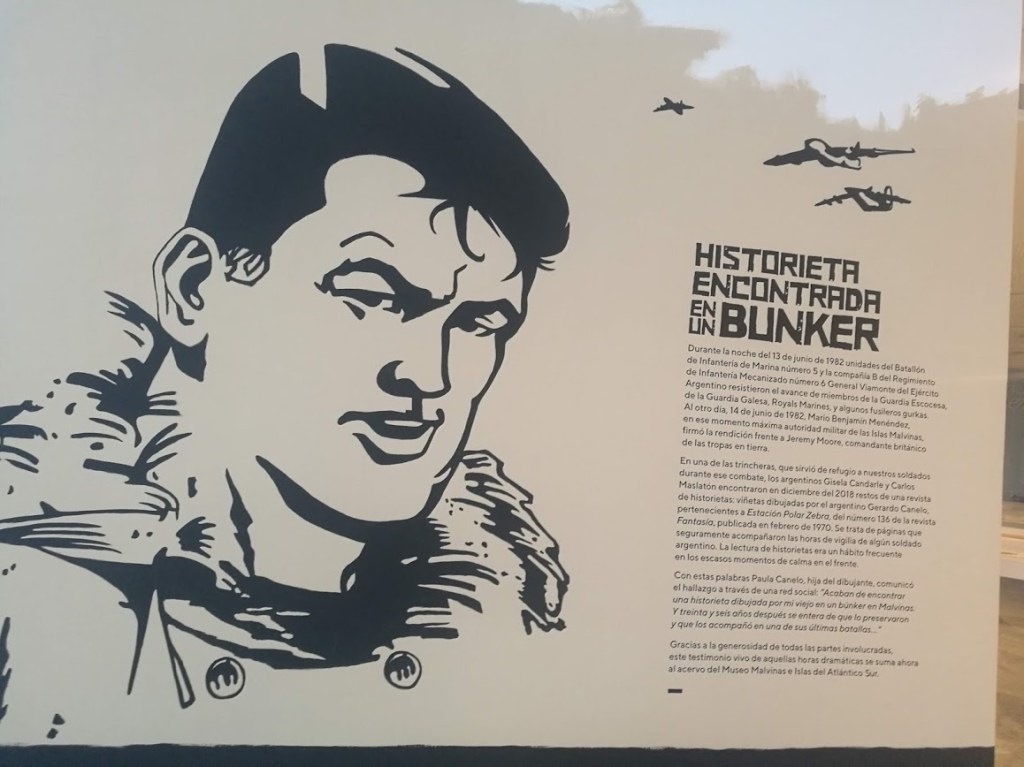
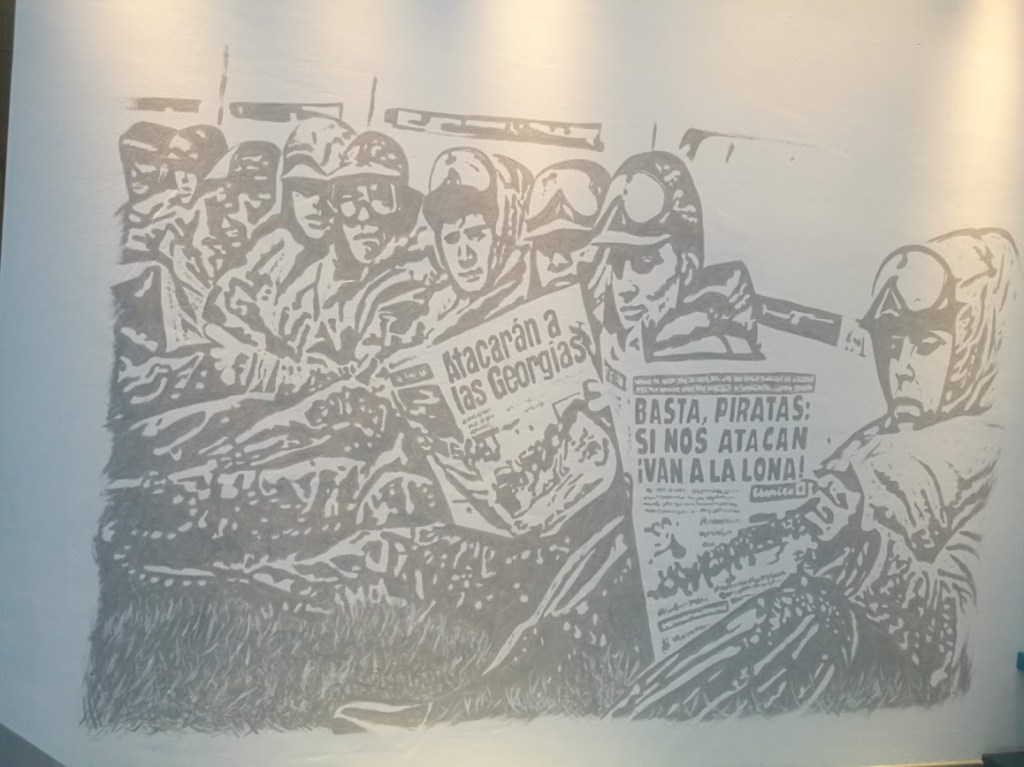
There’s a strong theme of heroic masculinity in the following section that reflects on the experience of one Argentinian soldier who we are told resisted an advance by British troops. Next are cartoons of soldiers reading comics in trenches. These don’t portray the reality of what these soldiers experienced and that this same museum lays bare on the third floor section covering the enquiry Argentina’s post-junta democratically-elected government held in the years after the conflict. Perhaps floor 1 is aimed at younger visitors on school trips who may not make it to the top floor.

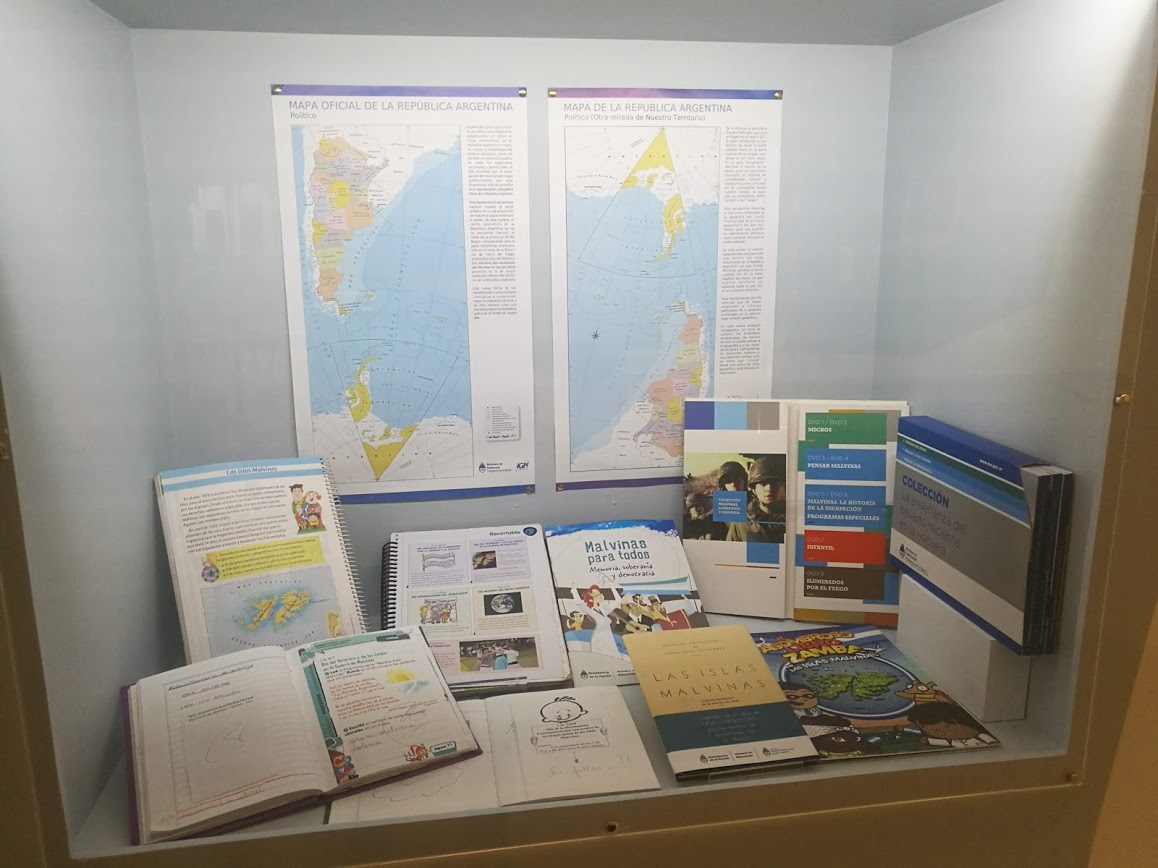
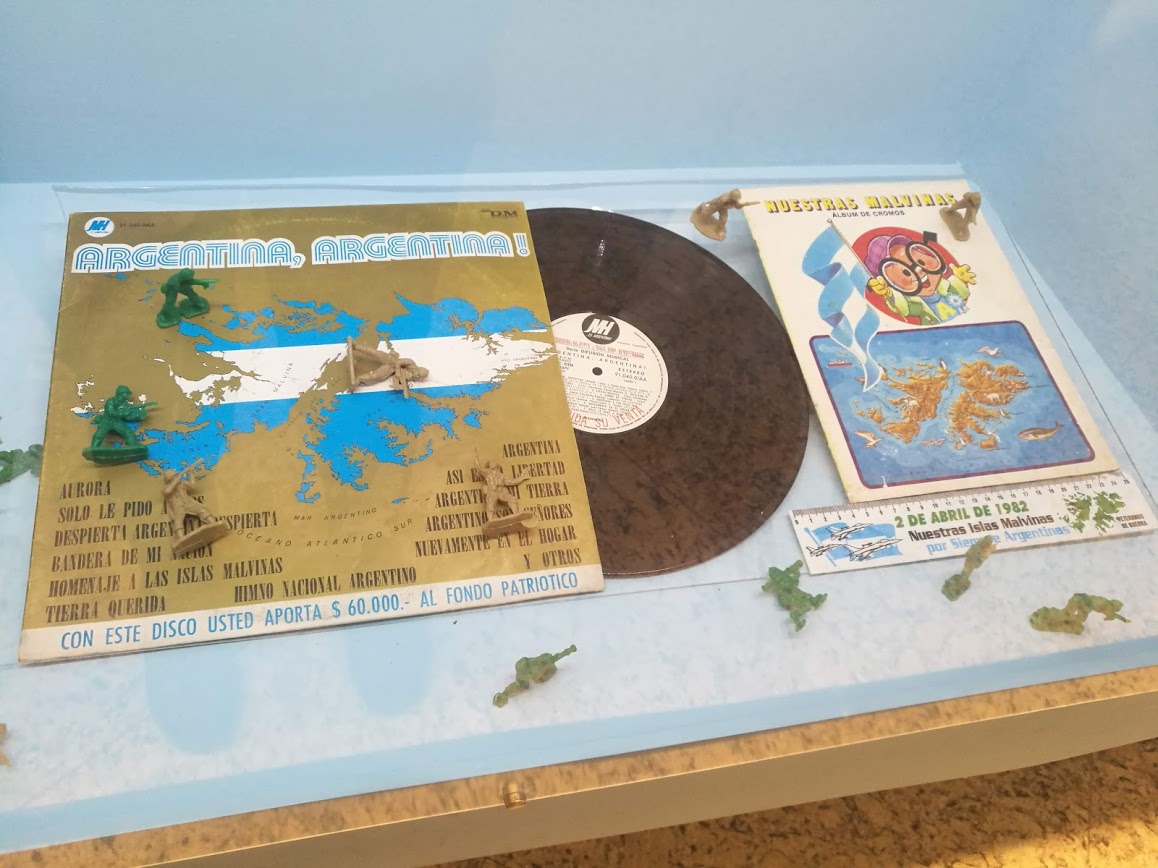
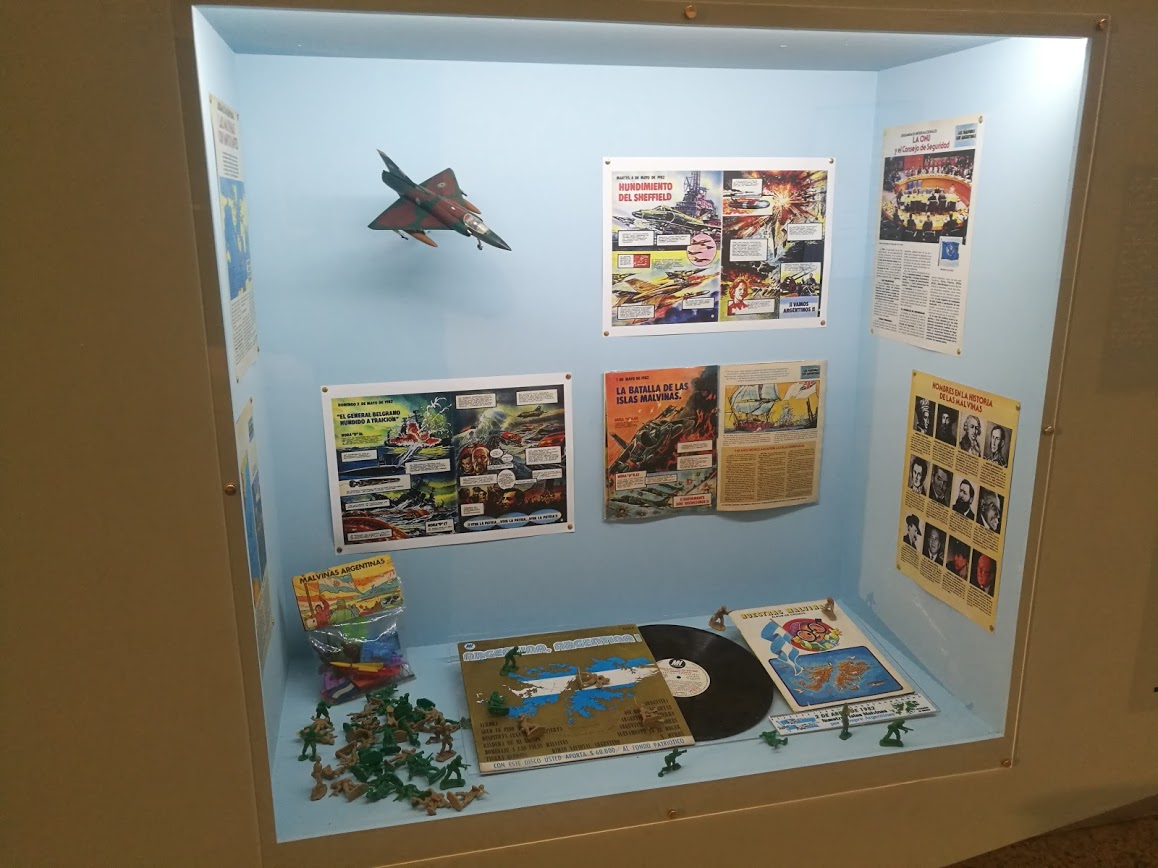
We get an insight into how children can be inculcated with nationalist sentiments during times of conflict through the comics, sticker books, toys and vinyl LPs (with a share of royalties going to the ‘patriotic fund’) – available in shops in 1982, showcased here. The policy of updating school textbooks in 2001 to place renewed emphasis on the Falklands question is explained in terms of the government needing to intervene more to sort out the economy and it therefore being reasonable that it would get more involved in what goes into teaching materials. Of course the ‘welcome distraction’ theory could also apply here. Letters penned by schoolchildren to soldiers come across as both sweet and hopeful and sinister when you consider they were being manipulated, even more ignorant of the reality of how the war was going than the adult population who believed until the end that they were on the brink of victory thanks to the junta’s propaganda machine.

One young writer enclosed his letter inside the wrapper of a bar of chocolate he sent to troops. It later turned up on sale in a corner shop, having been intercepted by the government and sold along with many other donations to shopkeepers for hard cash. A popular magazine did an investigation and exposed this situation soon after the war. That the museum was so unflinching about Galtieri’s catalogue of incompetence in trying to win the islands back was really interesting. His strategy is, it seems, being critiqued in forensic detail and held up as a policy of failure and ineptitude against which the current peaceful, manifest destiny-type approach promoted by the museum can define itself favourably.

The second and third floors give voice to troops abused by their own superiors in the trenches, showcase the inadequate gear they were sent off in and even explain how some troops died of starvation – possibly as rations were inadequate or because they were being stolen by other troops as discipline broke down. Of course this was all suppressed at the time and a lot of space is given over to enabling these voices to be heard, finally.

The museum ends as it started – with a slick and very moving film depicting the pain inflicted on Argentina’s people by the junta, protests initially in support of the war and then riots when the reality of defeat is communicated to the public. Attempts are made to order this tangle of memories through a series of thought-provoking statements in the final display. For the museum’s main message to be legitimate – that the Falklands still belong to Argentina and getting them back remains an urgent priority – memories of a brutal, incompetent dictatorship need to be split out from from memories of the Falklands war defeat and also from memories – real or manufactured – of the islands previously belonging to Argentina and hopes of reclaiming them without another disastrous war.

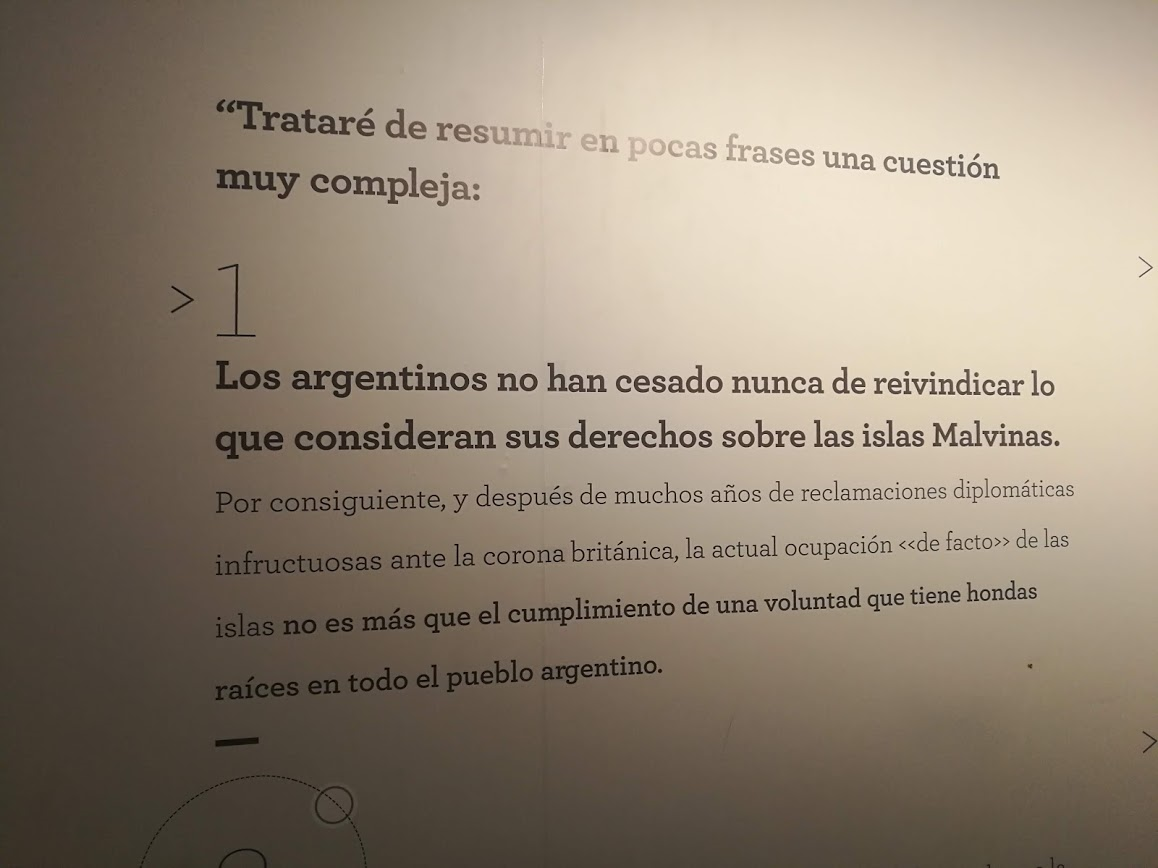
There were other fascinating aspects of this vast museum that there isn’t space to touch on. The section on British imperialism that must have raised the Ambassador’s eyebrows a bit, the shift towards portraying the Falklands issue as a regional one, the breathless celebration of the 1966 hijacking of an Aerolineas Argentinas plane by a militant group who landed on the Falklands, raised the flag and kidnapped islanders that jars a bit with the museum’s finger-wagging at rule-breaking ways of reclaiming the islands. This museum served as a window into the priorities of the current government by showing us how it depicts the past and how it skilfully (if one-sidedly when it comes to the British case for retaining sovereignty!) invites visitors to adapt, dispute and rework messages and meanings in displays. Visitors may be left with more questions than answers on their way home, mulling the following statements in the final display.

1. Argentinians have never stopped claiming what they consider their rights around the Falklands Islands. Consequently, and after many years of fruitless diplomatic claims with the British crown, the current occupation of the islands isn’t more than the fulfilment of a will that has deep roots in all the Argentinian people.

2. If this can be considered logical and justified, the fact that the occupation had been decided and achieved by the military government of Galtieri constitutes an act that the large majority of international observers consider a mere political move destined to distract the attention of Argentinians from the very serious situation unfolding at home.

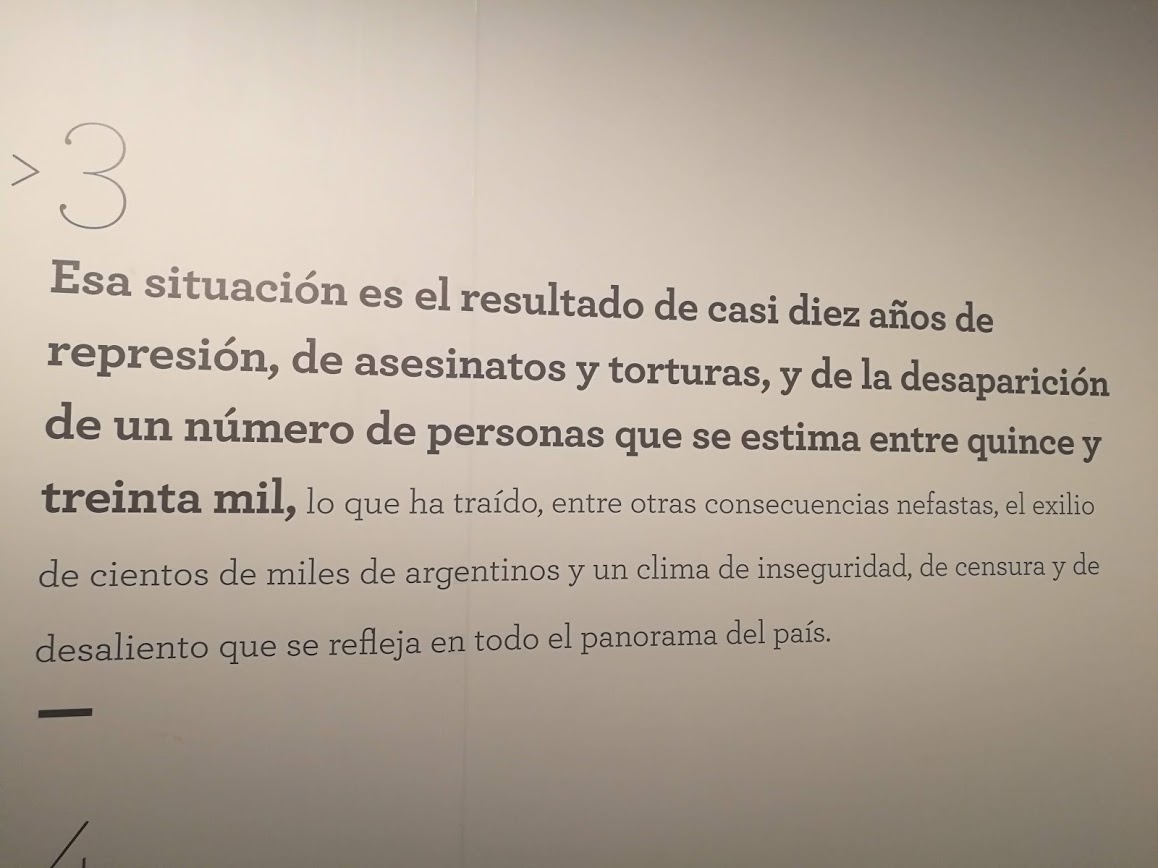
3. The situation is the result of nearly ten years of repression, assassinations and torture, and the disappearance of a number of people estimated to be about 15,000 – 30,000. What this has brought, among other consequences, is the exile of hundreds of thousands of Argentinians and a climate of insecurity, of censorship and discouragement that is reflected in the outlook of the country.

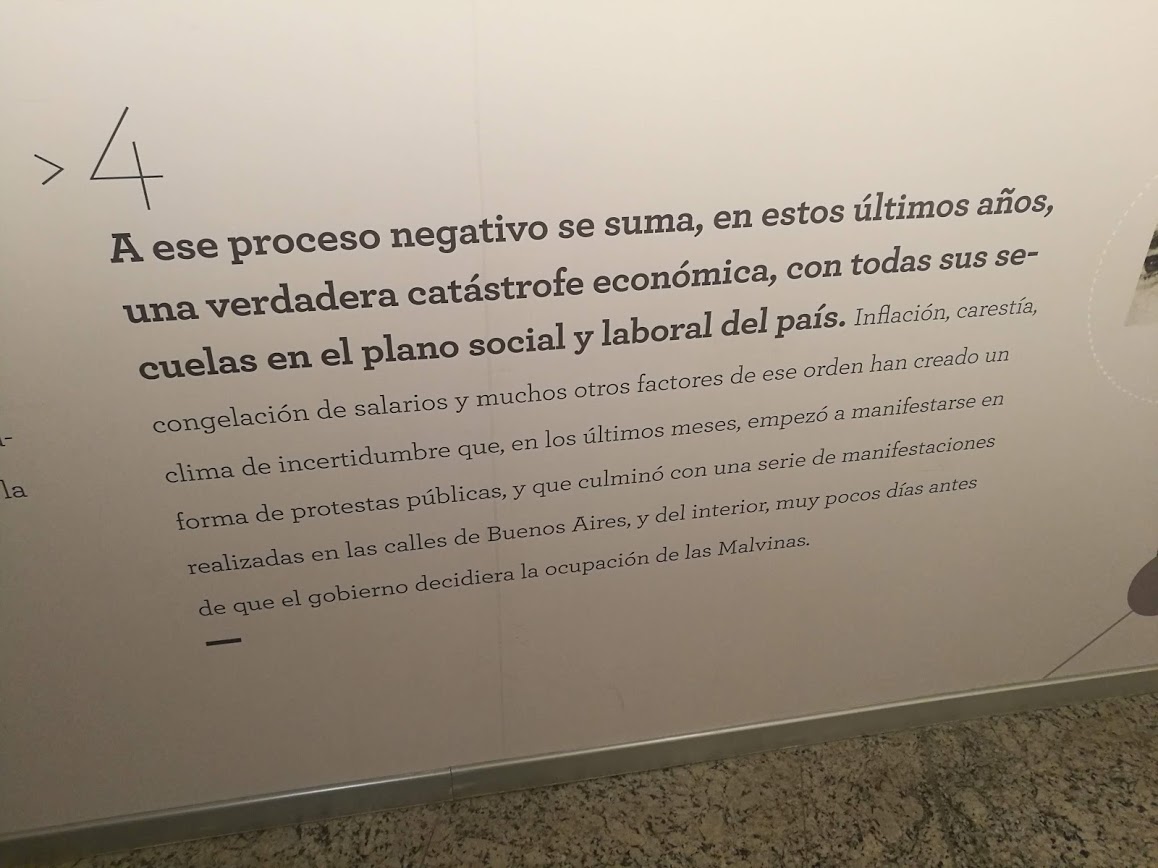
4. Added into that negative situation is, in the final last year, a catastrophic economic outcome with all its implications. Inflation, famine, freezing of salaries and many factors have created a climate of uncertainty that, in the final few months, started to manifest itself in public protests and that culminated in a series of protests in the streets of Buenos Aires and within the government, just a few days before the government decided to occupy the islands.

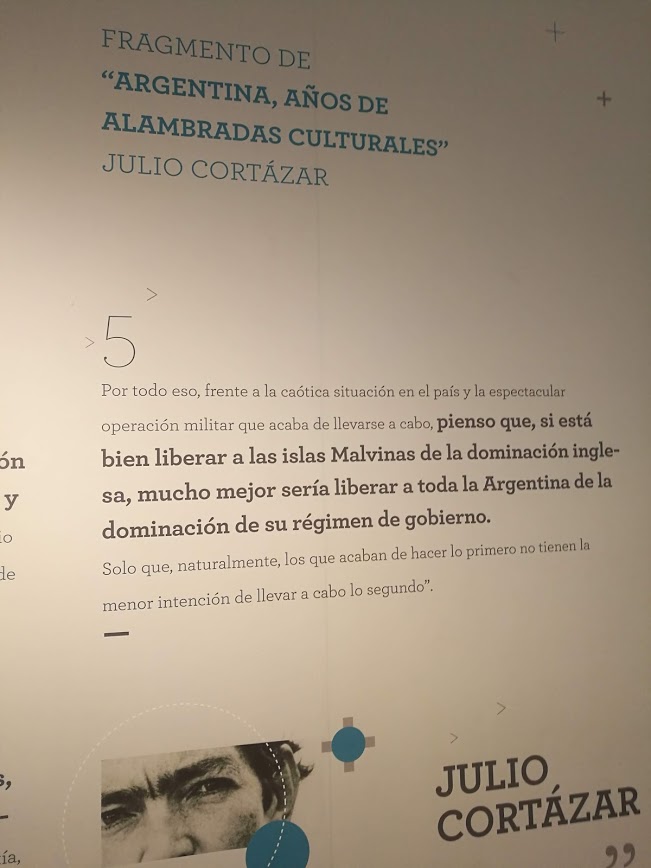
5. In all of this, faced with the chaotic situation in the country and the spectacular military operation that took place, consider this: if it is good to liberate the Falklands from British domination, it would be much better to liberate all of Argentina from the junta. Naturally only those who have just done the first of these things have less of an intention of carrying out the second thing.

Alright, maté?

Maté is a traditional South American caffeine-rich drink, quite similar to green tea. And it’s EVERYWHERE in Argentina.

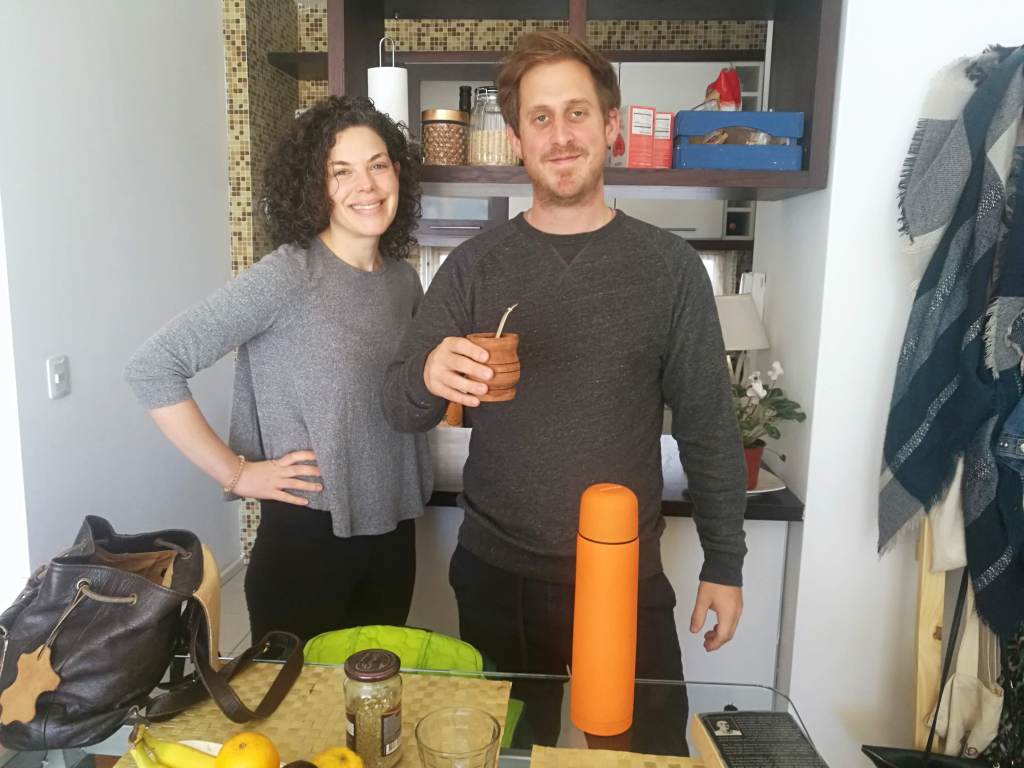
First things first: how do you prepare and enjoy it? Our friend J showed us the ropes at her flat so of course we now consider ourselves experts 🙂 Take your maté cup (an ordinary mug won’t do), fill it halfway up with maté leaves. Pour hot (not boiling) water from your thermos into the side of the cup, holding your metal maté straw in place. Don’t jiggle it around like we did – this is a rookie error and apparently blocks the straw! Then after a few minutes sip through the straw until all the liquid is gone. Then top the cup up, pouring the water from the thermos into the original area that the water was poured before you drank. This prevents disturbance apparently, and keeps the flavour. DO NOT MIX IT! FOR GOD’S SAKE DON’T MIX IT! Read some of the comments below this video to see the response this gets from devotees. Then pass the cup to your neighbour. And how does it taste? Like green tea but more intense and probably more addictive!

Maté with mates

If we were being poetic/pretentious we’d say the act of maté-drinking infuses Argentinian life like the flavour of the leaves infuses the hot water. Instead we’ll simply say: everyone’s at it. Tour guides taking a furtive sip in between breathless rants about geology as the bus lurches uphill, commuters plonked on buses and trains, office workers on their lunch break, families on a Sunday stroll, bands being interviewed on TV, our Airbnb hosts recovering from a hangover, couples enjoying trysts in dimly lit parks…it’s comprehensively embedded in Argentinian culture.

We’ve seen similar habits in south east Asia (chewing betel nut) and of course coco leaves are a big thing in Bolivia but the sheer dedication to lugging around the paraphernalia needed to enjoy maté is a sign of how important it is to a lot of people! It’s a bit like having a cuppa but lived out in the unlikeliest places when we would consider having a hot drink simply not practical. Like at Iguazu Falls where you have to contend with slippery boardwalks, huge crowds, getting soaked to the skin, thundering noise and securing your all-important photos without getting your phone all wet or falling over the edge. Some visitors were happy to flit around with a cup of boiling tea during this chaos and good on them because none of it went on us.

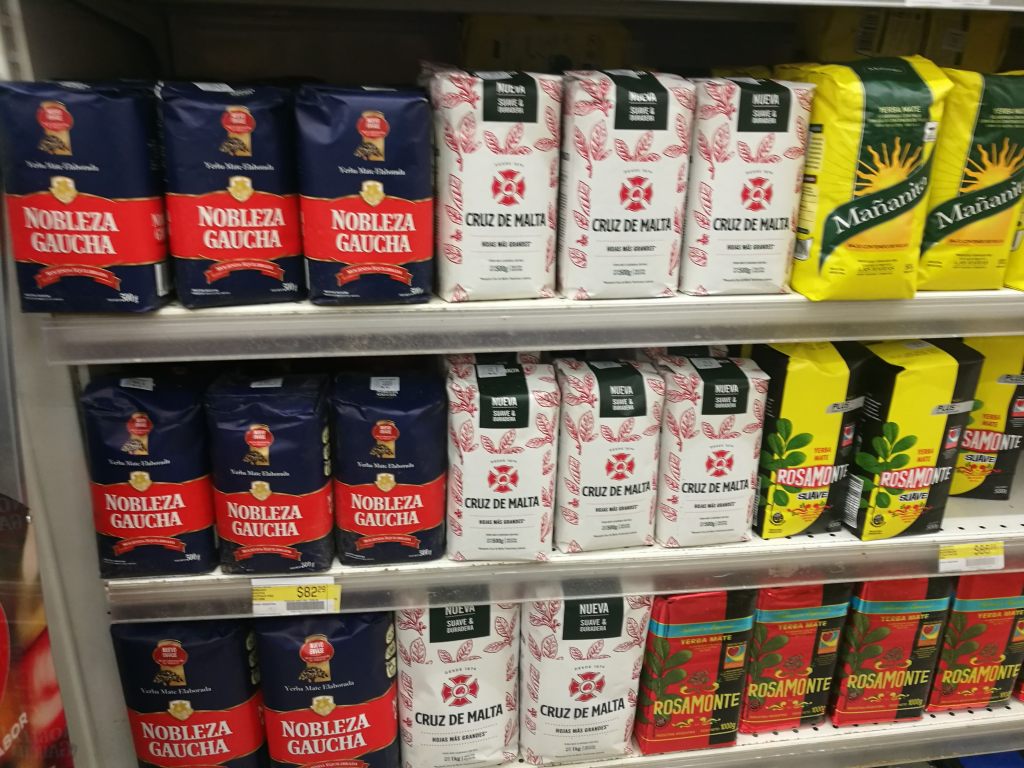
Just a snapshot of the varieties of mate on supermarket shelves in Buenos Aires

D’s reflections on how this would go down in the UK…Imagine someone walking around with a flask, a mug and some green tea bags, continuously topping it up through the day. Imagine a group of teenagers, who instead of going out on the lash on a Friday, go down to the local square to peacefully drink green tea, chat, dance and listen to music.

In London, walking around with a thermos, in your twenties, you’re probably either trying to flap your peacock wings on the streets of Shoreditch, or you’re openly proud of being part of the local diesel-train spotting group – here’s a link to find yours – or you’re just Duane Dibley.

That’s my instinctive and undoubtedly narrow-minded view, but it’s probably a view that holds true for most of the population. That aside, if you’re a hipster, train spotter or something in between, you can buy maté online via Amazon and in stores in the UK (although they’re bagged – not the authentic raw product). I can’t imagine you’re going to see characters on your local high street – from the menacing youth to the OAP – bowling around with maté soon. More likely it’ll be a clandestine event in the comfort of your home, surrounded by your other hipster friends. Oh yeah, Eric Dier drinks it too.

We’ve now walked over the border into Bolivia where coco tea, coco sweets and coco leaves are probably the local equivalents of maté. The sweets and tea have so far proven pretty effective in dealing with the very mild effects of high altitude in Humahuaca and La Quiaca but we’re heading higher from now on. We’ve already spied a few oxygen cylinders placed discreetly in hotel lobbies and oddly between us have fallen up the same flight of stairs three times in 24 hours. Possibly getting light-headed without realising it or maybe the wine we brought here from Cafayete was just too yummy. Just tell us if our lips are turning blue please.

Buenos Aires

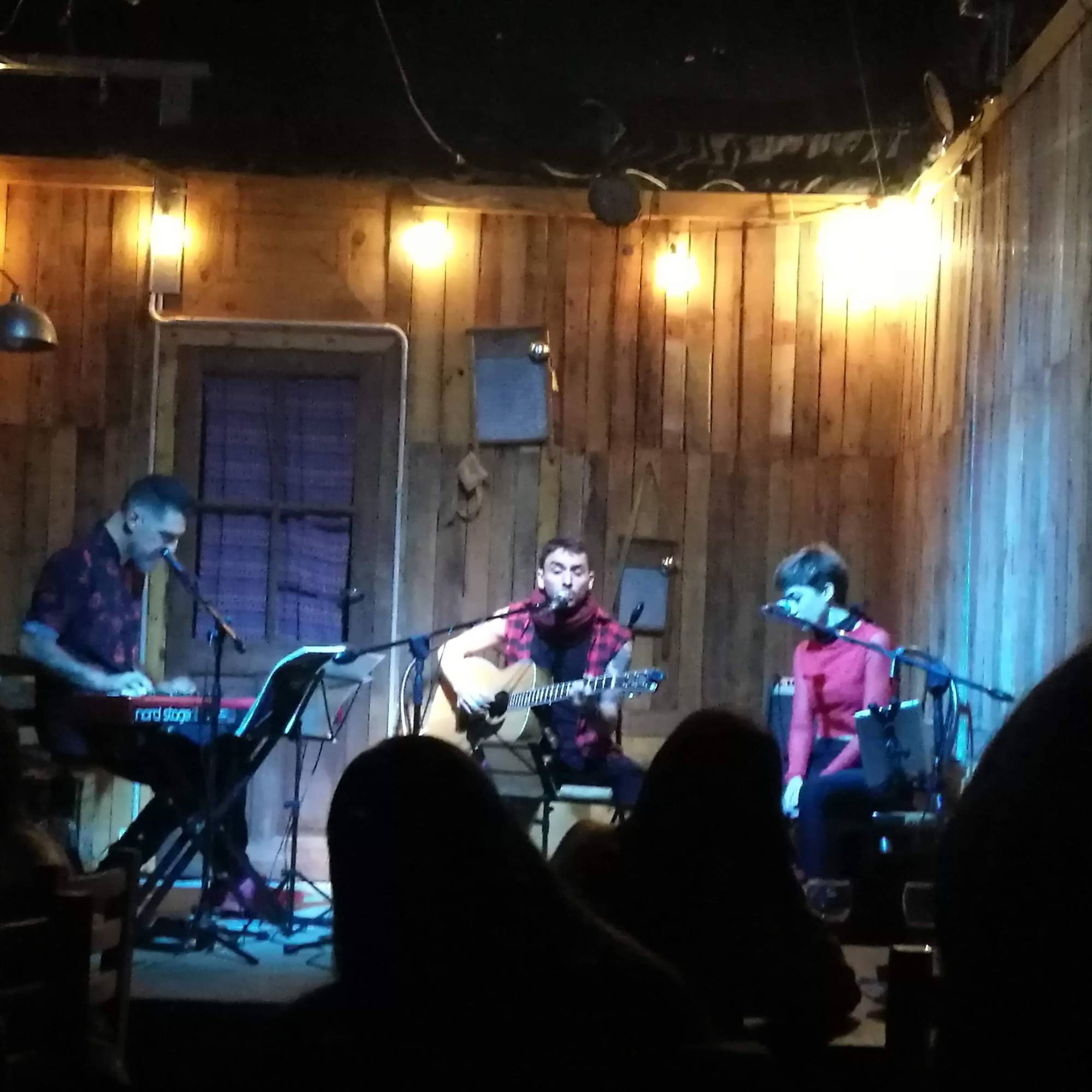
We’ve now spent exactly a week in Buenos Aires! It’s a good time to reflect on what we’ve been up to since our last entry and share some of the cool stuff we’ve done that’s made us decide to spend seven more days here. Logistics are pretty straightforward (apart from a few South American quirks…of which a bit more in future posts!) so it’s a nice base from which to continue decompressing post our London lives while doing some of the things we enjoy but never had time for back in the UK. Such as…going to the gym – we joined up for a week at a pretty basic but does-the-job neighbourhood place – reading, learning about Argentine culture and having enough time to absorb what’s going on around us in the city. The weather’s been pretty much perfect. Strong sunlight, no rain, a welcome lack of wind and just becoming autumnal. Porteños – Spanish word for someone who hails from a port with this term most usually applied to people from Buenos Aires – are gregarious as you’d expect and as the city is best at night we’ve seen a few live music acts including a really great trio at El Universal, La Bomba de Tiempo and some funk at a club called La Grande and a night at La Catedral (apparently a ‘bohemian tango temple’) are on the cards before we leave. And yes, that will involve me and D actually having to tango…! 1

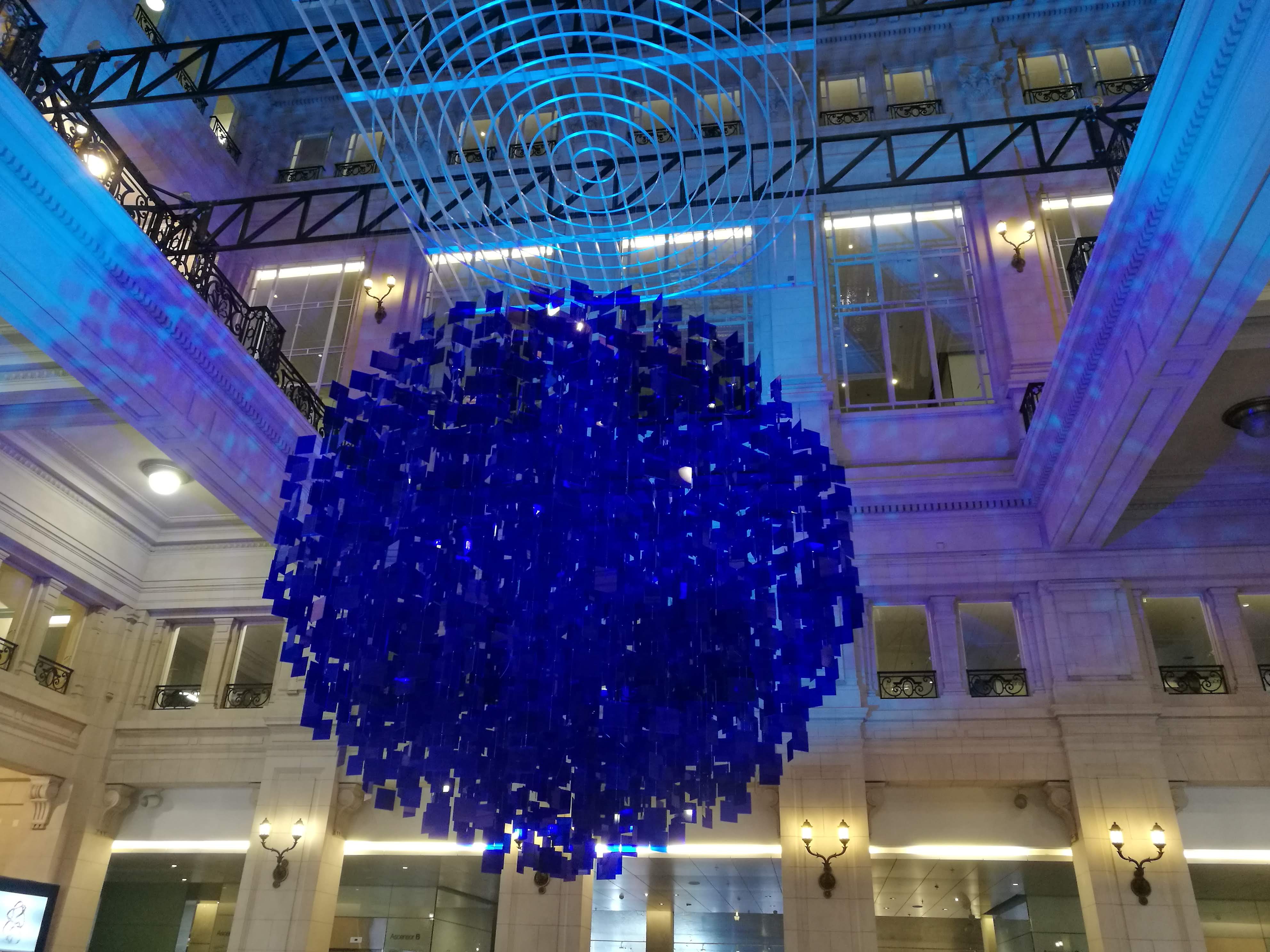
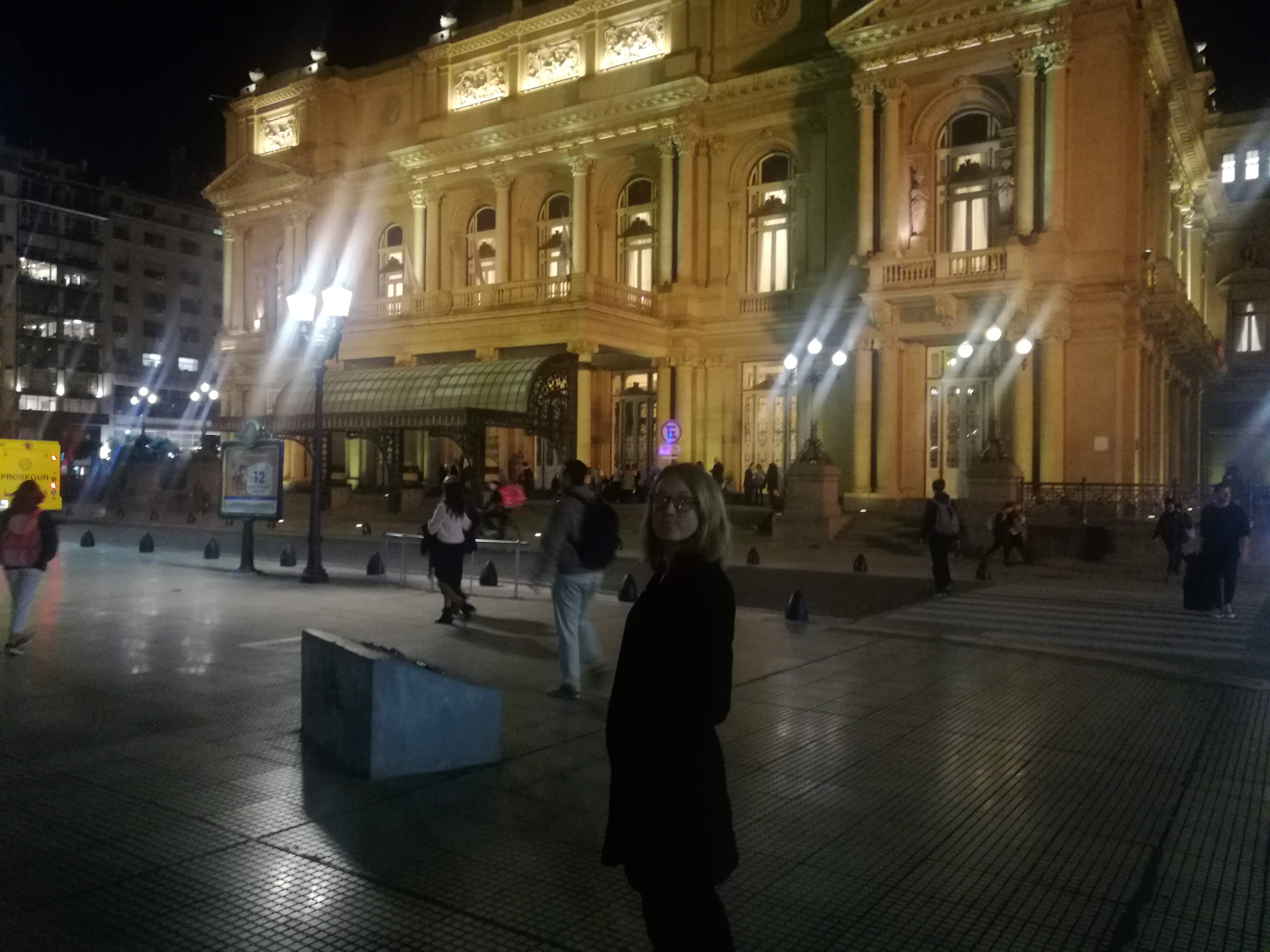
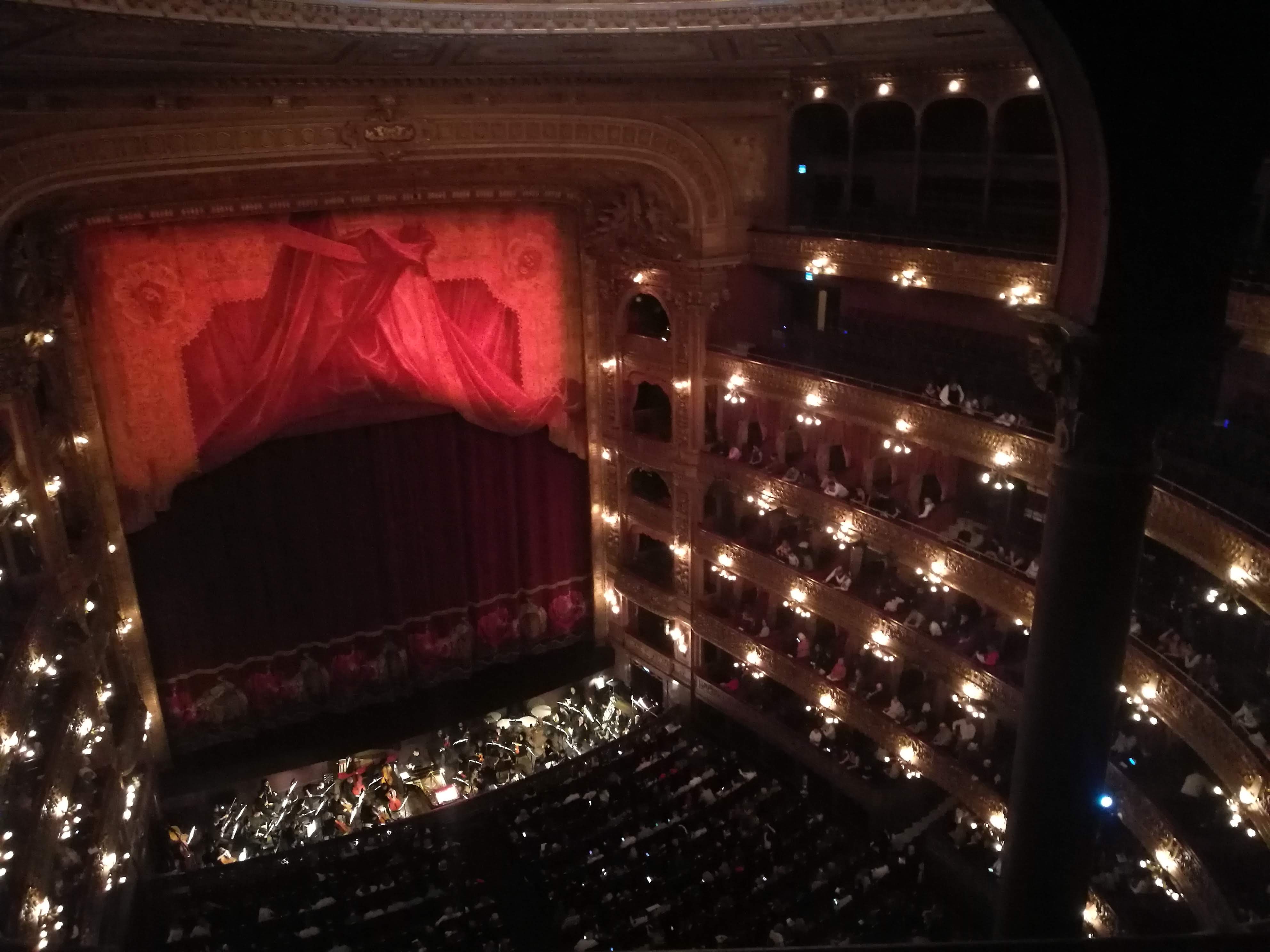
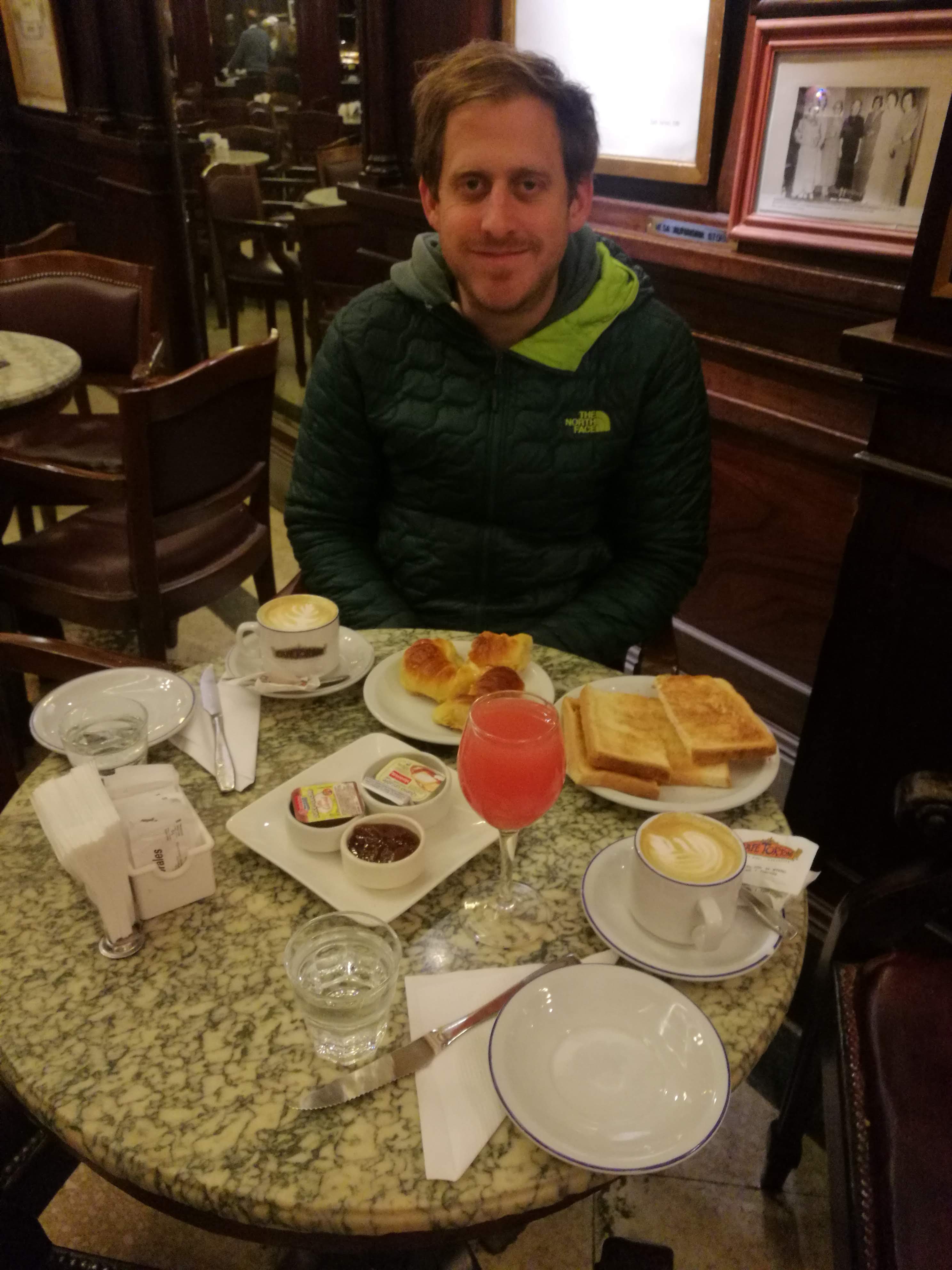
Learning more about Argentina’s politics and the legacy of dictatorship have been valuable and a separate blog post on those thought-provoking aspects of our trip will follow. But as you can see from these pics, we’ve complemented this relatively heavy-going fare with lots of culture. Snagging £3 standing tickets to see contemporary ballet in Teatro Colon and hearing a full orchestra in that amazing cavernous space was an evening well spent and a little surreal after having watched England go down 3-1 to the Netherlands in an English-themed boozer called The Gibraltar immediately beforehand (not sure if that counts as ‘culture’). We also checked out a Dali exhibit and the amazing recycled space of the city’s old post office now turned into the ultra-modern Centro Cultural Kirchner with its auditorium-inside-a-huge-metal-animal that could fill a football stadium easily. Has to be seen to be believed. As does the phenomenon below.

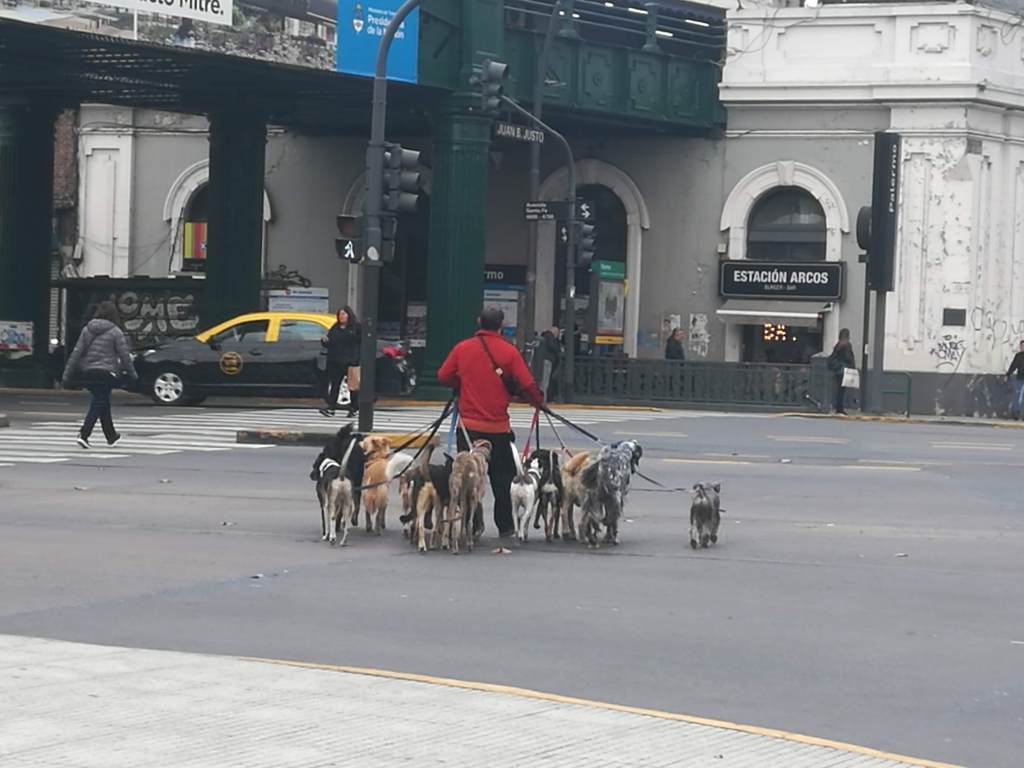
Professional dog walkers are a common sight in the central barrios but the number of hounds under this guy’s command surpasses anything else we’ve seen. Surely this is a bit terrifying if you’re one of the smaller pups? How their toilet trips are coordinated doesn’t bear thinking about…

D will share some reflections on the Casa Rosada – presidential palace – and the local drink of choice (mate) and the rituals surrounding it in his next post. Our next stops after Buenos Aires are now nailed down as Iguazu falls on the Brazilian border followed by Salta in the north west and its surroundings where a bit of a desert vibe is in order. The 18hr night bus to the falls promises camas (beds) but let’s see how that turns out in reality 🙂

The Journey Begins

Hello – thanks for joining us!

In this blog, Rachel (and Dunstan here and there) will be sharing our thoughts on travelling through various countries in South America over 3 months.

Now there’s probably loads of blogs out there about travelling around South America, with inspirational photos, raving descriptions, that will make you feel jealous whilst you’re on a 90 minute commute to London as it rains outside. Then there will probably be many that say that they’re different from this and offer a more ‘authentic’ view of life over here. Yawn.

This blog will be a simple journal of our day-to-day experiences in South America – our opinions on things to see, costs and itineraries etc.

To give some context of who we are, hopefully to help understand why we make certain decisions, we’re both 34 and had good incomes and savings, and are travelling for 2.5/3 months without any strict plan. We speak survival Spanish, and important to mention also is that we decided to go during the autumn/winter in South America (summer in Europe).

Let’s go further back….after spending almost two decades between us in London town, Rachel was offered a PhD place, outside of London, and Dunstan was contracting. We decided that this would be a perfect time to go somewhere we’d never been and we decided that South America would be great seeing as we’d heard so many positive things from others.

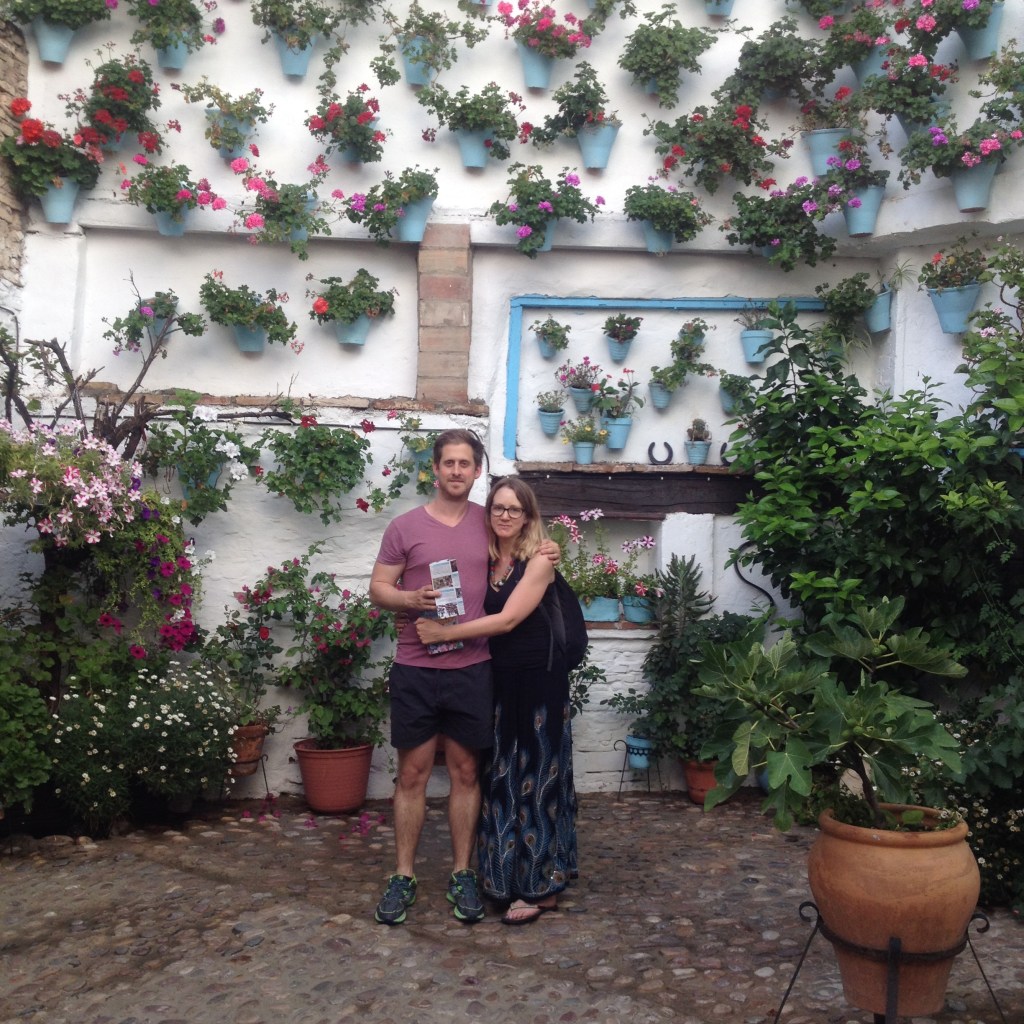
This is us, in Cordoba a few years ago.

Originally we booked flights to Buenos Aires through Norwegian Air around 2 months before we left, purely as a way to ensure we go actually go! At this stage we didn’t have any idea if were going to stay in London when we got back etc so everything was up in the air. However, once we knew our plans, we had 1 month to find people to rent our flat in London, pack and find somewhere to store our things, organise stuff for our travel whilst sustaining 9-5 jobs. It was exhausting and stressful to put it mildly. 😞

Bit of an early fail when the airport cash machines had run out of currency. So we paid for coffee in the airport in dollars to get change in Pesos. It’s fair to say we were a bit blinded by the various exchange rates at this point so she could have given us anything to be honest.

Our initial view of Buenos Aires was somewhat confused as the driver – whose car had a hole in the bottom of the chassis (we could see straight through whilst driving at 60 mph) – mentioned that the city was very green. This was mentioned in the face of 6+ lanes of traffic that seem to permeate the entire city. Despite the clear lie, he was a nice person and helped us find our accommodation via a dropoff to pick up the keys to our accommodation.

The Airbnb – where we am writing this from – is nice. A room for £50 for 7 nights between two i.e. £25/person, or £2-£3 per person per night which is ridiculously cheap.

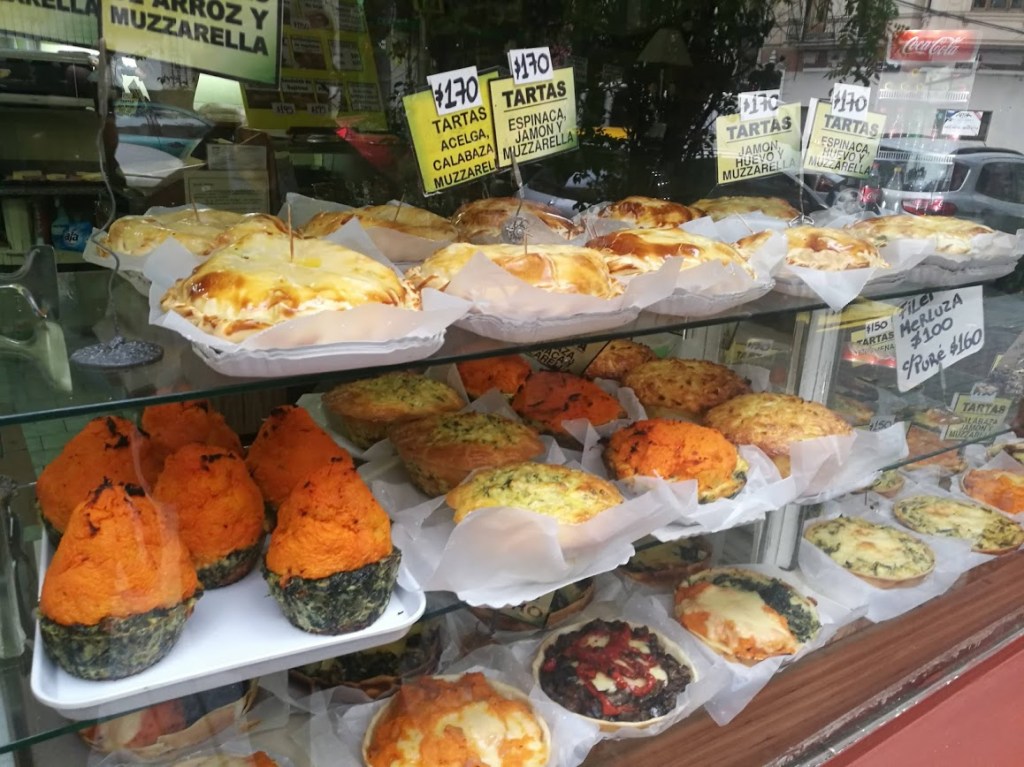
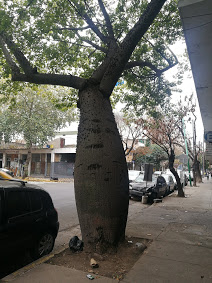
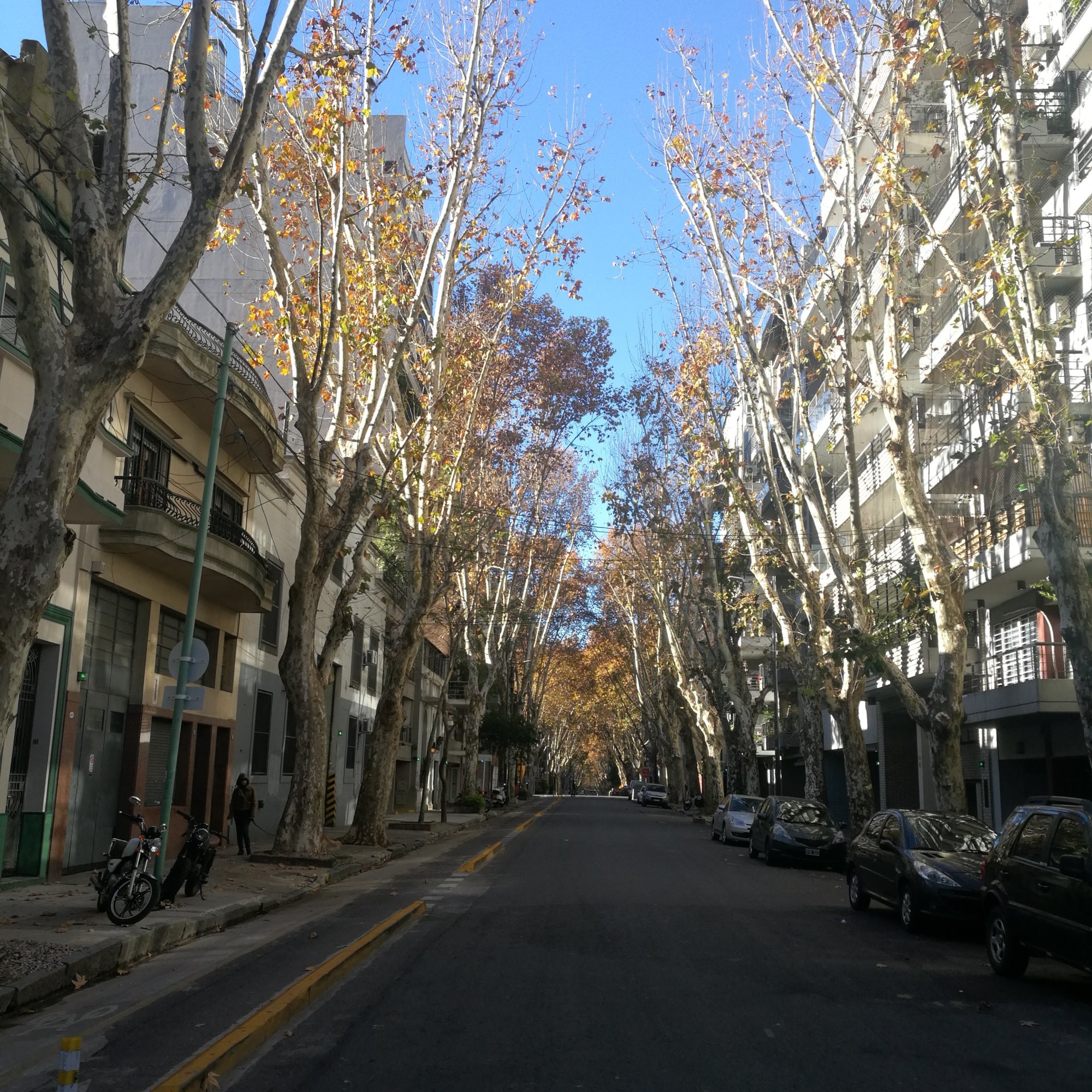
Anyway, what did we do on our first day? We unpacked our things properly knowing that we’d be in one place at least 7 nights and decided to go for a wander. Our Airbnb is situated in Palermo, close to Avenida de Santa Fe which is one of the main arteries through Buenos Aires. Think of the south circular running through the whole of London but twice as wide and with more shops and ‘life’ on it. Palermo itself is a cool area with many nice restaurants of all types, some really good coffee shops, bakeries, bars and all other things you get in what is a middle-class area of Buenos Aires. We’ve not a perspective of what this area is like during other times of the year, but it feels especially nice now and ideal to acclimatise coming from London. Although it’s close to winter, the temperature is around 15 degrees, the sky is clear blue, and the autumnal colours can be seen on the high trees from the pavements.

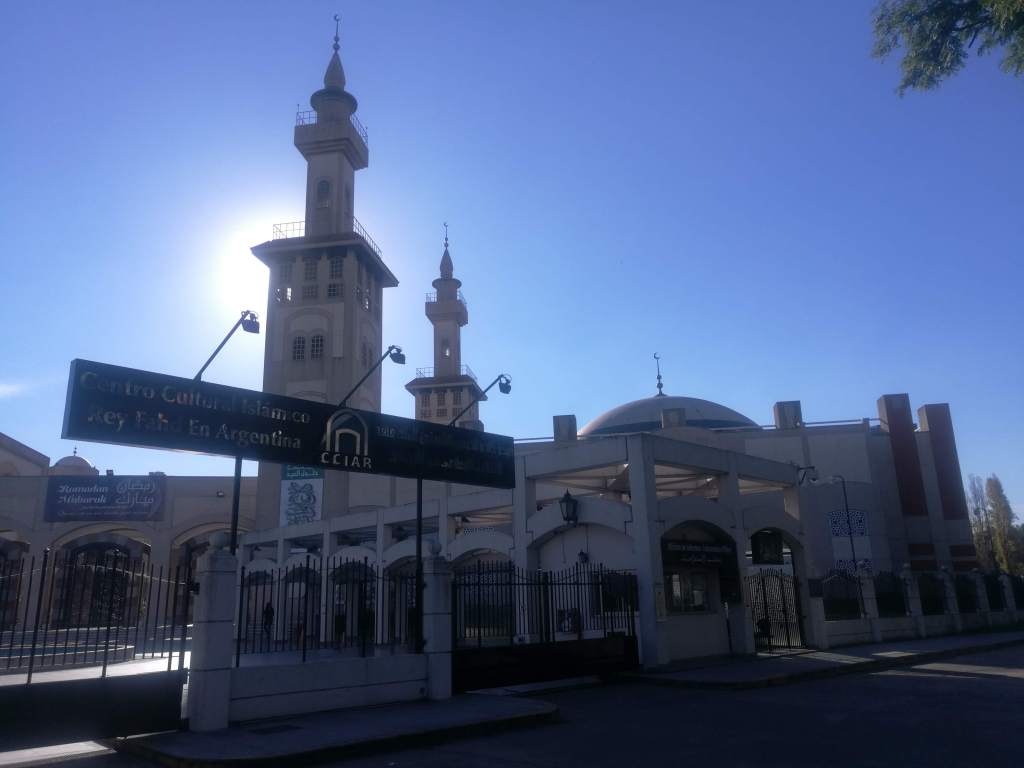
After leaving the flat, we headed to Palermo station, and crossed the monstrously wide highway in the middle of the city walking past a huge mosque. Traffic priority isn’t straightforward. At times, it feels like two cars are about to collide at a crossroads (as the city is built in blocks roads cross…a lot) on and then it all seems calm and controlled. Other times it feels that when crossing the pedestrian crossing, you’re about to get mown down by a taxi only for it to slow down and stop just before you. It’s unnerving initially but you get used to it and you become more confident – hopefully not too confident.

Back to wandering……maybe due to our lack of pre-reading about Buenos Aires, we were surprised to see such a huge mosque in quite a central place in the city. We didn’t imagine that there would be a Muslim community. The mosque itself wasn’t the most ornate but packed a punch in terms of size.

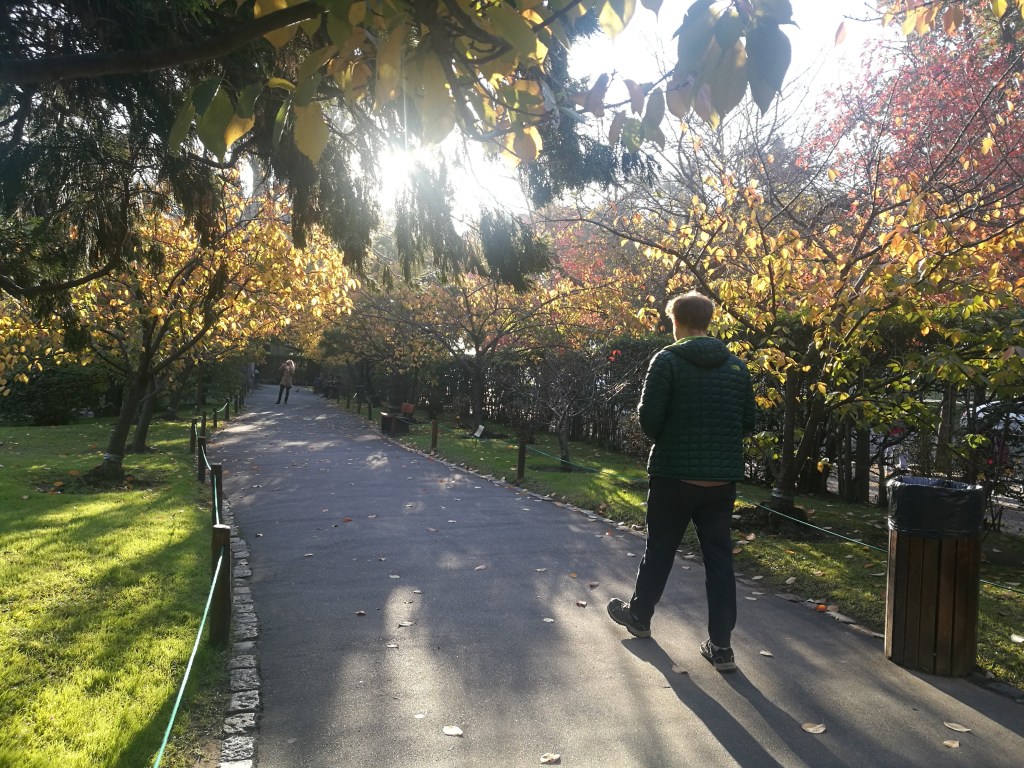
From here, we kept walking and walking, aiming towards the Japanese Gardens. We certainly underestimated how long this would take, and how big the city is. The Japanese gardens were cool with huge koi and lots of locals indulging their selfie habits in the unique surroundings. It was quite surreal to have gone from London to Argentina to “Japan” all within the space of about 14 hours. Discombobulating.

After trekking back to our flat, we quickly changed, met our friend J, who has lived here for over a year as a teacher. We grabbed some beers and had our first try of empanadas – handheld local pasties stuffed with random fillings – and went to a show.

La Bomba De Tiempo (Time Bomb) is a percussion group that do sets every Monday. The venue – a former warehouse and now a huge cultural ‘city’ – was around 20 minutes by Uber from Palermo. Ubers only take cash here – pretty weird! The music itself was great, the vibe was energetic, the communication between the performers tangible. The smell of hashish was pungent, and the beer came in litres. People were having a great time dancing and jumping around but nobody seemed drunk. Somewhere similar in the UK there would surely have been some ruckus or some people the worse for wear.

A packed first day. Sleep was not hard to come by.